
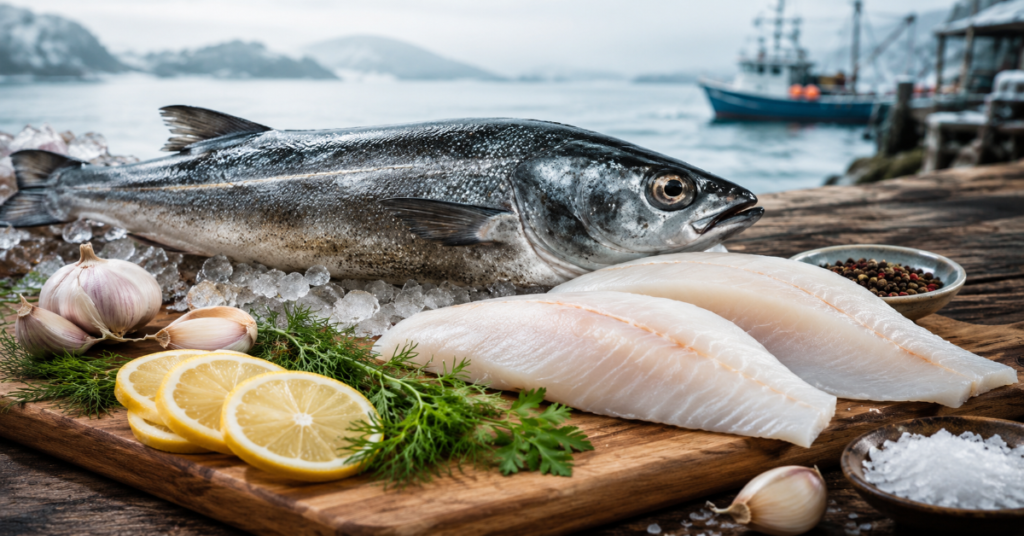
Alaskan seiti is the Finnish name commonly used for Alaska pollock, a mild white fish from the North Pacific. It appears in frozen fillets, fish fingers, battered products, fish-and-chips portions and surimi, the seafood paste used in many crab-stick products. For shoppers, its appeal is practical: it is lean, inexpensive compared with premium white fish and easy to season.
The fish sits in the cod family and is usually marketed internationally as Alaska pollock or walleye pollock. NOAA describes five U.S.-managed Alaska pollock stocks, including Eastern Bering Sea, Aleutian Islands and Gulf of Alaska stock units. The main assessed stocks are not overfished and are not subject to overfishing, although some smaller stock areas have unknown population status with management measures in place.
For readers comparing seafood choices, the important point is not just the name. Seiti is a commodity fish with a large industrial footprint. It feeds home kitchens, fast-food supply chains, frozen-food brands and surimi manufacturers. That scale creates two realities at once. It can be a budget-friendly source of lean protein, but it also depends on strict catch limits, bycatch controls and credible certification systems.
Matrics360’s food coverage has recently explained unfamiliar specialty food terms such as Masgonzola and seafood-adjacent culinary trends such as Calamariere, making this guide a natural extension for readers decoding imported or translated food labels.
What Is Alaskan Seiti?
Alaskan seiti means Alaska pollock in Finnish usage. The fish is also called walleye pollock and is sometimes associated with the Japanese and Russian trade name mintai. It is not the same as oily salmon, premium cod loin or strongly flavored mackerel. Its identity is built around mildness.
Alaska pollock belongs to the cod family. NOAA notes that pollock can grow up to about 3 feet, usually reach 12 to 20 inches and grow relatively fast compared with longer-lived species. That biological productivity is one reason the fish supports large commercial harvests.
In stores, it usually appears as:
| Product form | Typical use | What to expect |
| Frozen fillets | Home baking, pan frying, soups | Mild flavor, flaky texture |
| Battered portions | Fish-and-chips, school meals, frozen meals | Crisp coating, soft interior |
| Fish sticks | Family meals, convenience foods | Processed and breaded |
| Surimi base | Crab sticks, seafood salads, imitation crab | Washed fish protein paste |
| Blocks and mince | Industrial processing | Ingredient for branded products |
The important shopping distinction is between plain fillets and processed formats. Plain fillets let the fish behave like a lean white protein. Breaded, battered or surimi products may contain added sodium, starch, oil, sugar or binders.
Nutrition: How Lean Is It?
Raw Alaska pollock is a lean seafood. USDA-linked nutrition databases commonly list raw Alaska pollock at about 76 kcal, 17.2 g protein, 0.82 g fat and 0 g carbohydrate per 100 g. Some product entries vary depending on whether the fish was previously frozen or treated with moisture-retaining additives.
| Fish, raw per 100 g | Calories | Protein | Fat | Carbs | Practical reading |
| Alaska pollock | About 70 to 76 kcal | About 17 g | Under 1 g | 0 g | Very lean, mild and high-protein |
| Atlantic cod | About 82 kcal | About 18 g | Under 1 g | 0 g | Slightly firmer premium white fish |
| Haddock | About 74 kcal | High-protein | Low fat | 0 g | Mild but often more expensive |
The exact number changes by database, species entry and product treatment. The safer editorial wording is that seiti is low-calorie, high-protein and very low in fat when sold as plain fish. Once it becomes battered fish, fish sticks or surimi, the nutrition profile belongs to the final product, not just the fish.
A useful cooking insight: because the fish is so lean, dryness is the main failure point. A fillet can go from moist to cottony quickly if cooked too long. Short cooking, gentle heat, added moisture or protective coating helps.
Taste, Texture and Best Cooking Methods
Seiti tastes mild, slightly sweet and clean. It does not have the strong marine flavor of sardines or mackerel. That neutrality is why it works in school meals, fast-food sandwiches and frozen seafood products.
| Method | Best for | Risk | Practical fix |
| Oven baking | Frozen fillets | Dryness | Add oil, butter, tomato sauce or lemon broth |
| Pan frying | Thin fillets | Breaking apart | Pat dry and use medium heat |
| Air frying | Breaded portions | Over-browning | Cook from frozen and check early |
| Poaching | Soups and stews | Blandness | Season the liquid strongly |
| Fish cakes | Leftover fillets | Mushy texture | Chill mixture before shaping |
Simple recipe ideas:
Lemon-dill baked seiti: Place thawed fillets in a baking dish with olive oil, lemon juice, dill, salt and black pepper. Bake until just flaky. Serve with potatoes or rice.
Seiti fish tacos: Season fillets with paprika, cumin, garlic and lime. Pan cook gently, then serve in tortillas with cabbage, yogurt sauce and pickled onions.
Nordic-style seiti soup: Simmer potatoes, carrots, leeks and fish stock. Add cubes of pollock near the end so they cook gently without falling apart.
Crispy seiti bites: Cut fillets into strips, dip in egg, coat with breadcrumbs and bake or air fry. This gives a homemade alternative to heavily processed fish sticks.
Why Alaska Pollock Became a Global Food Resource
Alaska pollock is one of the most commercially important white fish species because it combines volume, mild taste and processing flexibility. It can be frozen at scale, cut into fillets, minced into blocks, formed into breaded products or washed into surimi paste.
Surimi production explains much of its global importance. The process removes fat, blood, pigments and strong flavors from minced fish muscle, leaving a functional protein paste. That paste is blended with salt, starch, sugar, egg white or other stabilizers depending on the product. It is then shaped, flavored and cooked into seafood analogues such as imitation crab.
The hidden trade-off is that surimi makes fish highly usable but less transparent. Consumers may not realize that a crab stick is often made from pollock rather than crab. That is not automatically negative, but the label matters. Anyone monitoring sodium, additives or allergens should read the ingredient list.
Sustainability and MSC Certification
U.S. Alaska pollock has a strong sustainability record compared with many global fisheries. NOAA states that the Aleutian Islands, Eastern Bering Sea and Western/Central/West Yakutat Gulf of Alaska stocks are not overfished, and the listed stocks are not subject to overfishing based on recent assessments and catch data. Smaller Bogoslof and Southeast Gulf of Alaska population levels remain unknown, though management measures are in place.
The Marine Stewardship Council lists the BSAI and GOA Alaska pollock fishery as certified, with certification by MRAG Americas and an expiry date of December 17, 2030.
| Sustainability factor | Current signal | Why it matters |
| Stock status | Major U.S. assessed stocks not overfished | Supports continued harvest under limits |
| Overfishing status | Not subject to overfishing | Suggests current catch pressure is controlled |
| Certification | MSC certified through 2030 | Gives buyers a recognizable third-party label |
| Smaller stock uncertainty | Some population levels unknown | Shows why stock-by-stock management matters |
| Bycatch and ecosystem pressure | Managed through federal rules and allocations | Certification does not remove all trade-offs |
A balanced view is necessary. MSC certification is an environmental certification, not a complete guarantee about every social, labor or ecosystem concern. Recent criticism of seafood certification schemes has argued that environmental labels can create a broader ethical impression than they formally cover. The responsible way to interpret the blue label is as evidence of fishery assessment against MSC’s standard, not as a blanket moral certificate for the entire seafood supply chain.
Current Stock Status and Harvest Levels
For 2026, the fishery remains large. A February 2026 Federal Register action listed the Bering Sea subarea pollock TAC at 1,383,200 metric tons and the Aleutian Islands subarea TAC at 10,800 metric tons after a reallocation.
NOAA’s 2026 to 2027 Alaska groundfish harvest page states that the Inseason Management Branch monitors groundfish catch rates and prohibited species catch according to catch limits, allocations, gear, sectors and seasonal apportionments.
| Area or management detail | 2026 figure or status | Source context |
| Bering Sea subarea pollock TAC | 1,383,200 mt | Federal Register reallocation table |
| Bering Sea CDQ directed fishing allowance | 139,400 mt | Federal Register allocation table |
| Bering Sea incidental catch allowance | 46,000 mt | Federal Register allocation table |
| Total Bering Sea non-CDQ DFA | 1,197,800 mt | Federal Register allocation table |
| Aleutian Islands subarea TAC | 10,800 mt | Federal Register allocation table |
The practical implication is that Alaska pollock remains abundant in the marketplace, but the fishery is not unmanaged abundance. It is a quota-driven system with seasonal allocations, community development quotas, sector allocations and bycatch constraints.
Cost Compared With Cod and Haddock
Pollock is usually cheaper than cod and often cheaper than haddock because it is harvested at larger scale, heavily processed and widely used in frozen formats. Exact retail prices vary by country, season, brand, cut, certification and whether the fish is sold plain or breaded.
| Fish | Typical market position | Nutrition comparison | Best use |
| Alaska pollock / seiti | Budget to mid-market | Very lean, high-protein, mild | Frozen fillets, fish sticks, surimi, tacos |
| Cod | Mid to premium | Lean, slightly firmer, mild | Loins, fish-and-chips, baked dishes |
| Haddock | Mid to premium | Lean, mild, slightly sweeter | Smoked haddock, chowder, frying |
The cost insight is simple: when a recipe uses heavy seasoning, breading, sauce or fish cake preparation, pollock often gives better value. When the fish itself is the centerpiece, such as a thick cod loin with butter sauce, cod or haddock may justify the higher price.
Risks and Trade-Offs
The main culinary risk is overcooking. Plain seiti has little fat to protect texture, so dry heat must be controlled carefully.
The main nutrition risk comes from processed formats. Breaded fish fingers and battered portions may contain more sodium and fat than plain fillets. Surimi products can be useful, but they are not nutritionally identical to whole fish.
The main sustainability risk is oversimplification. U.S. Alaska pollock is carefully managed, but stock status is not identical across every population. A shopper should prefer clear origin labeling, MSC-certified product where available and plain product formats when nutrition is the priority.
The main market risk is substitution confusion. “White fish” labels can hide species differences. Seiti, cod, haddock and hake may appear similar in frozen aisles, but they are not identical in texture, price or sourcing.
The Future of Alaskan Seiti in 2027
The future of alaskan seiti in 2027 will likely be shaped by three forces: seafood affordability, certification scrutiny and processed protein demand.
First, affordability favors pollock. Inflation-sensitive shoppers and food-service buyers need lean protein that can be frozen, portioned and cooked consistently. Pollock’s scale gives it an advantage over premium white fish.
Second, certification will face more scrutiny. MSC certification remains important, and the current BSAI and GOA Alaska pollock certificate runs to 2030, but seafood labels are increasingly judged against wider environmental and labor expectations.
Third, surimi demand will keep pollock relevant beyond the fillet case. As consumers seek convenient seafood proteins, crab-stick salads, seafood snacks and ready-to-cook products may continue using pollock because its washed protein structure works well in formed products.
The uncertainty is ecological. Management can set quotas, but ocean temperature, prey availability, bycatch politics and recruitment strength can change stock outlooks. That makes annual harvest specifications more important than static claims.
Key Takeaways
- Seiti is best understood as Alaska pollock, a mild North Pacific white fish.
- Plain fillets are lean, low-calorie and high in protein.
- Pollock usually costs less than cod and haddock because of its scale and processing role.
- The fish is highly versatile but needs moisture-conscious cooking.
- MSC certification is useful, but it should not be treated as a complete ethical guarantee.
- Current U.S. management relies on stock-specific assessments, TACs and seasonal allocations.
- Surimi is one of the most important industrial uses of pollock.
Conclusion
Alaskan seiti is not a mysterious seafood category. It is Alaska pollock, a lean and mild white fish that became globally important because it is affordable, adaptable and suited to freezing and processing. For home cooks, its biggest advantage is simplicity. It accepts seasoning easily, cooks quickly and works in soups, tacos, baked dishes and homemade fish bites.
Its limitations are equally clear. Alaskan Seiti Plain fillets can dry out, processed formats can change the nutrition profile and sustainability claims need careful reading. U.S. Alaska pollock is strongly managed and MSC certified, but responsible seafood buying still depends on origin, product form and current fishery data.
For most shoppers, the best use of seiti is practical rather than prestigious. Buy plain fillets when you want lean protein. Choose certified products when available. Cook gently. Treat breaded and surimi products as convenience foods rather than direct substitutes for whole fish.
FAQ
Is alaskan seiti the same as Alaska pollock?
Yes. Alaskan seiti usually refers to Alaska pollock, known in some markets as walleye pollock or mintai. It is a mild white fish from the North Pacific and is commonly sold frozen.
Is seiti healthy?
Plain seiti is a lean seafood choice. It is low in calories, high in protein and very low in fat. The health profile changes when it is breaded, battered or made into surimi products with added sodium and starch.
How should I cook frozen seiti fillets?
Thaw gently if possible, pat dry, season well and cook only until flaky. Baking with lemon, oil and herbs works well. Pan frying also works, but the fillets can break if handled too aggressively.
Is Alaska pollock cheaper than cod?
Usually, yes. Pollock is often less expensive because it is harvested at very large scale and used widely in frozen and processed seafood. Cod is often priced higher, especially when sold as thick loins.
Is alaskan seiti MSC certified?
Many U.S. Alaska pollock products come from MSC-certified fisheries. The BSAI and GOA Alaska pollock fishery is listed by MSC as certified, with the certificate expiring on December 17, 2030.
What is surimi made from?
Surimi is usually made from minced white fish such as Alaska pollock. The fish muscle is washed, refined, stabilized and formed into products such as imitation crab sticks.
Is pollock better than haddock?
Neither is automatically better. Pollock is usually cheaper and works well in processed or heavily seasoned dishes. Haddock often has a slightly sweeter flavor and is popular for frying, smoking and chowders.
Methodology
This article was prepared from the supplied Matrics360 production brief, which defined the core keyword, category rules, structure, SEO requirements and editorial standards. Public verification used NOAA Fisheries for stock status and management context, the Federal Register and NOAA harvest specification pages for 2026 allocation data, MSC for certification status and USDA-linked nutrition sources for nutrient estimates.
No private product testing, chef interview or laboratory nutrition analysis was conducted for this draft. Cooking guidance is based on standard culinary handling of lean white fish and should be reviewed by a human editor before publication. A Matrics360 editor should manually verify every citation, confirm internal links are live, check the author bio page and add the required AI-assisted drafting disclosure before publishing.
References
Marine Stewardship Council. (2026). BSAI and GOA Alaska pollock. MSC Fisheries.
National Marine Fisheries Service. (2026). Fisheries of the Exclusive Economic Zone Off Alaska; Reallocation of pollock in the Bering Sea and Aleutian Islands. Federal Register.
NOAA Fisheries. (2026). 2026–2027 Alaska groundfish harvest specifications.
NOAA Fisheries. (2026). Alaska pollock.
U.S. Department of Agriculture, Agricultural Research Service. (2026). FoodData Central.
Matrics360. (2026). Masgonzola: Flavor, nutrition and uses explained.
Matrics360. (2026). Calamariere meaning and trends in 2026.