
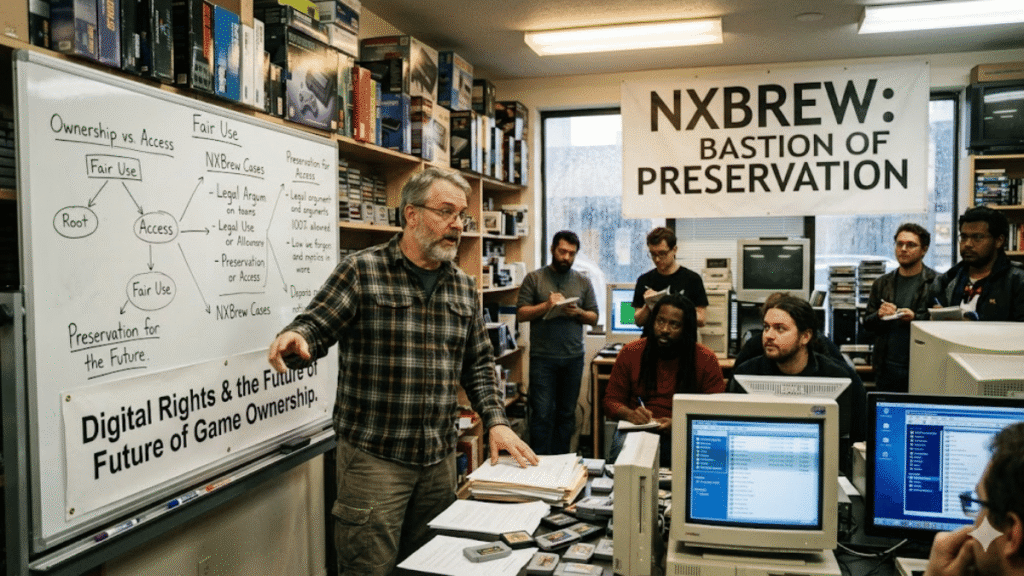
The digital landscape of video game distribution is currently undergoing its most radical transformation since the advent of physical cartridges. At the center of this shift is NXBrew, a prominent web-based repository that has become a primary destination for users seeking Nintendo Switch software files, including ROMs, updates, and downloadable content (DLC). For many, NXBrew serves as a critical resource for software preservation and emulation, allowing titles to be played on hardware beyond their original design. For copyright holders and legal entities, however, it represents a significant breach of intellectual property rights and a persistent challenge to the traditional retail model of the gaming industry.
Navigating NXBrew reveals a community-driven architecture designed to circumvent the limitations of official digital storefronts. The site functions by indexing links to third-party file-hosting services, effectively acting as a librarian for the “gray market” of digital goods. While the search intent for most users is the direct acquisition of software, the existence of such platforms raises profound questions about the nature of digital ownership in 2026. As publishers move toward “Games-as-a-Service” (GaaS) models—where software is licensed rather than owned—sites like NXBrew have positioned themselves as an unofficial backup for a history that corporate entities may eventually choose to delete. This tension between corporate profitability and cultural preservation defines the current era of digital interaction.
The Mechanism of Modern Piracy
The operational strategy of NXBrew is built on a foundation of decentralization. Unlike the centralized peer-to-peer networks of the early 2000s, modern repositories utilize “cyberlockers” or direct download links (DDL). This method allows the site to remain relatively lean, as it does not host the copyrighted material on its own servers but provides the metadata and navigation required to find it elsewhere. This legal maneuvering attempts to exploit the “safe harbor” provisions of the Digital Millennium Copyright Act (DMCA), although the efficacy of this defense has been increasingly challenged by aggressive litigation from companies like Nintendo of America.
The user experience on NXBrew is characterized by a high degree of technical literacy. Users must navigate layers of link shorteners and aggressive advertising, a common trade-off for access to high-value software. The site provides specific file formats—most notably .NSP and .XCI—which are compatible with custom firmware (CFW) such as Atmosphere. This ecosystem has fostered a secondary market for “jailbroken” hardware, where the physical console is modified to bypass signature checks. The persistence of NXBrew despite numerous domain seizures suggests a “whack-a-mole” dynamic that characterizes the relationship between the underground internet and institutional law enforcement.
Comparative Landscape of Digital Repositories
To understand the scale of NXBrew, one must compare it to its peers in the emulation and ROM-sharing space. The following table illustrates the key differences in accessibility, file types, and the typical user base for these platforms.
| Feature | NXBrew | Ziperto | Vimm’s Lair |
| Primary Platform | Nintendo Switch | Multi-platform Handhelds | Retro Consoles (Pre-2010) |
| File Types | .NSP, .XCI, .NSO | .CIA, .3DS, .ROM | .ISO, .ROM, .BIN |
| Host Method | DDL (Mega, 1fichier) | DDL & Torrent | Internal Server Hosting |
| Update Frequency | Daily (Launch Day) | High | Periodic |
| Legal Status | Active / Under Scrutiny | Active | Partially Scrubbed (2024) |
The aggressive update schedule of NXBrew is particularly noteworthy. Often, software is uploaded to the site prior to its official retail release date, a phenomenon known as a “street-date break.” This puts immense pressure on publishers who rely on the initial 48-hour sales window to recoup development costs. However, proponents argue that for consumers in regions with high import taxes or no official eShop access, these sites are the only viable path to participation in global gaming culture.
Expert Insights on Software Preservation
The debate over sites like NXBrew is frequently framed by experts in digital archaeology. Frank Cifaldi, founder of the Video Game History Foundation, has long argued that the industry’s failure to provide a legal path for preservation leads inevitably to the rise of unauthorized repositories. “The current legal framework for copyright does not account for the fragility of digital media,” Cifaldi noted in a 2024 industry symposium. “When a server goes dark, the history is gone. If the only people saving that history are the pirates, then the pirates are the historians.”
Legal analysts, however, emphasize the economic damage. Intellectual property attorney Richard Hoeg of Hoeg Law often points out that “the intent behind the preservation doesn’t mitigate the statutory infringement.” According to Hoeg, the “fair use” argument rarely holds up in court when the material is distributed at scale to thousands of users for free. This creates a stalemate: the industry protects its bottom line with litigation, while the community protects its access with encryption and mirrored domains.
Timeline of Significant Digital Rights Milestones
The history of software distribution is marked by a series of escalations between developers and those seeking to democratize access. The following timeline tracks the progression of these tensions.
| Date | Event | Impact on Digital Ecosystem |
| 2017 | Nintendo Switch Launch | Created a new frontier for handheld emulation research. |
| 2018 | Domain Seizures (LoveROMs) | Nintendo wins $12M settlement, forcing sites underground. |
| 2021 | Gary Bowser Sentencing | Leader of Team-Xecuter jailed for selling hacking tools. |
| 2024 | Yuzu Emulator Shutdown | Settlement with Nintendo leads to removal of major tools. |
| 2026 | The Rise of “Ghost Sites” | Shift toward decentralized, non-indexed repositories. |
The shutdown of the Yuzu emulator in 2024 was a watershed moment for the community that frequents NXBrew. By targeting the tools used to play the files, rather than just the files themselves, Nintendo shifted the battlefield. Yet, the resilience of NXBrew demonstrates that as long as there is hardware capable of running unsigned code, there will be a demand for centralized hubs to provide that code.
The Ethical Quagmire of the “Gray Market”
Beyond the legalities, there is a complex ethical layer to NXBrew’s existence. Many users participate in “buy and back up” behavior—purchasing a physical copy of a game but downloading a digital version from NXBrew to avoid wearing out the cartridge reader or to play with enhanced graphics via PC emulation. This group views the site as a utility rather than a theft tool. They argue that if they have already compensated the developer, the method of consumption should be irrelevant.
Conversely, the ease of access provided by NXBrew undoubtedly facilitates blatant piracy. Smaller independent developers often feel the sting of these leaks most acutely. Unlike massive corporations with billion-dollar reserves, an “indie” developer’s success can be entirely derailed if their game is available for free on NXBrew three days before its official launch on the eShop. This creates a rift within the gaming community: a desire for free access versus the need to support the creators whose work they enjoy.
Technical Evolution and Security Risks
Security is perhaps the most significant deterrent for the average user exploring NXBrew. The site is a minefield of malicious scripts and deceptive “Download” buttons that lead to unwanted software. Experienced users rely on a stack of browser extensions—uBlock Origin, FastForward, and NoScript—to filter the signal from the noise. This high barrier to entry serves as a natural filter, but it also exposes less-informed users to potential credential theft or system compromise.
The technical evolution of Switch files themselves has also changed. The transition from .XCI (cartridge dumps) to .NSP (eShop packages) required a deeper understanding of Nintendo’s “Title Keys” and encryption layers. NXBrew stays relevant by not just providing the game files, but also the specific update patches (v1.0.1, etc.) and DLC unlockers that are often missing from other, less comprehensive sites. This completeness is what keeps the site at the top of the search rankings despite the constant threat of legal action.
Takeaways
- Platform Role: NXBrew functions as a comprehensive index for Nintendo Switch software, updates, and DLC, primarily utilizing third-party hosting.
- Legal Landscape: The site operates in a legal gray area, frequently changing domains to avoid DMCA-related seizures and litigation.
- Technological Synergy: It relies on the existence of custom firmware (CFW) like Atmosphere to allow the playback of unauthorized software.
- Preservation vs. Piracy: Experts are divided; some see it as essential for digital history, while others view it as a direct threat to developers.
- User Security: Accessing the site requires advanced ad-blocking and script-filtering tools to avoid malware and deceptive links.
- Market Impact: Leaks on NXBrew often precede official release dates, impacting the critical initial sales window for publishers.
Conclusion
NXBrew stands as a provocative symbol of the friction between modern consumer expectations and corporate digital rights management. It is a digital artifact of a time when the boundaries of ownership are being redrawn by the move to the cloud. While it undoubtedly facilitates the unauthorized distribution of intellectual property, it also serves as a mirror reflecting the inadequacies of the current gaming market. When consumers feel that their ability to own, preserve, and modify the products they buy is being eroded, they will inevitably turn to the shadows to find those features.
The future of NXBrew is uncertain. As consoles become more integrated with online services and hardware-level encryption becomes more sophisticated, the “Golden Age” of easy piracy may be coming to a close. However, the community that built NXBrew is resilient and technically proficient. As long as the desire to play games exists outside the “walled gardens” of official platforms, there will be a successor to NXBrew. The ongoing dialogue between these underground sites and the industry is not just about free software; it is a fundamental debate about the cultural legacy of the digital age.
FAQs
Is it legal to download files from NXBrew?
In most jurisdictions, downloading copyrighted software without the permission of the rights holder is a violation of civil law and, in some cases, criminal law. While “backups” are often discussed, the act of downloading them from a third-party source generally falls outside of “fair use” protections.
How does NXBrew stay online if it is illegal?
The site uses various techniques to evade detection and shutdown, including registering domains in countries with lax intellectual property enforcement, using “bulletproof” hosting, and frequently rotating its URL to stay ahead of search engine delisting and ISP blocks.
What is the difference between .NSP and .XCI files?
.NSP (Nintendo Submission Package) files are digital-only versions intended for the eShop, while .XCI (NX Cartridge Image) files are direct dumps from physical game cartridges. Both are used by NXBrew to provide different methods of software installation for modified consoles.
Are the files on NXBrew safe from viruses?
While the game files themselves are usually clean “dumps,” the websites used to host and link them are often laden with malware, intrusive ads, and phishing attempts. Navigating these sites requires significant technical caution and robust security software.
Can I use NXBrew files on an unmodified Nintendo Switch?
No. Unmodified consoles only run software that has been digitally signed by Nintendo. To use files from NXBrew, a console must be running Custom Firmware (CFW), which typically requires hardware vulnerabilities present only in older “unpatched” models or via mod-chips.