
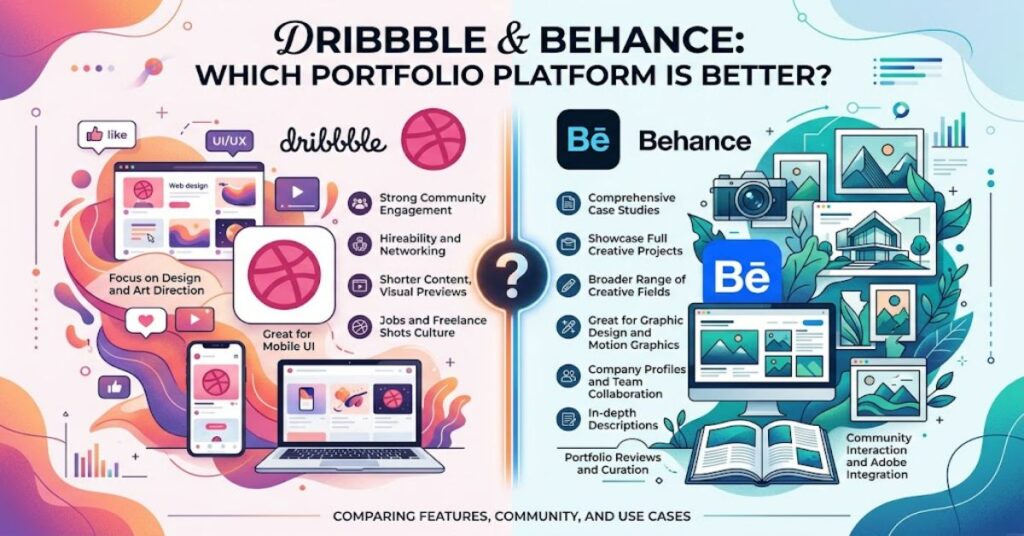
Choosing between Dribbble & Behance depends on what a designer needs a portfolio to accomplish. Dribbble is strongly oriented towards rapid visual discovery, designer profiles, freelance services and hiring. Behance places greater emphasis on complete creative projects, process documentation and professional presentation.
That distinction matters because a portfolio is not simply an online gallery. It is a communication tool. A product designer may need to demonstrate interface decisions, while a branding designer may want to explain research, concepts, typography and final applications. An illustrator may prioritise visual impact, whereas an art director may need to demonstrate an entire campaign.
Both platforms have developed substantially since their launches. Dribbble began in 2009 as an invite-only community and opened to all designers in 2021. Its current service combines portfolio discovery with freelance hiring and payments. Behance, founded in 2006 and now part of Adobe, describes itself as a creative network with more than 50 million members.
The practical question, therefore, is not which platform is universally better. It is which one better matches the way a designer wants their work to be discovered, understood and converted into professional opportunities.
Dribbble vs Behance: Core Differences
The clearest distinction is presentation format. Dribbble has historically centred on individual visual pieces known as “shots”. This encourages concise presentation: a strong interface, logo, illustration, animation or branding concept can communicate an idea almost immediately.
Behance works differently. Its “Projects” can combine images, video and other media around a related creative theme or process. That makes the platform particularly useful when context is important.
| Factor | Dribbble | Behance |
| Primary strength | Visual discovery | Complete project presentation |
| Typical presentation | Individual shots and selected work | Detailed projects and case studies |
| Best for | UI, UX, branding, illustration and visual design | Graphic design, photography, illustration, art direction and multidisciplinary work |
| Hiring | Strong freelance and designer hiring ecosystem | Jobs, freelance opportunities and recruiter tools |
| Project context | Usually concise | Usually more extensive |
| Best portfolio role | Showcase and discovery channel | Portfolio and case-study platform |
This difference creates an important strategic choice. A designer who wants a recruiter to understand a complex project may benefit from Behance’s longer format. Someone trying to make a memorable visual impression in a crowded design feed may benefit from Dribbble’s concise presentation.
What Dribbble Does Best
Dribbble’s strongest advantage is speed of visual communication. Its current platform allows designers to share work, build profiles, browse opportunities and offer services. It also operates a dedicated hiring ecosystem for freelance, contract, part-time and full-time design work.
That makes Dribbble particularly useful for designers whose strongest selling point is visual execution.
The platform is also commercially focused. Dribbble says clients can browse designers, request proposals and use its payment system for projects. This creates a shorter path between portfolio visibility and paid work.
However, the same visual-first structure can become a limitation. A single polished screen may demonstrate craft without explaining the research, constraints, iterations or business objectives behind it. Designers relying on Dribbble should therefore treat individual shots as attention-grabbers rather than assuming that every piece functions as a complete case study.
What Behance Does Best
Behance’s advantage is depth. Its project structure allows creatives to present a sequence of images and other media while explaining the work around them. This makes it easier to demonstrate creative reasoning rather than only the final result.
Behance also supports career discovery. Its current platform offers freelance services, creative jobs, asset sales and professional portfolio features. Its recruiter products are designed around portfolio-first candidate evaluation, with Behance stating that more than eight million creative portfolios are available to recruiters.
A documented Behance recommendation is to use five to 15 high-quality images for a project, alongside a strong cover image and relevant descriptive keywords. That approach naturally encourages designers to think about narrative structure.
The trade-off is time. A detailed Behance project requires more preparation than uploading a single visual. Designers must decide how to sequence the work, explain decisions and remove unnecessary material. A badly structured case study can therefore bury strong work beneath too much information.
Which Platform Is Better for Getting Hired?
Neither platform guarantees employment. The better choice depends on the hiring context.
Dribbble has a particularly direct commercial orientation. Its current hiring service connects companies with freelance, contract, part-time and full-time designers, while designers can also browse opportunities and offer services.
Behance has a broader portfolio-to-career ecosystem. Its job platform supports freelance and full-time listings, while recruiters can evaluate portfolios alongside professional information.
For freelance designers seeking rapid client discovery, Dribbble can therefore be highly practical. For applicants whose work needs substantial explanation, Behance may provide stronger evidence of process and capability.
A Better Strategy: Use Each Platform Differently
The most useful insight is that designers do not necessarily need to choose one.
A portfolio can operate as a funnel. Dribbble can capture attention through highly polished visual pieces, while Behance can provide the deeper evidence once someone wants to understand the project.
| Portfolio goal | Recommended approach |
| Show a new UI concept | Dribbble |
| Explain a full branding project | Behance |
| Attract freelance clients | Dribbble plus Behance |
| Demonstrate creative process | Behance |
| Build visual discovery | Dribbble |
| Present multidisciplinary work | Behance |
| Support recruiter evaluation | Both, with different project formats |
This two-platform approach also reduces duplication. Instead of copying the same portfolio everywhere, designers can publish concise visual highlights on Dribbble and develop selected projects into deeper Behance case studies.
Risks and Trade-Offs
The biggest risk is confusing activity with professional progress. Likes, views and appreciations are useful indicators of visibility, but they do not necessarily translate into qualified leads or employment.
Another issue is portfolio positioning. Publishing too many unrelated projects can make a designer appear versatile but unfocused. Conversely, showing only one type of work can restrict perceived capability.
There is also a quality threshold. Both platforms contain large quantities of highly polished creative work. A portfolio therefore needs a clear niche, consistent visual language and evidence of professional problem-solving rather than simply attractive images.
The Future of Dribbble & Behance in 2027
Both platforms are moving beyond simple portfolio hosting. Dribbble has expanded towards services, marketplace activity, proposals and payments, while Behance is strengthening professional identity, recruitment and monetisation features. Dribbble’s history shows a shift from an invite-only community towards a broader commercial platform. Behance’s recent product direction includes professional credentials, career services and deeper connections between portfolios and hiring.
By 2027, the strongest portfolios are likely to be those that combine visual quality with credible context. Automation and AI may make portfolio production faster, but that increases the importance of original thinking, documented process and recognisable professional judgement.
The direction is clear, but the exact balance between discovery, recruitment and AI-assisted portfolio creation remains uncertain.
Key Insights
- Portfolio format should match the complexity of the work being presented.
- Dribbble is strongest when immediate visual impact matters.
- Behance provides more room for narrative and project context.
- A large audience does not automatically produce qualified clients.
- Case studies should demonstrate decisions, constraints and outcomes.
- Using both platforms can create complementary rather than duplicate portfolios.
Conclusion
Dribbble & Behance are better understood as complementary creative platforms than direct substitutes. Dribbble excels at visual discovery, concise presentation and a commercially focused designer marketplace. Behance provides greater space for detailed projects, creative processes and professional portfolio development.
For a designer building a career, the strongest approach is often to give each platform a specific job. Use Dribbble to attract attention with sharp, focused visual work. Use Behance to demonstrate the thinking behind major projects and provide recruiters or clients with deeper evidence.
The final decision should reflect the designer’s discipline, audience and career model. A UI designer seeking freelance leads may prioritise Dribbble. A multidisciplinary creative director may gain more from Behance. Someone pursuing both visibility and credibility can maintain both, provided the content is adapted rather than duplicated.
FAQ
Is Dribbble better than Behance for designers?
Not universally. Dribbble is stronger for concise visual discovery and freelance opportunities, while Behance is better for detailed projects and case studies.
Should I use Dribbble and Behance together?
Yes. Using both can work well when Dribbble is used for visual discovery and Behance provides deeper project context.
Is Behance good for getting freelance work?
Yes. Behance supports freelance services, proposals and creative job opportunities, alongside portfolio presentation.
Is Dribbble good for finding design clients?
Yes. Dribbble has dedicated hiring and freelance services that connect businesses with designers and agencies.
Which platform is better for UX case studies?
Behance is generally better suited to detailed UX case studies because its project format provides more space for research, iterations, decisions and outcomes.
Can a beginner use both platforms?
Yes. Beginners can use Dribbble for selected visual experiments and Behance for stronger projects that demonstrate a developing design process.
Methodology
This comparison was based on current platform documentation and official information from Dribbble, Behance and Adobe, including their portfolio, hiring, job and professional-service features. Platform descriptions were checked against current product pages available in October 2026.
The analysis does not claim firsthand testing of either platform. Documented platform examples, including Dribbble’s hiring and payment workflow and Behance’s project, jobs and recruiter systems, were used as verifiable experience signals rather than invented personal observations.
A limitation is that platform features, pricing, algorithms and job inventories can change frequently. Performance also varies according to discipline, portfolio quality, location and professional experience.
References
Adobe. (2025, October 28). New Behance features to grow your creative career. Behance.
Behance. (2026). About Behance: Connecting creatives with opportunities. Behance.
Behance. (2026). What is Behance? Behance Help Center.
Behance. (2026). Recruiter Pro: Candidate portfolio access. Behance.
Behance. (2026). Creative jobs on Behance. Behance Help Center.
Dribbble. (2026). About Dribbble. Dribbble.
Dribbble. (2026). For designers. Dribbble.
Dribbble. (2026). Hire designers. Dribbble.
Editorial note: This article was drafted with AI assistance and requires human editorial verification of current platform features, statistics and references before publication.