
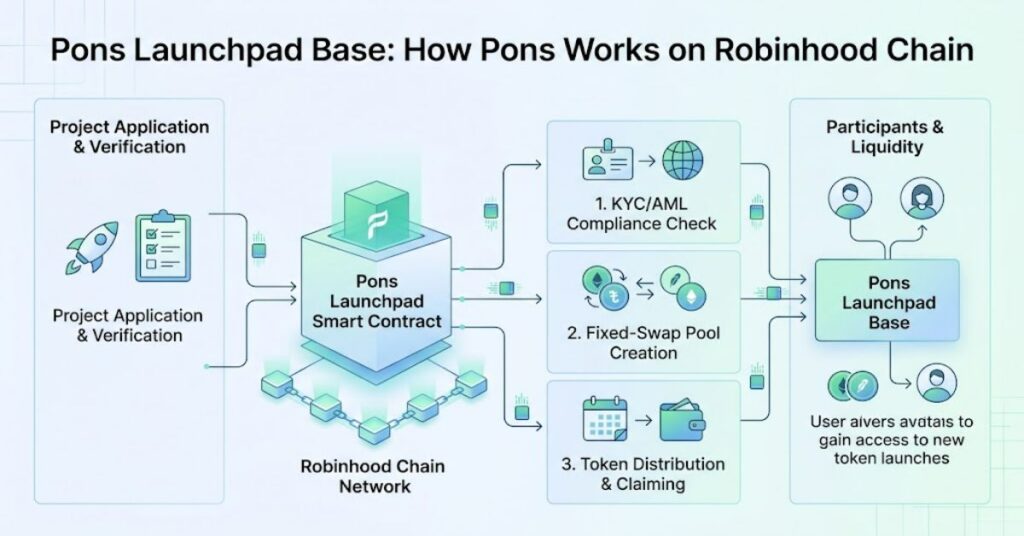
If you are searching for pons launchpad base, the first distinction to make is between the search phrase and the network on which Pons actually operates. Pons is not a launchpad on Coinbase’s Base network. Current Pons documentation identifies Robinhood Chain as its network, while Robinhood describes that chain as an Ethereum-compatible Layer-2 built with Arbitrum technology. Its chain ID is 4663 and ETH is used as the native gas asset.
Pons is designed around a simple proposition: let users launch and trade fixed-supply tokens without the launchpad taking custody of their assets. The platform’s documentation says transactions are requested and approved through the user’s own wallet rather than being held or controlled by Pons.
The more interesting part is what happens after creation. Instead of requiring a creator to build a conventional token contract, arrange initial liquidity and immediately establish a conventional decentralised exchange market, Pons uses a bonding-curve launch mechanism. Buyers and sellers interact with the launch mechanism while the token works towards a defined graduation threshold.
That model makes Pons closer to a permissionless token-discovery marketplace than a traditional venture-style launchpad. It lowers technical barriers, but it also changes the risk profile. A token can be easy to create without being useful, sustainable or safe to buy.
What Is Pons Launchpad?
Pons is a launch and trading platform for fixed-supply tokens on Robinhood Chain. Its public documentation describes it as non-custodial, meaning the platform does not hold users’ funds and transactions require wallet approval.
Robinhood Chain itself is EVM-compatible. Developers can use familiar Ethereum tooling, while users can connect compatible wallets and transact using ETH. Robinhood’s documentation lists chain ID 4663 for the mainnet.
The Pons model can be simplified into four stages:
- A creator configures a token.
- The token begins trading through a bonding curve.
- Market activity moves the launch towards its graduation threshold.
- A qualifying launch transitions into a decentralised exchange liquidity pool.
Current public documentation displays a 0.0005 ETH launch fee and a 4.2 ETH graduation target for ETH-quoted launches, although these should be treated as live interface parameters rather than immutable protocol guarantees.
How the Pons Launch Mechanism Works
A bonding curve changes the launch process because liquidity and price discovery are built into the mechanism rather than being entirely dependent on an external market maker.
When users buy, the curve determines the relevant price according to its programmed rules. As demand develops, the token progresses towards graduation. Selling works in the opposite direction and can reduce the economic activity supporting the launch.
This creates an important distinction between launching and graduating.
Launching only means that a token has been created and made available through the mechanism. Graduation requires substantially more market participation.
For an ETH-quoted Pons launch, current documentation identifies 4.2 ETH as the displayed graduation threshold. Once that threshold is reached, the launch can transition into a Uniswap V4 pool, with the relevant liquidity held through the launcher’s locking mechanism.
Pons Launch Structure
| Feature | Pons model |
| Network | Robinhood Chain |
| Chain ID | 4663 |
| Token model | Fixed supply |
| User custody | Non-custodial |
| Initial trading | Bonding curve |
| Displayed launch fee | 0.0005 ETH |
| ETH graduation threshold | 4.2 ETH |
| Post-graduation venue | Uniswap V4 |
| Wallet approval | Required |
These values reflect the currently documented interface and should be checked against the live protocol before a transaction is signed. Pons documentation itself warns that interface data can lag on-chain state.
Pons Compared With a Traditional Token Launch
The strongest argument for a launchpad such as Pons is reduced complexity.
A conventional token project may need a smart contract, deployment process, liquidity pool, token distribution system and several separate operational decisions. Pons packages much of the initial launch process into a predefined framework.
| Area | Pons launchpad | Traditional token launch |
| Contract creation | Protocol-managed launch process | Creator normally deploys contract |
| Initial pricing | Bonding curve | Creator-selected mechanism |
| Initial liquidity | Built into graduation design | Usually arranged separately |
| Technical barrier | Relatively low | Higher |
| Custody | User-controlled wallet | Depends on project |
| Supply | Fixed launch structure | Creator-defined in many models |
| Market risk | Very high | Very high |
| Smart-contract risk | Still present | Depends on contract quality |
This does not make Pons inherently safer. It shifts where complexity sits.
The creator has less infrastructure to build, but users still need to assess the token, contract address, liquidity conditions, distribution, creator behaviour and market depth.
Why the Bonding Curve Matters
The bonding curve is more than a pricing feature. It determines how early market participants experience the token.
A conventional decentralised exchange pool has two assets supplied as liquidity. A bonding-curve system instead provides a programmed route for buying and selling during the launch phase.
That has three practical consequences.
First, early pricing is mechanically structured. Buyers are interacting with a predefined curve rather than negotiating a price manually.
Second, demand becomes part of the launch process. A token that attracts little interest may never reach graduation.
Third, graduation becomes a market milestone rather than merely a technical event. Reaching the threshold indicates that enough economic activity accumulated to trigger the next stage, but it does not establish that the project has long-term value.
That final point is especially important. Pons documentation explicitly distinguishes graduation from a quality guarantee. A graduated token can still lose most or all of its value.
What Makes Pons Non-Custodial?
Non-custodial does not mean risk-free.
The distinction is about who controls the assets and authorises transactions. Pons says the user’s wallet submits each transaction, rather than the platform taking possession of funds.
This reduces one category of counterparty exposure. Users are not simply depositing assets into a centralised exchange account and trusting the platform to return them.
But the responsibility moves towards the wallet holder.
A user can approve the wrong transaction, send funds to an incorrect address, buy a malicious token or interact with a contract that behaves differently from what they expected. Blockchain transactions may also be irreversible.
For that reason, non-custody should be understood as a control model, not as a safety rating.
Three Risks That Are Easy to Miss
Graduation Does Not Equal Quality
A token reaching its graduation threshold proves that the required economic condition was met. It does not prove that the creator is reputable, that the community is genuine or that demand will continue.
This is a key analytical distinction because launchpad interfaces can make graduation visually prominent. Investors should treat it as a protocol milestone, not an endorsement.
Token Names Are Not Reliable Identifiers
Pons documentation warns that token names and symbols can be copied. The contract address is therefore a more reliable identifier than a familiar-looking name or ticker.
This matters particularly in fast-moving meme-token markets, where visually similar listings can create confusion.
Liquidity Protection Is Not Price Protection
Locked liquidity can reduce the specific risk of someone simply withdrawing the designated liquidity position after graduation. It cannot prevent holders from selling.
That means a token may have technically locked liquidity while still experiencing severe price declines.
The distinction is simple:
Liquidity security can reduce one failure mode; it cannot manufacture demand.
Pons Activity and Market Scale
Pons has developed into a substantial launch environment on Robinhood Chain. Bitquery’s September 2026 analysis of 32 days of on-chain activity reported more than 207,000 tokens created during its study period, alongside billions of dollars in subsequent trading activity. The same analysis found that a large majority of tracked wallets ended the period with less value than they started with.
The figures illustrate the central tension in permissionless token markets: high throughput does not necessarily mean high-quality outcomes.
| Indicator | What it tells you |
| Number of launches | Supply of new speculative assets |
| Graduation count | Percentage reaching the next market stage |
| Trading volume | Activity, not necessarily profitability |
| Wallet outcomes | Whether participants actually retained value |
| Creator fees | Economic incentive for launching tokens |
| Locked liquidity | Protection against selected liquidity-withdrawal risks |
The distinction between activity and value is one of the most useful ways to analyse Pons.
A platform can process thousands of launches while only a small fraction develop persistent liquidity or communities.
Pons, Robinhood Chain and the Meaning of “Base”
The word “base” in the search phrase pons launchpad base can create confusion because Base is also the name of a separate Ethereum Layer-2 network.
Pons’ current documentation identifies Robinhood Chain rather than Base as its operating network. Robinhood describes its chain as an Ethereum-compatible Layer-2 and provides chain ID 4663.
That distinction matters when checking:
- Network configuration
- Contract addresses
- Wallet balances
- Gas assets
- Block explorers
- Token contracts
- Bridge routes
Sending assets or interacting with the wrong network can create unnecessary financial risk. Users should always confirm the network and contract address before approving a transaction.
The Future of Pons Launchpad Base in 2027
Pons’ 2027 outlook is closely connected to Robinhood Chain’s broader development as an on-chain financial network.
Robinhood’s own documentation positions the chain as infrastructure for crypto, traditional markets and real-world assets. The network is EVM-compatible, which lowers the technical barrier for developers already familiar with Ethereum tooling.
For Pons, the major opportunity is not simply producing more launches. It is whether the ecosystem can improve discovery, transparency and sustained liquidity as the number of tokens increases.
The biggest constraint may therefore become attention rather than deployment capacity.
If thousands of assets can be created cheaply, users need better ways to distinguish meaningful projects from temporary speculation. Contract verification, transparent launch parameters, on-chain analytics and clearer risk disclosures could become increasingly important.
Regulation is another uncertainty. Token launchpads occupy an area where decentralised infrastructure, speculative trading and financial-market rules can overlap. The applicable treatment can depend on the asset, jurisdiction and economic structure.
The sensible 2027 expectation is therefore measured: Pons may become more technically mature, but greater launch volume alone will not solve the fundamental problem of identifying durable value.
Key Conclusions
- Pons operates on Robinhood Chain, not Base.
- Its non-custodial model leaves transaction approval with the user’s wallet.
- Bonding curves provide the initial mechanism for token pricing and trading.
- A displayed 4.2 ETH threshold currently defines graduation for ETH-quoted launches.
- Graduation is a protocol milestone, not evidence of investment quality.
- Locked liquidity can address certain liquidity-withdrawal risks but cannot prevent price collapse.
- Contract addresses matter more than token names or tickers when verifying assets.
Conclusion
Pons represents a newer style of token launchpad in which creation, price discovery and market progression are embedded into an on-chain mechanism. Its appeal comes from simplicity: creators can launch without building every component of a conventional token market, while users can trade through their own wallets.
The trade-off is that simplicity at the infrastructure level does not remove financial complexity. A fixed supply does not create demand. Graduation does not guarantee quality. Non-custody does not protect users from bad approvals or poor investment decisions.
For readers searching for pons launchpad base, the most important factual clarification is that Pons operates on Robinhood Chain, an Ethereum-compatible Layer-2, rather than Base. Understanding that network distinction, checking contract addresses and separating protocol milestones from investment signals are essential when evaluating the platform.
Frequently Asked Questions
Is Pons a launchpad on Base?
No. Current Pons documentation identifies Robinhood Chain as its network. Robinhood Chain uses chain ID 4663 and is an Ethereum-compatible Layer-2.
What is the Pons launchpad used for?
Pons is used to create, explore and trade fixed-supply tokens. Tokens begin through the launch mechanism and can progress towards graduation when the required market threshold is reached.
Is Pons non-custodial?
Yes. Pons states that users approve transactions through their own wallets and that the platform does not custody user assets.
What is the Pons graduation threshold?
Current public documentation displays 4.2 ETH for ETH-quoted launches. This is a live protocol parameter and should be checked before signing a transaction.
Does graduating on Pons make a token safe?
No. Graduation indicates that the required launch condition has been reached. It does not guarantee quality, legitimacy, future liquidity or price stability.
How can I identify the correct Pons token?
Use the token’s deployed contract address rather than relying only on its name or ticker. Names and symbols can be copied.
What network does Pons use?
Pons operates on Robinhood Chain. The current mainnet chain ID is 4663 and ETH is the native gas asset.
Methodology
This article Pons launchpad base was prepared using current Pons documentation, Robinhood Chain documentation and independent on-chain research published during 2026. Protocol parameters such as the launch fee and graduation threshold were treated as current interface values rather than permanent constants because live contract configurations can change.
No hands-on wallet transaction or token purchase was conducted for this article, so no fabricated testing results or personal performance claims are presented. Independent research was used to provide market context, while official network documentation was prioritised for Robinhood Chain specifications.
The principal limitation is that permissionless token markets change quickly. Launch counts, trading volumes, fees, liquidity and individual token outcomes can change between research and publication. Readers should verify transaction-critical information directly on-chain before signing.
Editorial disclosure: This article was drafted with AI assistance and should be reviewed and independently verified by the Matrics360.com editorial team before publication.
References
Bitquery Research. (2026). Pons launchpad growth on Robinhood Chain. Bitquery.
Modus. (2026). Launch a token on Pons, Robinhood Chain’s launchpad. Modus.
Pons. (2026). Pons documentation: Launchpad overview, launch mechanism and risk disclosures. Pons Docs.
Pons. (2026). Pons FAQ and launch documentation. Pons Docs.
Robinhood. (2026). Robinhood Chain. Robinhood.
Robinhood Chain. (2026). Connecting to Robinhood Chain. Robinhood Chain Documentation.
Robinhood Chain. (2026). Deploy smart contracts. Robinhood Chain Documentation.