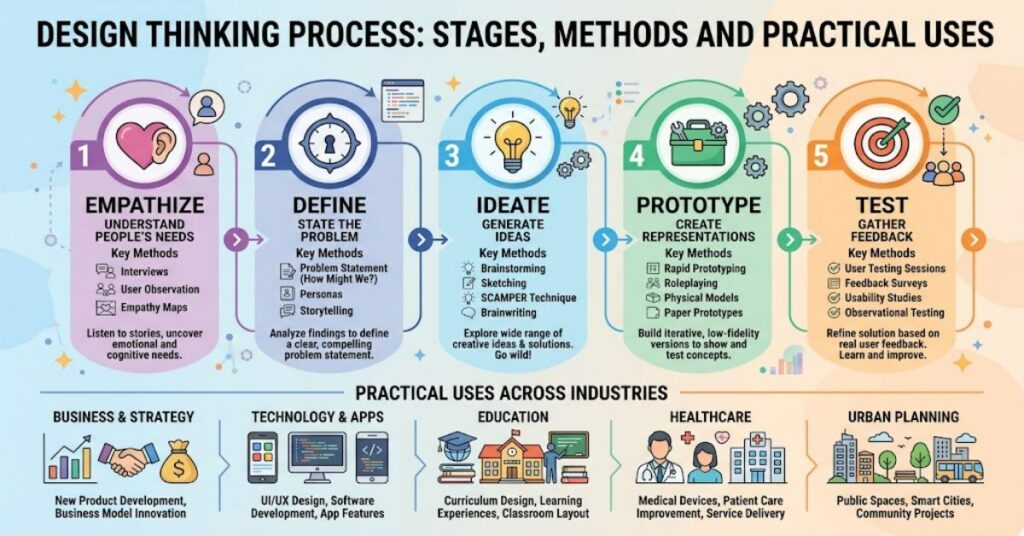
The design thinking process is a human-centred method for solving problems by understanding people’s needs before deciding what to build. Rather than beginning with a predetermined product or feature, teams investigate the situation, identify meaningful problems, generate possible solutions and test early ideas with users.
A common teaching model uses five stages: empathise, define, ideate, prototype and test. Stanford’s d.school has used these five modes in introductory activities, while other established frameworks include additional stages such as implementation. IDEO similarly stresses that design thinking is not a fixed sequence and describes it as a flexible practice that moves between research, synthesis, ideation, prototyping and testing. (Stanford d.school, n.d.; IDEO, n.d.)
That distinction matters. A team might prototype an idea, discover that users misunderstood it and return to problem definition. New research may reveal that the original problem was poorly framed. An apparently strong concept may fail during testing and require another round of ideation.
The process is therefore better understood as a learning system than a checklist.
It can be applied to digital products, services, education, healthcare, business processes and public-sector challenges. Its central discipline is simple: understand the people affected by a problem, make assumptions visible, create alternatives and gather evidence before committing heavily to one solution.
The Five Core Stages
| Stage | Main question | Typical methods | Main output |
| Empathise | What do people actually need? | Interviews, observation, contextual research | User insights |
| Define | What problem should we solve? | Synthesis, journey maps, problem statements | Defined challenge |
| Ideate | What could solve it? | Brainstorming, sketching, workshops | Potential concepts |
| Prototype | How can we make the idea tangible? | Mock-ups, wireframes, role-play | Testable representation |
| Test | What happens when people use it? | Usability testing, feedback, observation | Evidence for iteration |
1. Empathise
Empathy is the research stage. Teams seek to understand users’ behaviours, motivations, frustrations and environments rather than relying solely on assumptions.
Useful methods include semi-structured interviews, observation, diary studies and contextual inquiry. The objective is not simply to collect opinions. Researchers are looking for patterns between what people say, what they do and the constraints surrounding their behaviour.
This distinction is important. A customer may say they want more features, while observation reveals that the existing interface is already difficult to navigate. Good design research investigates the gap.
2. Define
Research produces information; definition turns that information into a design challenge.
Teams synthesise findings, identify recurring patterns and formulate a problem statement. Tools such as affinity mapping, journey mapping and “How might we?” questions can help transform scattered observations into a focused challenge.
A weak definition can undermine everything that follows. If the team defines the problem as “users need a better app”, ideation remains vague. A more specific problem statement creates a useful boundary without dictating the answer.
3. Ideate
Ideation expands the range of possible responses.
The objective is initially to create multiple options rather than immediately selecting the first plausible idea. Brainstorming, sketching, analogy exercises and co-creation workshops can help teams generate alternatives.
This is where divergent thinking is useful. Later, teams move towards convergent thinking by evaluating ideas against user needs, technical feasibility and organisational constraints.
IDEO describes this movement as a recurring rhythm of creating choices and making choices rather than a one-directional march through predefined stages. (IDEO, n.d.)
4. Prototype
A prototype gives an idea a form that people can react to.
It does not need to be a finished product. A prototype might be a paper interface, clickable wireframe, storyboard, physical model or role-play of a service.
The appropriate level of fidelity depends on the question being tested. If the team wants to know whether users understand the navigation structure, a simple wireframe may be enough. Building the complete application would add cost without necessarily producing better evidence.
5. Test
Testing exposes assumptions to real users.
Researchers observe how participants interact with the prototype and look for evidence of confusion, unmet needs or unexpected behaviour. The result is not necessarily a pass-or-fail judgement. A test may show that the underlying problem needs to be reframed.
This is why testing should occur early. Discovering a fundamental flaw in a rough prototype is considerably less expensive than discovering the same flaw after a full production launch.
Linear Model vs Iterative Practice
The familiar five-stage diagram is useful for learning, but it can create the wrong mental model if treated as a strict sequence.
| Approach | Strength | Limitation | Best use |
| Five-stage model | Easy to understand | Can appear overly linear | Teaching fundamentals |
| Iterative design thinking | Reflects real project work | Requires stronger judgement | Complex problems |
| IDEO-style flexible phases | Encourages repeated learning | Less prescriptive | Innovation and strategy |
| Design sprint-style work | Fast and focused | Limited time for deep research | Specific, bounded questions |
Stanford’s d.school has explicitly questioned the idea of a single universal design process, while IDEO states that there is no one-size-fits-all methodology. These positions are important because design thinking is sometimes taught as five boxes that must be completed in order. The evidence from established practitioners points towards flexibility instead. (Stanford d.school, 2025; IDEO, n.d.)
What Makes the Process Effective?
Three factors often determine whether the method produces useful results.
Research quality: Weak or unrepresentative user research can lead teams towards the wrong problem.
Problem framing: A narrowly framed problem may eliminate promising solutions before ideation begins, while an excessively broad problem becomes difficult to act upon.
Testing discipline: Positive comments are not enough. Teams need to observe behaviour and test whether the proposed solution actually addresses the identified need.
IDEO frames successful design around three considerations: desirability for people, feasibility with available technology and viability for the organisation. These dimensions help prevent a common failure mode in which a solution is desirable but impossible to deliver sustainably. (IDEO, n.d.)
Risks and Trade-Offs
Design thinking is not a guaranteed innovation formula.
Workshops can become performative if participants generate ideas without conducting meaningful research. Interviews can produce misleading results if teams ask leading questions. Prototype testing can also create false confidence when participants do not represent the intended audience.
There is another trade-off: speed versus depth. Rapid prototyping can reduce development risk, but complex social or institutional problems may require extensive research before a useful prototype can be defined.
The process also requires organisational tolerance for uncertainty. If managers expect teams to know the correct answer at the beginning, experimentation becomes difficult.
Three Practical Insights
The problem definition is often more consequential than the brainstorming session. A large number of ideas cannot compensate for solving the wrong problem.
A prototype is primarily a learning instrument. Treating it as a miniature final product encourages teams to polish prematurely rather than test important assumptions.
Iteration should follow evidence, not habit. Returning to an earlier stage makes sense when new evidence changes the team’s understanding. Repeating workshops simply because the methodology says to do so adds little value.
The Future of Design Thinking Process in 2027
Design thinking is likely to remain useful in 2027, but its role is changing as AI accelerates research synthesis, concept generation and prototyping.
IDEO’s current material already discusses human-AI collaboration and the use of AI for prototyping, scenario modelling and systems foresight. The important constraint is that AI-generated concepts do not replace human understanding of context, lived experience or organisational responsibility. (IDEO, n.d.)
AI may therefore shorten some activities without removing the underlying design disciplines. Teams can generate more concepts quickly, summarise research faster and create prototypes with less technical effort. That makes evaluation more important, not less.
The strongest future application is likely to combine human-centred research with faster experimentation while retaining human judgement over desirability, feasibility, viability and ethical consequences.
Key Takeaways
- Start with people and evidence rather than a predetermined solution.
- Treat the five stages as a flexible framework, not an inflexible sequence.
- Use research to uncover behaviour, context and unmet needs.
- Define the problem carefully before investing heavily in solutions.
- Prototype at the lowest useful level of fidelity.
- Test assumptions with representative users.
- Balance desirability, feasibility and viability before implementation.
Conclusion
The design thinking process works best when it is treated as a disciplined way of learning rather than a formula for producing instant innovation. Its familiar five stages provide a useful structure: understand people, define a meaningful problem, generate alternatives, make ideas tangible and test what happens.
The deeper value lies in the movement between those stages. Research can change the problem. Testing can challenge the prototype. A failed concept can reveal a better question. That flexibility is not a weakness; it is central to the method.
The approach also has clear limits. Poor research, weak facilitation and superficial testing can produce attractive workshops without meaningful outcomes. Design thinking cannot remove technical, financial or organisational constraints.
Used properly, however, it gives teams a practical way to reduce assumptions and learn earlier. In an environment where products and services increasingly depend on complex user behaviour, that discipline remains relevant.
Frequently Asked Questions
What are the five stages of the design thinking process?
The commonly taught five stages are empathise, define, ideate, prototype and test. They describe a useful framework for moving from user research towards tested solutions, although practitioners often move between stages rather than following them once in a fixed order.
Is the design thinking process linear?
No. IDEO explicitly describes design thinking as flexible and iterative. Teams may return to research or problem definition after testing a prototype. Stanford’s d.school has also cautioned against treating one process model as the single correct way to practise design.
What is the first step in design thinking?
In the common five-stage model, the first step is empathise. It involves understanding users through methods such as interviews, observation and contextual research before defining the problem.
What happens during the ideation stage?
Ideation involves generating multiple possible responses to a defined problem. Teams may use brainstorming, sketching, co-creation and other creative techniques before narrowing the options.
Why are prototypes important in design thinking?
Prototypes make ideas tangible and allow teams to test assumptions before committing substantial resources. They can be simple, such as sketches or wireframes, rather than fully developed products.
What is the difference between design thinking and human-centred design?
The concepts overlap. Human-centred design emphasises designing around people’s needs and contexts, while design thinking describes a set of mindsets and methods used to explore problems, generate ideas, prototype and learn through iteration.
Methodology
This article was developed from established design-methodology sources, prioritising primary material from IDEO and Stanford’s d.school, alongside Nielsen Norman Group’s design-thinking framework. No independent user research, workshop or product-design experiment was conducted for this article.
The analysis distinguishes the commonly taught five-stage model from broader professional approaches. IDEO’s current framework explicitly describes design thinking as flexible and iterative, while Stanford’s d.school has documented concerns about presenting one rigid process as universal.
The main limitation is that design thinking is not a single standardised methodology. Terminology, stages and tools vary between organisations, disciplines and educational programmes. Readers should therefore treat the five-stage model as a practical framework rather than a formal industry standard.
This article was drafted with AI assistance and should be reviewed by the RubbleMagazine.co.uk editorial team before publication. All references and claims should be independently checked against their original sources.
References
IDEO. (n.d.). Design thinking: Human-centered innovation. IDEO.
IDEO. (n.d.). Isn’t design thinking a set, step-by-step process? IDEO Design Thinking.
IDEO. (n.d.). What’s the difference between human-centered design and design thinking? IDEO Design Thinking.
Nielsen Norman Group. (2016). Design thinking 101. Nielsen Norman Group. Reviewed 15 July 2026.
Stanford d.school. (2025). Let’s stop talking about THE design process. Stanford University.
Stanford d.school. (n.d.). The Wallet Project & Gift-Giving Project. Stanford University.