
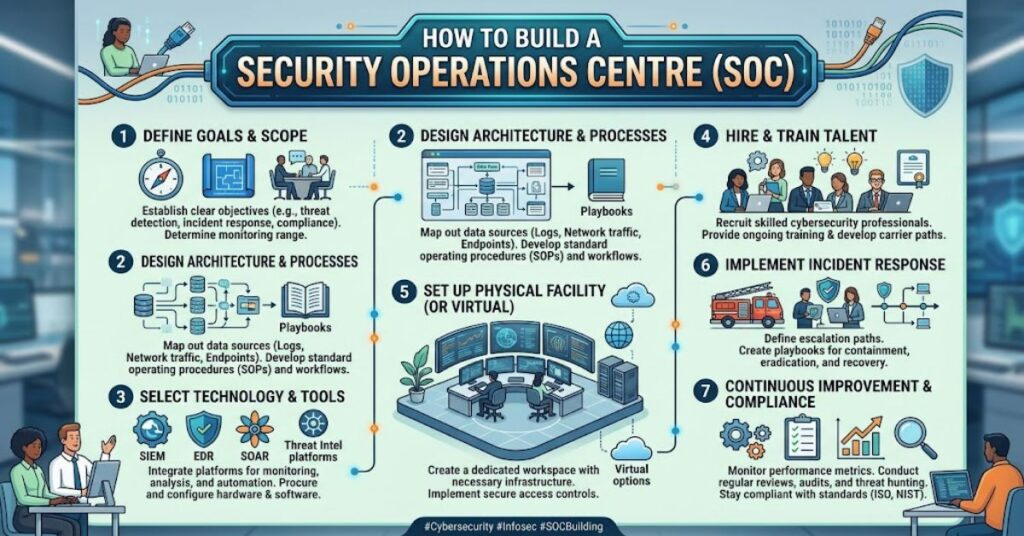
To build SOC capability is to create an organised function for monitoring, detecting, investigating and responding to cybersecurity threats. A Security Operations Centre can be entirely internal, outsourced to a managed security service provider, or operated through a hybrid model combining internal staff with external expertise.
The basic objective is straightforward: turn security data into timely decisions.
A modern SOC receives telemetry from systems such as endpoints, identity platforms, cloud environments, firewalls, applications and network infrastructure. Analysts then investigate suspicious activity, determine whether an alert represents a genuine incident and coordinate the appropriate response.
The challenge is that technology alone does not create an effective SOC. Organisations also need an operating model, escalation procedures, asset knowledge, incident classifications, staff responsibilities and clear measures of performance.
NIST’s Cybersecurity Framework 2.0, published in February 2024, places cybersecurity risk management within a broader organisational framework rather than treating individual security technologies as isolated controls. Its incident-response guidance was subsequently updated through NIST SP 800-61 Revision 3 in April 2025.
For organisations planning a new SOC, this leads to a useful principle: design the operating process first and then select technology that supports it.
Start With the SOC Operating Model
Before buying a SIEM or recruiting analysts, define what the SOC is expected to accomplish.
A small organisation may initially need business-hours monitoring with an escalation arrangement outside normal working hours. A larger enterprise handling sensitive systems may require 24/7 monitoring, dedicated incident responders and specialist threat-hunting capability.
The operating model should answer several practical questions:
- Which systems and business services are monitored?
- Who owns incident decisions?
- Which alerts require immediate escalation?
- Who can isolate an endpoint or disable an account?
- When should legal, communications or senior management teams become involved?
- Which activities remain internal and which are outsourced?
This prevents a common structural problem: purchasing expensive security tools without deciding who is responsible for acting on their output.
| SOC model | Typical structure | Main consideration |
| Internal SOC | Employees operate monitoring and response | Greater organisational control but higher staffing requirements |
| Managed SOC | External provider monitors and responds | Access to specialist capability with less direct control |
| Hybrid SOC | Internal team plus external specialists | Flexible but requires clear ownership |
| Co-managed SOC | Internal analysts supported by a provider | Useful when internal capability is developing |
Build the Technology Stack Around Visibility
Technology should support the SOC’s defined workflow.
A typical stack may include a Security Information and Event Management platform, endpoint detection and response, identity monitoring, vulnerability-management systems, network telemetry, cloud-security controls and threat-intelligence feeds.
The SIEM can provide centralised analysis of logs and security events. EDR contributes detailed endpoint telemetry. Identity data helps analysts investigate suspicious authentication, privilege escalation and account compromise.
The important issue is not simply how many tools are connected. It is whether the SOC receives enough reliable data to investigate an alert.
An organisation that collects enormous quantities of low-value logs may create analyst fatigue without improving detection. Conversely, missing identity, endpoint or cloud telemetry can leave major gaps in an investigation.
NIST CSF 2.0 specifically supports organisational profiles and risk-based implementation rather than prescribing one universal technology stack.
Design Detection Before Chasing Alerts
A SOC needs detection logic that reflects the organisation’s actual risks.
Useful detection priorities can include compromised credentials, suspicious administrator activity, malicious PowerShell execution, unusual authentication patterns, endpoint compromise, data exfiltration indicators and exploitation of internet-facing systems.
Detection engineering should therefore begin with questions such as:
- Which attacks could cause the greatest business damage?
- Which telemetry would reveal those attacks?
- Can the SOC distinguish malicious behaviour from legitimate administration?
- What action should follow a confirmed detection?
This produces a more useful detection programme than simply activating every available vendor rule.
| SOC capability | Primary purpose | Useful measurement |
| SIEM | Central event analysis | Relevant events ingested and investigated |
| EDR | Endpoint detection and response | Endpoint coverage and investigation quality |
| Identity monitoring | Detect account abuse | Suspicious authentication detections |
| Threat intelligence | Add external context | Intelligence linked to active investigations |
| SOAR/automation | Reduce repetitive work | Automated actions and successful playbooks |
| Case management | Track investigations | Resolution time and documentation quality |
Build the Team Around Decisions
A SOC team may include Tier 1 analysts, Tier 2 investigators, senior incident responders, threat hunters, detection engineers and a SOC manager. Smaller organisations may combine several responsibilities.
The critical skill is not simply technical knowledge. Analysts must be able to interpret evidence and make consistent decisions under pressure.
Training should cover incident classification, evidence preservation, escalation, communication and the organisation’s specific technology environment.
NIST’s 2025 incident-response revision emphasises integrating incident response throughout cybersecurity risk management. It also highlights preparation, investigation, response and recovery as connected activities rather than isolated steps.
This has a practical implication: SOC analysts should understand what happens after an alert becomes an incident. A detection that cannot trigger an effective response process has limited operational value.
Measure What the SOC Actually Achieves
SOC performance should not be reduced to the number of alerts closed.
Useful measures include mean time to detect, mean time to respond, investigation quality, false-positive rates, detection coverage, escalation accuracy and the percentage of critical assets covered by monitoring.
However, metrics need context. A very low mean response time may look impressive while hiding a high false-positive rate or incomplete incident records.
The 2025/2026 UK Cyber Security Breaches Survey illustrates why organisational context matters. It estimated that 19% of UK businesses experienced at least one cyber crime during the previous 12 months, with the likelihood increasing substantially among larger organisations. The survey also cautions that unidentified or unremembered incidents are likely to mean reported figures underestimate the true scale.
The lesson for SOC design is significant: visibility and measurement are themselves security capabilities.
Risks and Trade-Offs When Building a SOC
Building a SOC involves several unavoidable trade-offs.
Cost versus coverage: 24/7 internal monitoring requires staffing and infrastructure. Outsourcing can provide wider coverage but introduces dependency on an external provider.

Automation versus control: Automated containment can reduce response time, but poorly configured playbooks can disrupt legitimate business activity.
Data volume versus analyst capacity: More telemetry can improve visibility, but excessive low-value alerts can overwhelm analysts.
Specialisation versus flexibility: Highly specialised teams can handle advanced investigations but may become difficult to staff. Cross-trained teams can be more flexible but may have less depth in niche areas.
These trade-offs should be documented rather than hidden behind technology purchases.
Three Practical Insights for a Better SOC
1. Asset inventory should influence detection priorities. Monitoring everything equally is rarely efficient. Critical systems, privileged identities and exposed services should receive stronger detection coverage.
2. Incident response should be tested before an emergency. Tabletop exercises can expose unclear responsibilities, missing contact information and unrealistic escalation procedures before a real incident occurs.
3. Detection engineering should be treated as continuous work. Attack techniques, software environments and legitimate administrative behaviour change. Detection rules therefore require review, tuning and retirement rather than permanent activation.
These principles are consistent with the broader risk-management approach in NIST CSF 2.0 and its incident-response guidance.
The Future of Building a SOC in 2027
By 2027, build SOC development is likely to place greater emphasis on automation, identity telemetry, cloud visibility and AI-assisted security analysis.
That does not mean human analysts disappear. Instead, repetitive investigation and enrichment tasks are increasingly likely to be automated while analysts focus on validation, complex investigations and response decisions.
NIST’s current CSF 2.0 work already includes resources addressing AI-related cybersecurity analysis and reporting, showing that AI is becoming part of formal cybersecurity planning rather than simply a vendor feature.
The UK government is also continuing its Cyber Security Breaches Survey programme, with the 2026/2027 fieldwork scheduled ahead of an April 2027 release.
The underlying infrastructure challenge will remain unchanged: organisations need accurate asset information, usable telemetry and people who can act on security findings.
Key Takeaways
- Define the mission first: A SOC should have clear responsibilities and measurable security outcomes.
- Prioritise visibility: Critical identities, endpoints, applications and infrastructure require reliable telemetry.
- Choose tools based on workflow: Technology should support investigation and response rather than dictate them.
- Treat analysts as decision-makers: Training must cover judgement, escalation and incident coordination.
- Test response procedures: Exercises can reveal operational weaknesses before real incidents occur.
- Tune continuously: Detection rules and playbooks require regular review as environments change.
- Measure outcomes: Alert volume alone does not demonstrate effective security operations.
Conclusion
To build a SOC successfully, organisations need to think beyond dashboards, alerts and security products. A Security Operations Centre is an operating capability that connects people, processes, data and technology around a common purpose: detecting threats and responding to them effectively.
The strongest starting point is therefore not a technology shopping list. It is a clear definition of critical assets, likely threats, monitoring requirements, escalation routes and response authority.
From there, organisations can select the appropriate SIEM, EDR, identity controls, automation platforms and specialist services. The size of the SOC can vary considerably, but its fundamental requirements remain consistent.
NIST’s recent cybersecurity guidance reinforces this integrated approach, while UK government survey data demonstrates the continuing need for organisations to improve their ability to identify and manage cyber risk.
A well-designed SOC is not simply a room full of analysts watching alerts. It is a repeatable decision-making system that improves as threats, technology and organisational priorities change.
Frequently Asked Questions
How much does it cost to build a SOC?
There is no universal cost. An internal 24/7 SOC requires substantially more staffing and infrastructure than a small team supported by a managed security provider. Costs depend on log volume, endpoint count, staffing model, required coverage and technology licences.
What tools are needed to build a SOC?
A typical SOC may use SIEM, EDR, identity monitoring, vulnerability-management, network-monitoring, threat-intelligence, case-management and security-automation technologies. The exact stack should reflect the organisation’s risks and operating model.
How many people are needed for a SOC?
Staffing depends on coverage requirements. A business-hours SOC may operate with a small team, while genuine 24/7 internal coverage requires considerably more personnel to account for shifts, leave, training and specialist functions.
Should a small business build an internal SOC?
Not necessarily. Smaller organisations may find a managed or hybrid model more practical, particularly when they lack enough security specialists to provide continuous monitoring and incident response.
What should a SOC monitor first?
Critical business systems, privileged identities, internet-facing services, endpoints and important cloud environments are sensible priorities. Monitoring should be based on risk rather than simply the volume of available data.
What is the difference between SIEM and SOC?
A SIEM is a technology platform used to collect, correlate and analyse security events. A SOC is the wider operational function involving people, processes and technologies that detect, investigate and respond to security incidents.
Methodology
This article build SOC was prepared using current guidance from the National Institute of Standards and Technology and recent UK government cybersecurity statistics. NIST Cybersecurity Framework 2.0, published in February 2024, was used for the broader risk-management structure, while NIST SP 800-61 Revision 3, published in April 2025, informed the discussion of incident response. UK context was drawn from the Cyber Security Breaches Survey 2025/2026.
No hands-on SOC deployment or independent security benchmark was conducted for this article. The practical recommendations are therefore analytical rather than claims of firsthand testing. Costs and staffing requirements can vary substantially according to organisational size, regulatory requirements, technology estate and monitoring coverage.
Editorial disclosure: This article build SOC was drafted with AI assistance. Named statistics, technical claims and references should be independently checked by a human editor against the original sources before publication.
References
Department for Digital, Culture, Media and Sport, & Department for Science, Innovation and Technology. (2026, 30 April). Cyber security breaches survey 2025/2026. GOV.UK.
Department for Digital, Culture, Media and Sport, & Home Office. (2026, 21 September). Cyber Security Breaches Survey 2026/2027: Official statistics announcement. GOV.UK.
National Institute of Standards and Technology. (2024, 26 February). The NIST Cybersecurity Framework (CSF) 2.0. NIST.
Nelson, A., Rekhi, S., Souppaya, M., & Scarfone, K. (2025, 3 April). Incident response recommendations and considerations for cybersecurity risk management: A CSF 2.0 community profile (NIST SP 800-61 Rev. 3). National Institute of Standards and Technology.