
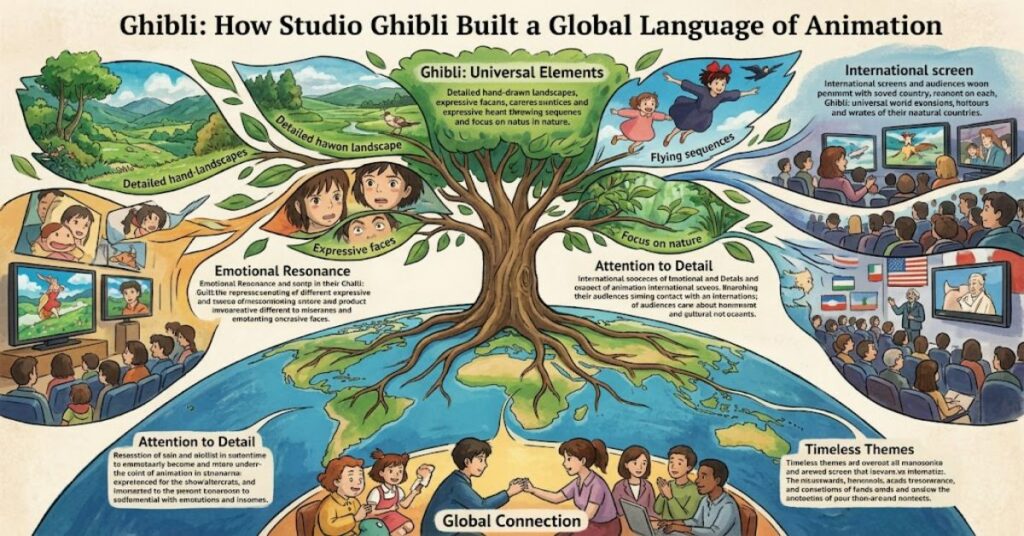
Ghibli has become shorthand for a particular kind of animation: hand-drawn worlds filled with forests, spirits, flying machines, quiet villages, unusual creatures and emotionally complicated characters. Yet the word represents more than an aesthetic. Studio Ghibli is a Japanese animation company founded in 1985, with its origins connected to the success of Nausicaä of the Valley of the Wind and the filmmaking partnership surrounding Hayao Miyazaki and Isao Takahata.
The studio’s identity developed around theatrical feature animation rather than a broad production model. Its official history describes a particularly unusual commitment to feature-length animated films, with original works forming a major part of its production philosophy.
That focus helps explain why Ghibli films often feel carefully constructed rather than formulaic. A story may contain adventure, fantasy, comedy and conflict while leaving considerable space for silence and observation. A character can make mistakes without becoming a conventional villain. Nature can be beautiful and dangerous at the same time.
This approach has allowed Ghibli to travel across language and cultural boundaries. Its international reputation is now supported not only by films but also by museums, exhibitions, theatrical adaptations and continuing cinema releases. In 2024, The Boy and the Heron won the Academy Award for Animated Feature Film, adding another major milestone to the studio’s international history.
How Studio Ghibli Started
Studio Ghibli began operations in June 1985 in Kichijōji, Tokyo. Its formation followed the commercial and critical success of Nausicaä of the Valley of the Wind, directed by Miyazaki and produced before the studio formally existed.
Miyazaki and Takahata became the central creative figures, while producer Toshio Suzuki played an important role in developing the studio’s production and commercial structure. Suzuki joined the establishment of Ghibli in 1985 and became a full-time studio figure from 1989.
The early years established an important pattern. Rather than treating animation simply as children’s entertainment, Ghibli produced films capable of addressing war, environmental destruction, ageing, grief, work, family and identity.
The 1988 double feature of My Neighbour Totoro and Grave of the Fireflies illustrates the breadth of this strategy. The two films were released together despite having radically different emotional tones.
What Makes Ghibli’s Animation Distinctive?
Ghibli’s visual identity is frequently associated with hand-drawn animation, richly developed backgrounds and expressive character movement. However, reducing the studio to an “art style” misses an important part of its method.
| Element | Typical Ghibli treatment | Effect |
| Environment | Detailed natural and built spaces | Creates a sense of lived reality |
| Characters | Strengths and contradictions | Avoids simplistic moral categories |
| Nature | Beautiful but sometimes threatening | Adds ecological complexity |
| Pacing | Action mixed with quiet observation | Gives scenes emotional breathing room |
| Sound | Music and environmental sounds | Strengthens atmosphere and place |
One distinctive feature is the attention given to ordinary activity. Eating, walking, cleaning, travelling and looking at landscapes can occupy meaningful screen time. These moments make extraordinary events feel connected to everyday life.
Another is moral ambiguity. Films such as Princess Mononoke do not reduce environmental conflict to a simple battle between heroes and villains. Human industrial activity causes destruction, yet individual characters also have legitimate needs and vulnerabilities.
This makes Ghibli particularly useful as a cultural case study: fantasy becomes a way to examine real social tensions.
From Japanese Studio to Global Cultural Brand
Ghibli’s international reach developed gradually. Its films became widely available outside Japan through distribution, dubbing, home video and later digital-era discovery. The result was a global audience that could engage with specifically Japanese cultural references without requiring every element to be translated into familiar Western storytelling conventions.
The studio’s business structure has also expanded beyond filmmaking. Its official corporate profile lists film production, overseas licensing, publishing, music rights, merchandising and operation of the Ghibli Museum among its activities.
| Development | Date | Significance |
| Studio Ghibli established | 1985 | Formal beginning of the studio |
| My Neighbour Totoro released | 1988 | Established a lasting cultural icon |
| Staff became regular employees | 1989 | Strengthened the studio’s production organisation |
| Ghibli Museum opened | 2001 | Extended the studio experience beyond cinema |
| Studio became a Nippon TV subsidiary | 2023 | Major corporate ownership development |
| The Boy and the Heron won Oscar | 2024 | Major international recognition |
| New exhibitions and remasters | 2026 | Demonstrate continuing cultural demand |
The 2023 ownership change is particularly important. Studio Ghibli became a subsidiary of Nippon Television Holdings following a share transfer, with the stated purpose of supporting the studio while allowing it to remain focused on filmmaking.
Cultural Impact and the Ghibli Experience
The Ghibli experience increasingly exists outside the cinema.
The Ghibli Museum in Mitaka provides one example of how animation can be presented as a physical cultural environment. Exhibitions and installations allow visitors to encounter production artwork, characters and filmmaking processes in ways that differ from simply watching a finished film.
Current exhibition activity shows that demand remains substantial. In 2026, the “Friday Roadshow and Ghibli Exhibition” is scheduled in Yamaguchi through 12 October, while the Ghibli Park Exhibition in Osaka runs through 26 September. The official international programme also lists exhibitions and stage productions continuing into 2027.
This reveals an important commercial and cultural insight: Ghibli’s intellectual property functions across multiple formats without depending entirely on new feature releases.
Risks and Trade-Offs
The studio’s identity also creates constraints.
High-quality hand-drawn animation requires substantial labour, specialist skills and production time. A brand built around artistic consistency can also face pressure when audiences expect every new project to reproduce familiar visual or emotional characteristics.
There is another risk: global popularity can encourage simplified interpretations of Ghibli as merely “cosy” or aesthetically pleasing. That framing can obscure themes involving war, displacement, ecological conflict and social change.
The internationalisation of the brand therefore involves a balancing act. Accessibility can broaden the audience, but excessive simplification can weaken cultural context.
The Future of Ghibli in 2027
Ghibli’s near-term trajectory is more visible through cultural programming than through a confirmed wave of new feature films. Official listings show exhibitions continuing into 2027, including The Story of Studio Ghibli in Singapore and Spirited Away stage productions in Toronto and Los Angeles.
The studio is also continuing to revisit its existing catalogue. In 2026, Whisper of the Heart and Arrietty are scheduled for limited IMAX screenings following 4K digital remastering under Studio Ghibli supervision.
This suggests that preservation, restoration and experiential formats may remain important parts of Ghibli’s cultural strategy. It does not, however, establish what films the studio will produce next.
Key Takeaways
- Ghibli’s identity was built around theatrical animation and strong artistic authorship.
- Its films frequently combine fantasy with serious social and environmental themes.
- Detailed environments are as important to the storytelling as character design.
- The studio’s business now includes licensing, publishing, music, merchandise and cultural attractions.
- Exhibitions and stage adaptations demonstrate that Ghibli’s stories can operate beyond film.
- Restoration and premium cinema presentations are helping older works reach new audiences.
- The studio’s continuing challenge is maintaining creative identity while operating as a global cultural brand.
Conclusion
Ghibli’s significance comes from the combination of artistic discipline and thematic ambition. Its films can be visually gentle while addressing difficult subjects, and fantastical worlds can function as reflections of recognisable human experiences.
Since its establishment in 1985, Studio Ghibli has developed from a Japanese animation company into a cultural institution with influence across cinema, art, music, publishing, exhibitions and live performance.
Its continuing relevance is not dependent solely on producing new films. Museum experiences, international exhibitions, restored releases and stage adaptations demonstrate how established stories can remain culturally active decades after their original release.
For audiences discovering Ghibli today, the central attraction is therefore broader than animation technique. It is a storytelling philosophy that gives equal importance to imagination, place, atmosphere and emotional complexity.
Frequently Asked Questions
What is Ghibli?
Ghibli generally refers to Studio Ghibl’i, the Japanese animation studio established in 1985. It is known for feature films associated with filmmakers including Hayao Miyazaki and Isao Takahata.
Why is Studio Ghibli famous?
The studio became internationally recognised for distinctive hand-drawn animation, detailed environments, memorable characters and stories addressing themes such as nature, childhood, conflict and identity.
Who founded Studio Ghibli?
Studio Ghibli was established in 1985 with the involvement of Hayao Miyazaki, Isao Takahata and producer Toshio Suzuki, alongside Tokuma Shoten.
What was the first Studio Ghibli film?
Castle in the Sky was the first feature released after the studio was established. Nausicaä of the Valley of the Wind, released in 1984, directly preceded the studio’s formation and helped make its creation possible.
Did Ghibli win an Academy Award?
Yes. The Boy and the Heron won the Academy Award for Animated Feature Film at the 96th Academy Awards in 2024.
Is Studio Ghibli still active?
Yes. Studio Ghibli continues to manage films, licensing, cultural activities and exhibitions. Its official 2026 information also lists upcoming international events and releases.
Methodology
This article was researched using Studio Ghibli’s official corporate history, company profile, chronology and current event information, alongside Academy of Motion Picture Arts and Sciences records. The analysis distinguishes documented corporate and historical facts from interpretation. Current information reflects sources available in September 2026.
No firsthand testing or personal field reporting was conducted for this article; therefore, no fabricated firsthand experience is presented. Exhibition schedules and corporate information can change, so dates should be checked against the relevant official announcement before publication.
Editorial disclosure: This article was drafted with AI assistance and requires human editorial review before publication. Statistics, named claims, citations and author credentials should be independently verified by the Matrics360.com editorial team.
References
Academy of Motion Picture Arts and Sciences. (2024). The 96th Academy Awards: Animated Feature Film. Academy Awards.
Studio Ghibli. (2026). Company profile. Studio Ghibli.
Studio Ghibli. (2026). History of Studio Ghibli. Studio Ghibl’i.
Studio Ghibli. (2026). Studio Ghibli chronology. Studio Ghibli.
Studio Ghibli. (2026). Studio Ghibli international events. Studio Ghibli.
Studio Ghibli. (2026). Ghibli exhibition and event information. Studio Ghibli.