
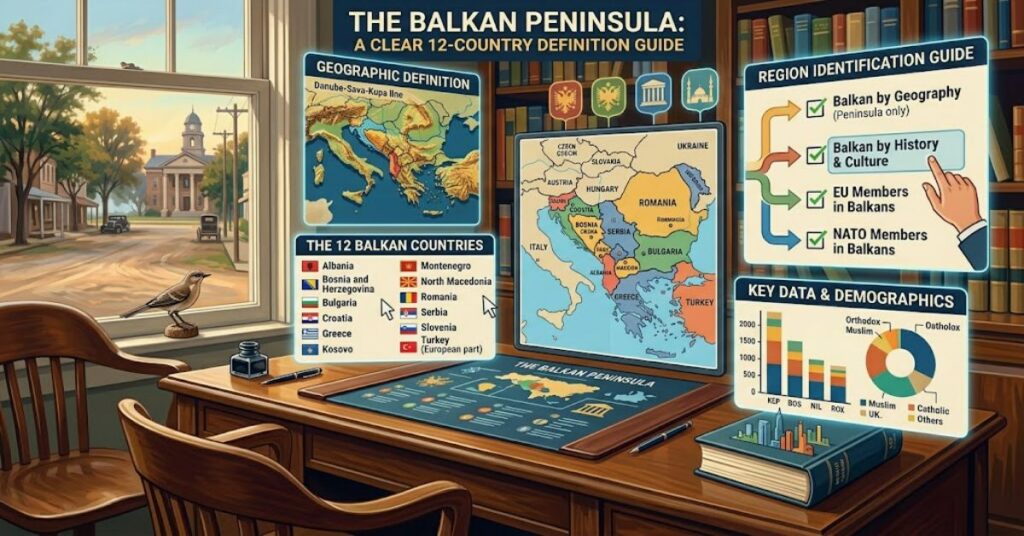
The Balkan countries form one of Europe’s most geographically and culturally varied regions. The Balkans are generally associated with southeastern Europe and the Balkan Peninsula, but there is no universally accepted list of countries that belong to it. Depending on the definition used, the region can include countries located wholly or partly on the peninsula, with broader interpretations reaching approximately 12 states.
A commonly used broad list includes Albania, Bosnia and Herzegovina, Bulgaria, Croatia, Greece, Kosovo, Montenegro, North Macedonia, Romania, Serbia, Slovenia and Türkiye. However, countries such as Romania, Slovenia, Croatia and Türkiye may be included or excluded depending on whether the writer is using geographical, historical or political criteria.
This distinction matters because “Balkans” and “Western Balkans” are not interchangeable terms. The European Union officially identifies six Western Balkan partners: Albania, Bosnia and Herzegovina, Kosovo, Montenegro, North Macedonia and Serbia.
The region’s complexity is therefore part of its identity. Mountain ranges, coastlines, empires, languages, religions and shifting political borders have all influenced how the Balkans are understood today.
Which Countries Are Considered Balkan Countries?
There is no single official international organisation that determines a definitive 12-country Balkan list. A broad geographical interpretation commonly includes the following:
| Country | Common Balkan association | EU member? |
| Albania | Strong | No |
| Bosnia and Herzegovina | Strong | No |
| Bulgaria | Strong | Yes |
| Croatia | Partial/common | Yes |
| Greece | Strong/common | Yes |
| Kosovo | Strong | No |
| Montenegro | Strong | No |
| North Macedonia | Strong | No |
| Romania | Partial/broad definition | Yes |
| Serbia | Strong | No |
| Slovenia | Partial/broad definition | Yes |
| Türkiye | Partial, European territory | Yes candidate |
The important point is that the list changes according to the definition being applied. The European Commission’s institutional use of “Western Balkans”, for example, is specifically limited to six partners rather than the wider geographical region.
Why Is the Balkan Definition Complicated?
The Balkan Peninsula is not defined by one universally accepted natural boundary. Unlike regions separated by an obvious ocean or political border, its northern limits are debated.
Historical changes make the issue even more complex. The region was shaped by the Byzantine, Ottoman and Austro-Hungarian spheres, followed later by the formation and breakup of Yugoslavia. Modern national borders therefore do not perfectly correspond with older cultural or geographical concepts.
This creates an important distinction:
| Definition | Main basis | Typical result |
| Geographical | Peninsula and physical geography | Broad country list |
| Historical | Empires and regional history | Variable |
| Political | Current institutions | Often narrower |
| EU policy | Enlargement framework | Six Western Balkan partners |
This is one reason a reader may encounter different answers when researching the number of Balkan states.
The Six Western Balkan Countries
In contemporary European politics, the term Western Balkans has a precise institutional meaning. The European Union identifies Albania, Bosnia and Herzegovina, Kosovo, Montenegro, North Macedonia and Serbia as the six Western Balkan partners.
The distinction has practical consequences because these six states are involved in the EU enlargement process. In November 2023, the European Commission introduced a €6 billion Growth Plan designed to support economic integration, reforms and convergence with the EU.
By June 2026, the EU continued to describe enlargement of the Western Balkans as a strategic priority, with investment, economic integration and regional cooperation remaining central themes.
Geography, Culture and Identity
The Balkans contain a striking mixture of landscapes and cultural traditions. The region includes Adriatic and Aegean coastlines, extensive mountain systems, river valleys and major urban centres.
Its cultural diversity is equally significant. South Slavic languages dominate several countries, while Albanian, Greek, Romanian and Turkish represent different linguistic traditions. Christianity and Islam have also played major historical roles, with Orthodox, Catholic and Muslim communities distributed across the region.
One useful insight is that political identity and geographical identity do not always overlap. A country can have strong historical or cultural links with the Balkans without being treated as a Western Balkan state in EU policy.
Why the Region Matters Economically
The Balkans are increasingly important in European trade, transport and investment. The EU is the region’s major economic partner, while infrastructure projects are improving connections between southeastern Europe and the wider European market.
The European Commission reported that EU-Western Balkans trade in goods exceeded €87.7 billion in 2025, representing year-on-year growth of approximately 5.2%.
A further structural development is regional economic integration. CEFTA and EU-backed initiatives seek to reduce trade barriers and improve movement of goods and services across the Western Balkans.
The Future of Balkan Countries in 2027
The most important trend heading into 2027 is the continued interaction between regional integration and EU enlargement.
The €6 billion Growth Plan remains a major policy mechanism, while transport, digital infrastructure, energy and regulatory alignment are expected to influence economic development.
However, EU accession is not guaranteed on a fixed timetable. Progress depends on reforms, institutional capacity and individual country performance. The European Commission’s 2024 enlargement assessments stressed the importance of structural reforms and the ability of candidate economies to withstand competitive pressure within the EU market.
The likely direction in 2027 is therefore deeper integration rather than a simple expansion of the geographical definition of the Balkans.
Key Insights
- The Balkans are a geographical and historical concept rather than a fixed political bloc.
- A broad interpretation can contain approximately 12 countries.
- The EU’s Western Balkans definition contains six countries.
- Croatia, Romania, Slovenia and Türkiye demonstrate why geographical classifications can overlap.
- EU enlargement is increasingly influencing the region’s economic identity.
- Infrastructure and trade integration may matter as much as formal political accession.
- Country-by-country analysis is more reliable than treating the Balkans as one uniform market.
Frequently Asked Questions
How many Balkan countries are there?
There is no universally agreed number. A broad geographical definition can include up to 12 countries, while narrower definitions include fewer states.
What are the six Western Balkan countries?
The EU identifies Albania, Bosnia and Herzegovina, Kosovo, Montenegro, North Macedonia and Serbia as the six Western Balkan partners.
Are all Balkan countries in the European Union?
No. Several countries commonly associated with the Balkans are EU members, including Bulgaria, Croatia, Greece, Romania and Slovenia, while others remain outside the EU.
Is Türkiye a Balkan country?
Türkiye is sometimes included in broad definitions because its European territory lies within the Balkan geographical area. Its inclusion depends on the definition being used.
Is Romania part of the Balkans?
Romania is included in some broad geographical and historical interpretations, although it is not normally included in the EU’s Western Balkans grouping.
Methodology
This article distinguishes geographical terminology from current EU political terminology. Information was checked against European Commission and European Council material covering the Western Balkans, EU enlargement, trade and regional integration. The principal limitation is that “Balkans” has no universally binding geographical definition, so broader country lists can legitimately differ.
Named institutional developments, including the EU Growth Plan announced on 8 November 2023 and the EU-Western Balkans Summit held on 5 June 2026, were used to establish current context.
Editorial disclosure: This article was drafted with AI assistance and requires human editorial verification of factual claims and references before publication.
Conclusion
The Balkan region is best understood as a flexible geographical and historical concept rather than a fixed list of countries. Depending on the criteria used, a broad definition can include up to 12 states, while the EU’s Western Balkans framework specifically covers six partners.
That distinction helps explain why different sources produce different country lists. Geography, history, culture and politics each provide a different lens. The region is also becoming more economically integrated with the European Union through trade agreements, infrastructure programmes and enlargement initiatives.
For readers researching the Balkans, the most reliable approach is therefore to identify the definition being used before interpreting a country list. The six-country Western Balkans classification is particularly useful for understanding current EU policy, while the broader geographical definition provides a better picture of the region’s physical and cultural scope.
References
European Commission. (2023, November 8). New €6 billion growth plan to bring Western Balkans closer to joining the EU.
European Commission. (2024, October 30). Enlargement reports 2024: Commission outlines progress and priorities for candidate countries.
European Commission. (2026, June 5). EU-Western Balkans Summit highlights enlargement as a strategic investment in Europe’s peace, stability and security.
European Commission. (2026). EU trade relations with Western Balkans.
Council of the European Union. (2026). EU-Western Balkans relations.