
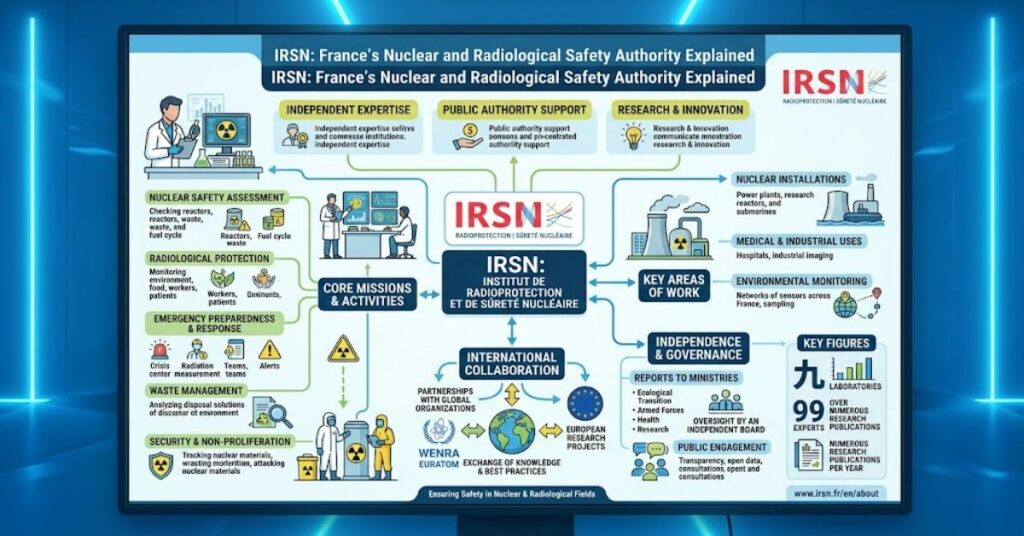
IRSN, short for Institut de radioprotection et de sûreté nucléaire, was France’s specialist public organisation for expertise in nuclear and radiological risks. It combined research, technical assessment, radiation protection expertise, environmental monitoring and emergency-response capabilities. For decades, its work supported decisions involving nuclear installations, radioactive materials, workers, patients and the wider public.
The organisation occupied an unusual position in France’s nuclear system because its responsibilities extended beyond a single facility or regulatory function. Its specialists studied reactor safety, radiation exposure, radioactive waste, environmental contamination and the consequences of nuclear or radiological accidents.
However, understanding IRSN today requires an important historical qualification. France reorganised its nuclear-safety framework in 2025, transferring many of the institute’s former responsibilities into a new structure. The Autorité de sûreté nucléaire et de radioprotection, or ASNR, became the country’s unified authority for nuclear safety and radiation protection on 1 January 2025.
That means IRSN is no longer simply a description of France’s current institutional arrangement. It is also the name of an organisation whose scientific expertise and functions were incorporated into the new framework.
Its legacy remains significant. The institute’s research programmes, technical knowledge, monitoring systems and specialist personnel contributed to France’s approach to nuclear-risk management for many years.
What Was IRSN?
IRSN was created in 2001 through the merger of the Office de protection contre les rayonnements ionisants and parts of the Institut de protection et de sûreté nucléaire.
Its purpose was to provide independent scientific and technical expertise on risks associated with ionising radiation and nuclear activities.
Its work covered several interconnected fields:
- Nuclear installation safety
- Radiation protection
- Environmental monitoring
- Radioactive waste
- Nuclear research
- Emergency preparedness
- Radiological accident response
- Exposure assessment
This broad remit allowed specialists to examine nuclear risks from both engineering and public-health perspectives.
IRSN’s expertise supported government departments and the nuclear regulator, but the organisation was not itself the operator of nuclear facilities. That distinction matters because technical assessment and facility operation require different institutional roles.
The Main Areas of IRSN Expertise
| Area | Role | Practical importance |
| Nuclear safety | Technical assessment of nuclear installations | Supports safer reactor operation |
| Radiation protection | Assessment of radiation exposure | Protects workers and the public |
| Environment | Monitoring radioactive substances | Identifies changes in environmental exposure |
| Emergency response | Scientific support during incidents | Helps authorities assess consequences |
| Research | Development of nuclear and radiological knowledge | Improves long-term risk assessment |
| Waste management | Technical studies concerning radioactive waste | Supports safe disposal and storage |
This structure illustrates why IRSN was more than a conventional research institute. Its work connected scientific research with operational risk assessment.
IRSN and Nuclear Safety in France
France has one of the world’s largest civilian nuclear-power programmes. That creates a substantial requirement for specialist safety expertise.
Nuclear safety involves more than checking whether a reactor is functioning correctly. Experts must consider ageing equipment, severe accidents, natural hazards, human factors, emergency procedures and interactions between different safety systems.
IRSN contributed technical assessments in these areas and developed scientific models for understanding potential accident scenarios.

The institute also played a role in assessing the consequences of radiation exposure. That required knowledge from several disciplines, including physics, biology, engineering and environmental science.
Its position within France’s nuclear system therefore reflected the complexity of nuclear risk itself.
Radiation Protection Beyond Nuclear Reactors
One of the most important aspects of IRSN was its focus on radiation protection beyond electricity generation.
Ionising radiation is used in medicine, industry and research. Medical imaging and radiotherapy, for example, can provide major benefits while also requiring careful management of radiation exposure.
Radiation protection seeks to ensure that exposure is justified, optimised and kept within applicable limits and requirements.
IRSN’s work included research and expertise concerning exposure to natural and artificial sources of radiation. It also contributed to understanding population exposure and occupational risks.
This broader perspective helped distinguish radiation protection from nuclear-reactor safety. The two fields overlap, but they address different exposure pathways and technical questions.
Environmental Monitoring and Emergency Response
Environmental surveillance was another major component of IRSN’s work.
Monitoring radioactive substances in the environment can involve measurements of air, water, soil, food and other materials. Such information becomes especially important after an accidental release because authorities need reliable evidence about contamination and potential exposure.
Emergency response creates a different challenge. During a nuclear or radiological incident, decision-makers may have incomplete information while facing pressure to act quickly.
Scientific teams can help interpret measurements, estimate possible exposure pathways and assess the implications of different scenarios.
Why Monitoring Data Matters
| Situation | Information needed | Decision supported |
| Routine operation | Background radiation levels | Long-term monitoring |
| Unusual measurement | Location and magnitude of change | Investigation |
| Radiological incident | Contamination and exposure estimates | Protective measures |
| Food contamination | Radioactivity concentration | Consumption guidance |
| Environmental release | Dispersion and deposition information | Public protection |
The value of this work lies not simply in collecting measurements but in turning technical observations into information that authorities can use.
IRSN and the 2025 Institutional Reform
The most important recent development is the creation of ASNR.
On 1 January 2025, France’s nuclear-safety authority and IRSN’s relevant responsibilities were brought together within the Autorité de sûreté nucléaire et de radioprotection.
The reform changed the institutional architecture of nuclear safety and radiation protection.
| Before 2025 | From 2025 |
| ASN served as nuclear-safety regulator | ASNR became the unified authority |
| IRSN provided scientific and technical expertise | Relevant IRSN expertise incorporated into ASNR |
| Responsibilities distributed across institutions | Greater institutional integration |
| Separate organisational identities | Unified nuclear-safety and radiation-protection authority |
The change does not mean the scientific work previously performed by IRSN suddenly became unnecessary. Rather, France changed how that expertise was organised within the national safety system.
This distinction is important when researching older articles, reports or references to IRSN. Historical documents may continue to use the name even though the institutional structure has changed.
Three Important Insights About IRSN
1. IRSN was not simply France’s nuclear regulator.
Its role centred heavily on scientific and technical expertise, research, assessment and radiation protection. Regulatory authority belonged to the relevant government and regulatory institutions.
2. Nuclear safety and radiation protection were deliberately connected.
IRSN’s broad remit meant nuclear-installation risks could be considered alongside wider questions of radiation exposure, environmental contamination and public protection.
3. The 2025 reform changed the organisational map, not the importance of specialist expertise.
France still requires engineers, physicists, health specialists, environmental scientists and emergency experts. Their institutional home changed as ASNR was established.
These distinctions prevent a common misunderstanding: treating IRSN as merely an old name for the French nuclear regulator.
Real-World Significance
IRSN’s importance came from the scale and complexity of France’s nuclear sector.
France operates a large fleet of commercial nuclear reactors, while nuclear technology also supports medicine, research and industry. The resulting risk-management system must therefore address routine exposure, ageing infrastructure, radioactive materials, emergency preparedness and long-term environmental questions.
The institute also contributed to public understanding during nuclear events.
Scientific information becomes particularly important during emergencies because public perception can be affected by uncertainty, incomplete reporting and conflicting interpretations.
Reliable monitoring and transparent technical assessment can help authorities communicate what is known, what remains uncertain and what protective measures are justified.
IRSN Compared With Other Nuclear Institutions
| Institution | Main function | Relationship to nuclear safety |
| Former IRSN | Research and technical expertise | Provided scientific assessment |
| Former ASN | Regulation and oversight | Exercised regulatory responsibilities |
| ASNR | Unified safety and radiation-protection authority | Current institutional framework |
| Nuclear operators | Facility operation | Responsible for safe operation |
| Research organisations | Scientific research | Develop technical knowledge |
The comparison shows why institutional roles should not be collapsed into a single category.
An operator is responsible for running a facility. A regulator establishes and enforces requirements. Scientific experts investigate technical questions and provide evidence. Effective safety depends on these functions working within an appropriate governance framework.
The Future of IRSN in 2027
By 2027, the most relevant question will not be whether the former IRSN structure returns, but how its expertise functions within ASNR.
The 2025 reform created a unified institution intended to combine nuclear safety and radiation protection responsibilities. Its effectiveness will depend on maintaining technical competence, research capacity, transparent decision-making and appropriate separation between operating interests and oversight.
France also faces long-term challenges involving reactor ageing, new nuclear construction, radioactive waste and changing energy infrastructure. These issues require sustained scientific expertise rather than short-term institutional solutions.
The former IRSN therefore remains relevant as a source of institutional and scientific history. Its work also helps explain why France developed a highly specialised approach to nuclear and radiological risk.
Key Takeaways
- IRSN was France’s specialist organisation for nuclear and radiological risk expertise.
- It was established in 2001 through institutional consolidation.
- Its work covered nuclear safety, radiation protection, environmental monitoring, research and emergency response.
- IRSN was distinct from nuclear facility operators and should not simply be described as France’s nuclear regulator.
- France reorganised its nuclear-safety institutions on 1 January 2025.
- Relevant IRSN responsibilities were incorporated into the new ASNR structure.
- Understanding IRSN remains important when interpreting France’s nuclear-safety history and technical documentation.
Conclusion
IRSN played a major role in France’s nuclear and radiological risk-management system for more than two decades. Its strength was the breadth of its scientific expertise, extending from nuclear-installation safety to radiation protection, environmental monitoring and emergency response.
The organisation’s history is particularly relevant because France’s institutional framework changed on 1 January 2025, when ASNR became the unified authority for nuclear safety and radiation protection. As a result, current discussions should distinguish between IRSN as a former institution and the technical expertise that continues within France’s new structure.
The legacy of IRSN is therefore not limited to its organisational name. Its research, specialist knowledge and experience contributed to the evidence base used to understand complex nuclear and radiological risks.
For readers researching French nuclear policy, the key is to place IRSN within its historical context while recognising that responsibility now sits within a reorganised national framework.
Frequently Asked Questions
What does IRSN stand for?
IRSN stands for Institut de radioprotection et de sûreté nucléaire, translated as Institute for Radiation Protection and Nuclear Safety. It was France’s specialist public organisation for nuclear and radiological risk expertise.
What did IRSN do?
IRSN conducted research and provided scientific and technical expertise covering nuclear safety, radiation protection, environmental monitoring, radioactive materials and emergency response.
Is IRSN still France’s nuclear safety authority?
Not in its former institutional form. France created ASNR on 1 January 2025, bringing together the relevant responsibilities of the former nuclear-safety authority and IRSN.
When was IRSN created?
IRSN was established in 2001 through the merger of existing French radiation-protection and nuclear-safety organisations.
What happened to IRSN in 2025?
Relevant IRSN functions and expertise were incorporated into ASNR as part of France’s reform of its nuclear-safety and radiation-protection institutions.
Was IRSN a nuclear power company?
No. IRSN was an expert organisation, not a commercial nuclear-power operator. Its role involved scientific research, technical assessment and expertise concerning nuclear and radiological risks.
Why is IRSN important?
IRSN helped develop and apply scientific knowledge about nuclear safety, radiation exposure, environmental contamination and emergency response. Its work remains important to understanding France’s nuclear-safety system.
Methodology
This article uses the supplied topic brief as its starting point and relies on established institutional information concerning IRSN, French nuclear-safety governance and the 2025 creation of ASNR. The analysis distinguishes historical information about IRSN from the current institutional framework.
No physical IRSN facility was visited or independently tested for this article, and no firsthand interview was conducted. Accordingly, no invented field observations, performance measurements or personal experiences have been presented as firsthand evidence.
The key limitation is institutional transition. Information describing IRSN before 2025 should not automatically be interpreted as describing the current structure of French nuclear regulation. Readers consulting historical reports should consider the date of publication and the institutional context at that time.
Editorial disclosure: This article was drafted with AI assistance and should be reviewed and independently verified by the Matrics360.com editorial team before publication. Named institutions, dates and regulatory developments should be checked against current official documentation before publication.
References
- Institut de radioprotection et de sûreté nucléaire. (n.d.). IRSN: Institute for Radiation Protection and Nuclear Safety. IRSN.
- Institut de radioprotection et de sûreté nucléaire. (n.d.). Nuclear safety and radiation protection expertise. IRSN.
- Autorité de sûreté nucléaire et de radioprotection. (2025). The Autorité de sûreté nucléaire et de radioprotection. ASNR.
- International Atomic Energy Agency. (2024). France: Nuclear safety and radiation protection framework. IAEA.
- Organisation for Economic Co-operation and Development, Nuclear Energy Agency. (2023). Nuclear safety and regulatory activities in France. OECD Nuclear Energy Agency.
Human verification note: The institutional history, 2025 organisational transition, terminology and reference details should be checked against the relevant official French government, ASNR, IAEA and OECD documentation before publication.