
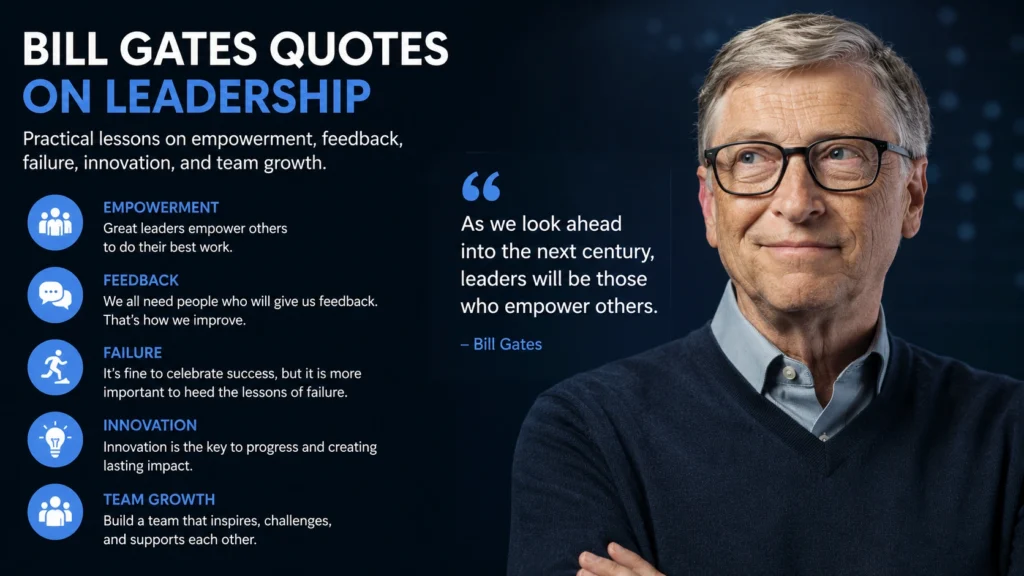
I believe the best Bill Gates quotes on leadership are useful because they do not treat leadership as a title, a speech, or a personality trait. They point toward action. When I study Gates’s words, I see a repeated pattern: empower people, listen to feedback, learn from failure, and build systems that help teams move faster. That matters because leadership today is rarely about one person having every answer. It is about creating the conditions where smart people can solve hard problems together.
Bill Gates is widely known as the co-founder of Microsoft, which he started with Paul Allen in 1975, and the Gates Foundation notes that he later transitioned to focus full time on the foundation’s work in 2008. His leadership journey has included technology, business, philanthropy, education, health, and climate-related work, so his quotes are often interpreted through many different lenses. In my view, the most valuable approach is not to worship the quotes, but to test them against everyday leadership challenges.
Key Takeaways From Bill Gates Quotes on Leadership
The strongest lesson I take from Bill Gates quotes on leadership is that leadership should make other people stronger. A manager who controls every decision may look powerful in the short term, but a leader who builds judgment, confidence, and ownership in others creates a stronger organization.
Another key takeaway is that feedback is not an insult. Gates has repeatedly emphasized the value of feedback in business and education contexts. On Gates Notes, he wrote about giving teachers the feedback they deserve so they can improve their practice. That same idea applies to teams, founders, managers, students, and professionals.
I also believe Gates’s quotes show that success can become dangerous when it creates overconfidence. Leaders need ambition, but they also need humility. When a team starts believing it cannot lose, it may stop listening, stop measuring, and stop improving.
What Bill Gates Quotes Reveal About Leadership
At the center of many Bill Gates leadership lessons is the idea that information should move quickly to the people who can act on it. That may sound simple, but many organizations still hide bad news, punish dissent, or reward leaders who look confident even when they are disconnected from reality.
One of the most cited Bill Gates quotes on leadership is:
“As we look ahead into the next century, leaders will be those who empower others.”
Bill Gates, as quoted by Inc.
This quote matters because it shifts leadership away from control and toward enablement. In my analysis, Gates is not saying leaders should abandon standards. He is saying leaders should create the tools, trust, clarity, and responsibility that allow other people to contribute at a higher level.
A practical example is a product team working under a strict founder. If the founder reviews every small decision, the team may move slowly and avoid ownership. If the founder defines the customer problem clearly, sets quality expectations, and gives the team room to test solutions, the team can learn faster. That is empowerment in action.
The Leadership Context Behind Bill Gates’s Career
I do not think we can understand Bill Gates quotes on leadership without remembering the environment that shaped them. Microsoft grew during a period when personal computing changed how people worked, learned, and communicated. Gates wrote in 2025 that he and Paul Allen created Microsoft in 1975 because they believed in the vision of a computer on every desk and in every home.
That kind of vision required more than technical skill. It required hiring talented people, making strategic decisions, responding to competition, and building products that could scale. We can debate many aspects of Gates’s leadership style, but his quotes often point toward a practical belief: information, talent, and speed matter.
From my perspective, this is why his leadership quotes remain popular. They are not limited to software companies. A school principal, startup founder, hospital administrator, nonprofit director, or team lead can all apply the same ideas. Leadership improves when people receive useful feedback, when customers are heard, and when teams are trusted to solve real problems.
Bill Gates Quotes on Leadership and Empowering Others
Empowerment is one of the clearest themes in Gates’s leadership philosophy. I believe empowerment has three parts: giving people responsibility, giving them information, and giving them the authority to act. Without all three, empowerment becomes a slogan.
For example, imagine a customer support manager who tells agents, “You are empowered to solve customer problems,” but requires approval for every refund, replacement, or escalation. That is not real empowerment. The team has responsibility without authority. A better leader would define clear boundaries, train agents well, and let them make decisions within those boundaries.
The Gates quote about empowering others also reminds us that modern leadership is distributed. One person cannot understand every customer complaint, technical issue, operational bottleneck, and market signal. We need people closer to the work to notice what is changing and speak up quickly.
In my view, empowering others also requires emotional discipline. A leader must resist the urge to be the smartest voice in every meeting. Sometimes the strongest leadership move is asking, “What are you seeing that I am missing?” That question gives other people permission to think, challenge, and contribute.
Learning From Unhappy Customers
One of Gates’s most useful business quotes is directly tied to leadership because it teaches leaders how to handle uncomfortable truth:
“Your most unhappy customers are your greatest source of learning.”
Bill Gates, Business @ the Speed of Thought
A Business @ the Speed of Thought excerpt lists this as a business lesson in a chapter about converting bad news into good. I find this quote powerful because it challenges the natural human instinct to defend ourselves. When customers complain, many leaders look for excuses. Gates’s quote pushes us to look for information.
In a realistic scenario, a small software company may receive repeated complaints about confusing onboarding. A weak leader may say, “Users are not reading the instructions.” A stronger leader asks, “Why does the product need so much explanation?” That shift turns criticism into design improvement.
This lesson applies outside business too. A teacher can learn from confused students. A nonprofit can learn from community members who say a program does not meet their needs. A manager can learn from employees who feel meetings are wasting time. The complaint is not always fully correct, but it often reveals something worth investigating.
Why Failure Can Be a Better Teacher Than Success
Gates is also often quoted on the danger of success:
“Success is a lousy teacher. It seduces smart people into thinking they can’t lose.”
Bill Gates, attributed to The Road Ahead
This quotation is cited by Tech Monitor as coming from The Road Ahead. I believe its leadership value is simple: winning can make teams careless. When results are good, leaders may stop asking hard questions. They may assume the strategy is perfect, the market will stay friendly, or competitors are too weak to matter.
A practical example is a company with a best-selling product. Sales are strong, so the leadership team ignores customer complaints about outdated features. A new competitor enters with a simpler, faster, cheaper alternative. By the time the original company reacts, customer loyalty has weakened. Success did not protect the company. It made the company slow.
In my view, the lesson is not to fear success. Leaders should celebrate progress. But celebration should not replace learning. A healthy team asks after every win, “What worked, what did not work, and what could fail next time?”
Table: Bill Gates Leadership Quotes and Practical Lessons
The table below connects several leadership themes commonly associated with Bill Gates to practical behavior. I use it as a simple way to move from inspiration to action.
| Leadership Theme | Related Gates Quote or Idea | Practical Meaning | Example Action |
|---|---|---|---|
| Empowerment | Leaders empower others | Leadership grows when people are trusted to act | Give team members decision rights within clear limits |
| Customer learning | Unhappy customers reveal learning opportunities | Complaints can expose weak systems | Review complaints weekly and assign fixes |
| Humility after success | Success can mislead smart people | Good results can create blind spots | Run post-success reviews, not only post-failure reviews |
| Feedback culture | People improve through useful feedback | Feedback should be specific and trusted | Create regular coaching conversations |
| Speed of information | Bad news should reach decision-makers quickly | Leaders should not hide problems | Build direct reporting channels for risks |
| Long-term thinking | Innovation requires future-focused judgment | Leaders should prepare before change is obvious | Invest in skills and tools before a crisis |
The most important takeaway is that a quote only becomes useful when it changes behavior. I do not see these quotes as motivational decorations. I see them as prompts for better leadership systems.
How Leaders Can Apply Bill Gates Quotes Step by Step
A leader who wants to apply these lessons should start with feedback. I would begin by asking the team three questions: What is slowing us down? What customer problem are we ignoring? What decision should be made closer to the work?
The second step is to separate criticism from blame. When people fear punishment, they hide problems. Leaders need to make it safe to raise issues early. That does not mean lowering standards. It means treating bad news as data before treating it as failure.
The third step is to give people real ownership. A leader can say, “You own the onboarding improvement project. Here is the goal, here are the constraints, and here is when we will review progress.” That is clearer than simply saying, “Be more proactive.”
The fourth step is to measure learning. If customers complain about delivery delays, track the most common causes. If employees say meetings are ineffective, measure meeting time and decision outcomes. In my view, leadership becomes stronger when opinions are tested against evidence.
The fifth step is to review success carefully. After a strong quarter, product launch, campaign, or school term, ask what could break next. This protects the team from overconfidence.
Common Mistakes When Using Bill Gates Quotes on Leadership
One common mistake is using quotes as decoration rather than guidance. A poster on the wall that says “empower others” means very little if the leader still controls every decision.
Another mistake is confusing empowerment with lack of accountability. I do not believe Gates’s empowerment idea means leaders should step back completely. Good empowerment includes clear goals, strong standards, and honest measurement.
A third mistake is treating customer complaints as attacks. When leaders personalize criticism, they become defensive. When they examine criticism, they become better. The difference is maturity.
A fourth mistake is copying Gates without context. Bill Gates led in specific industries, time periods, and organizational environments. We should not assume every Gates habit fits every workplace. The better approach is to extract principles: learn fast, listen carefully, empower talented people, and keep improving.
Expert Recommendations for Leaders
My strongest recommendation is to build feedback into the rhythm of work. Do not wait for an annual review, a crisis, or a lost customer. Ask for feedback before problems become expensive.
Second, I recommend using customer dissatisfaction as a structured learning source. A monthly complaint review can reveal patterns that leadership meetings miss. The goal is not to obsess over every negative comment. The goal is to identify repeated friction.
Third, leaders should create a clear decision map. Who can decide what? Which decisions need approval? Which decisions should be escalated? Without clarity, empowerment becomes confusion.
Fourth, I recommend conducting “success reviews.” Many teams review failed projects, but fewer review successful ones with the same seriousness. A success review asks why something worked and whether the same conditions will exist next time.
Finally, leaders should model learning publicly. When a leader says, “I was wrong about this,” the team learns that truth matters more than ego. From my perspective, that is one of the quiet foundations of strong leadership.
Table: From Leadership Quote to Daily Leadership Habit
This table turns the quote-based lessons into daily habits that leaders can use in meetings, customer reviews, and team development.
| Leadership Situation | Weak Reaction | Stronger Leadership Habit | Expected Outcome |
| A team member brings bad news | Defend the current plan | Ask what the data shows and what support is needed | Faster problem-solving |
| A customer complains | Explain why the customer is wrong | Look for the process failure behind the complaint | Better product or service quality |
| A project succeeds | Move on immediately | Review what worked and what risks remain | Less overconfidence |
| A junior employee has an idea | Dismiss it due to inexperience | Ask for reasoning and evidence | More ownership and creativity |
| A team keeps missing deadlines | Blame motivation | Examine workload, unclear priorities, and bottlenecks | More accurate planning |
| A leader feels overloaded | Work harder alone | Delegate decisions with clear boundaries | Stronger team capacity |
The main point is that leadership habits must be visible. People believe what leaders repeatedly do, not what leaders occasionally quote.
Why Feedback Is Central to Gates’s Leadership Lessons
Feedback appears repeatedly in Gates’s public writing, especially in education. On Gates Notes, he wrote that he spoke in a TED session about giving teachers the feedback they deserve so they can improve their practice. The Gates Foundation’s 2013 Annual Letter also discusses teacher feedback systems that are funded, high-quality, and trusted by teachers.
I think this matters beyond education because feedback is the engine of improvement. Without feedback, leaders guess. With feedback, leaders can compare intentions with results.
A sales leader may intend to motivate the team, but feedback may show that the team experiences constant pressure without clear priorities. A school leader may intend to support teachers, but feedback may show that teachers need practical coaching, not generic training. A founder may intend to build a simple product, but feedback may show that users are confused during setup.
In each case, feedback closes the gap between what the leader believes is happening and what people are actually experiencing.
How Bill Gates Quotes Apply to New Managers
New managers often think leadership means proving themselves. I understand that instinct, but Gates’s quotes point in a different direction. A new manager should not try to look powerful. A new manager should try to make the team more capable.
A practical first step is to meet each team member and ask what helps them do their best work. The second step is to clarify expectations. The third step is to remove one recurring obstacle. These actions may seem simple, but they communicate trust and seriousness.
For example, if a new manager discovers that designers are waiting too long for approvals, the manager can create a faster review process. That is empowerment. If the manager discovers customers keep asking the same support question, the manager can improve documentation. That is learning from unhappy customers.
In my view, new managers should use Bill Gates quotes on leadership as reminders to focus less on status and more on systems.
How Bill Gates Quotes Apply to Entrepreneurs
Entrepreneurs can learn a lot from Gates’s emphasis on feedback and customer dissatisfaction. A founder may love an idea, but customers decide whether the idea solves a real problem. The sooner a founder listens to unhappy users, the sooner the business can improve.
A hypothetical example helps. Imagine a founder launches a scheduling app for small clinics. Early users complain that the app is visually clean but does not handle last-minute patient cancellations well. The founder could defend the design, or the founder could treat the complaint as product intelligence. If the team improves cancellation workflows, the product becomes more useful.
Entrepreneurs also need Gates’s warning about success. Early traction can create false confidence. A few viral posts, strong first sales, or investor attention can make a founder believe the business is stronger than it is. The wise response is to keep learning.
How Bill Gates Quotes Apply to Team Culture
Team culture is built by repeated signals. If leaders punish bad news, people hide problems. If leaders reward learning, people surface problems earlier. Bill Gates quotes on leadership are especially useful here because they encourage leaders to value honesty over image.
A healthy team culture might include weekly customer learning reviews, open project retrospectives, and clear channels for raising risks. None of these habits require a huge budget. They require consistency.
I believe the best cultures do not pretend everything is perfect. They create disciplined ways to improve what is imperfect. This is where Gates’s thinking feels especially practical. Leadership is not just inspiration. It is the design of better feedback loops.
The Limits of Bill Gates Quotes on Leadership
It is also important to be careful. Quotes are short. Leadership is complex. A single quote cannot explain every decision Gates made, every Microsoft strategy, or every leadership challenge a reader may face.
In my view, the right way to use quotes is to treat them as starting points. “Empower others” starts a conversation about trust, accountability, and decision rights. “Learn from unhappy customers” starts a conversation about service quality and product design. “Success is a lousy teacher” starts a conversation about humility and risk.
We should also avoid assuming that a famous person’s quote is automatically correct in every setting. Some situations require urgency and direct command. Others require collaboration and patience. The leader’s job is to apply the principle wisely.
Practical Leadership Exercises Based on Bill Gates Quotes
One useful exercise is the empowerment audit. Write down five decisions you currently make. Then ask which two could be made by someone closer to the work. Define the boundaries, communicate the goal, and let that person own the decision.
Another exercise is the unhappy customer review. Gather the last 20 customer complaints, support tickets, or negative comments. Group them by theme. Look for repeated friction rather than isolated frustration. Then choose one fix that can be completed within two weeks.
A third exercise is the success review. Choose one recent win. Ask what conditions made it possible, which parts were repeatable, and which risks were hidden by the good result. This protects the team from becoming careless.
A fourth exercise is the feedback question. In the next one-on-one meeting, ask, “What is one thing I could do differently to help you work better?” Then listen without defending yourself. I have found that this kind of question can reveal issues that formal reports miss.
Conclusion
The central lesson I take from Bill Gates quotes on leadership is that strong leaders create stronger people and smarter systems. Gates’s best-known leadership ideas point toward empowerment, feedback, humility, and learning from uncomfortable information. These are not abstract values. They show up in how a leader handles complaints, delegates decisions, reviews success, and responds when someone brings bad news.
In my view, the practical value of these quotes is not in repeating them, but in applying them. A leader can start by giving one person clearer ownership, reviewing one pattern of customer dissatisfaction, or asking for one piece of honest feedback. Those small actions build a culture where learning becomes normal.
Bill Gates quotes on leadership remind us that the future belongs less to leaders who control everything and more to leaders who help others think, act, and improve. The next action is simple: choose one quote, turn it into one leadership habit, and practice it consistently this week.
Frequently Asked Questions
What Are the Best Bill Gates Quotes on Leadership?
The best Bill Gates quotes on leadership are the ones that focus on empowerment, feedback, learning, and humility. The most direct leadership quote is, “As we look ahead into the next century, leaders will be those who empower others.” I also think “Your most unhappy customers are your greatest source of learning” is highly relevant because it teaches leaders to listen instead of defend. These quotes are useful because they can be converted into daily leadership behaviors.
What Does Bill Gates Mean by Empowering Others?
Bill Gates’s quote about empowering others means that leadership should help people contribute at a higher level. In practical terms, that includes giving people information, tools, responsibility, and decision-making authority. I do not interpret empowerment as letting everyone do anything they want. Real empowerment works best when goals are clear, standards are strong, and people understand where they have freedom to act.
How Can Managers Use Bill Gates Quotes on Leadership at Work?
Managers can use Bill Gates quotes on leadership by turning each quote into a repeatable habit. For example, the quote about unhappy customers can become a weekly review of complaints and product issues. The quote about empowerment can become a decision-rights exercise where managers identify tasks they should delegate. The quote about success can become a post-win review that prevents overconfidence.
Why Is Customer Feedback Important in Bill Gates’s Leadership Thinking?
Customer feedback is important because it shows leaders where reality differs from intention. A company may believe its product is simple, but unhappy customers may reveal confusion. A manager may believe a process is efficient, but employee feedback may show delays and duplicated work. Gates’s quote about unhappy customers teaches leaders to treat complaints as learning signals, not personal attacks.
Are Bill Gates Quotes Enough to Become a Better Leader?
No, Bill Gates quotes are not enough by themselves. They can inspire better thinking, but leadership improves through practice, feedback, and consistent behavior. I see the quotes as prompts. They help leaders ask better questions, such as who needs more ownership, which complaints reveal real problems, and where success may be hiding risk. The improvement happens when those questions lead to action.
Sources and References
Bill Gates profile, Gates Foundation: Used for background on Gates co-founding Microsoft with Paul Allen in 1975 and transitioning to full-time foundation work in 2008.
Gates Notes, “Celebrating 50 years of Microsoft”: Used for Gates’s own reflection on creating Microsoft in 1975 and the original vision of a computer on every desk and in every home.
Inc., “For Bill Gates, 2 Traits Separate Great Leaders From Everyone Else”: Used for the leadership quote about empowering others.
Business @ the Speed of Thought excerpt: Used for the quote about unhappy customers and learning.
Tech Monitor, “13 Bill Gates quotes on business, success and ambition”: Used for attribution of the quote about success being a lousy teacher.
Gates Notes, “My TED Talk: Giving Teachers What They Deserve”: Used for Gates’s discussion of feedback and improvement in education.
Gates Foundation 2013 Annual Letter: Used for Gates Foundation context on feedback systems and education improvement.
Disclaimer
This article is for general informational and educational purposes only. I have used publicly available sources to verify the quotations and background details included here, but leadership advice should always be adapted to the specific team, organization, industry, and situation. The interpretations in this article are editorial analysis, not official statements from Bill Gates, Microsoft, Gates Notes, or the Gates Foundation.