
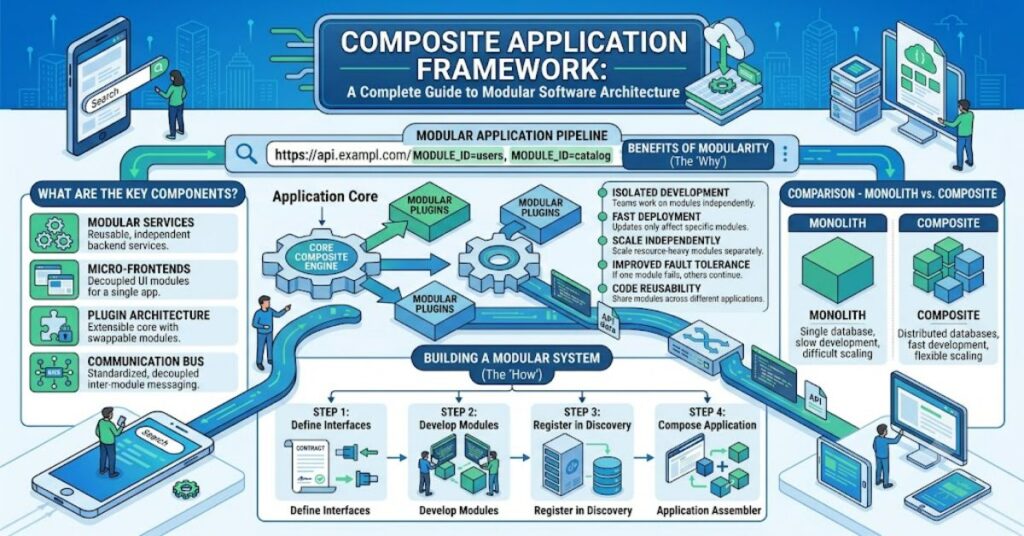
A Composite Application Framework is a software architecture designed to assemble multiple independent applications, microservices, and shared components into a single, cohesive solution. Instead of building every feature from scratch, developers reuse modular services that communicate through standardized interfaces. This approach significantly reduces development time while improving scalability and long-term maintainability.
Modern businesses rely on dozens of applications for customer management, finance, analytics, communication, and operations. Without a structured framework, integrating these systems becomes increasingly complex. A Composite Application Framework addresses this challenge by providing a common architecture where separate modules work together while remaining independently deployable.
Cloud computing, containerization, and API-driven development have accelerated the adoption of composite architectures across industries. Organizations now expect software platforms to evolve rapidly without disrupting existing services. CAF enables this flexibility by allowing developers to replace, upgrade, or expand individual modules without rebuilding the entire application.
Whether developing enterprise resource planning systems, healthcare platforms, financial applications, or e-commerce solutions, Composite Application Frameworks provide the architectural foundation needed to build scalable, resilient software ecosystems.
What Is a Composite Application Framework?
A Composite Application Framework is a modular software architecture that integrates independent components into a unified application.
Rather than developing one large monolithic system, developers assemble reusable building blocks such as:
- Microservices
- APIs
- Shared user interface components
- Authentication services
- Databases
- Third-party integrations
Each component performs a specific function while communicating with others through standardized protocols.
Core Components
Most Composite Application Frameworks contain several essential architectural elements.
| Component | Purpose |
| User Interface Layer | Presents a unified experience to users |
| Business Services | Executes application logic |
| APIs | Connect independent systems |
| Data Layer | Stores and retrieves information |
| Authentication | Controls secure user access |
| Integration Layer | Connects external applications |
These components remain loosely coupled, allowing updates without affecting the entire platform.
How a Composite Application Framework Works
Instead of relying on a single codebase, CAF distributes responsibilities across specialized modules.
A typical workflow includes:
- User submits a request.
- API gateway receives the request.
- Required microservices process individual tasks.
- Shared data services retrieve information.
- The framework combines responses.
- A unified interface displays the final result.
Because services remain independent, developers can update one module without disrupting the rest of the application.
Key Benefits
Organizations adopt Composite Application Frameworks for several practical reasons.
| Benefit | Business Value |
| Faster development | Reusable components reduce coding time |
| Scalability | Individual modules scale independently |
| Easier maintenance | Updates affect only specific services |
| Flexibility | New features integrate quickly |
| Improved reliability | Component failures remain isolated |
| Better collaboration | Teams work on separate modules simultaneously |
These advantages make CAF especially attractive for enterprise software projects.
Composite Framework vs Monolithic Architecture
Choosing the right architecture depends on business requirements.
| Feature | Composite Application Framework | Monolithic Application |
| Deployment | Independent services | Single deployment |
| Scalability | Module-based | Entire application |
| Maintenance | Easier | More complex over time |
| Development Speed | Faster with reusable modules | Slower for large systems |
| Fault Isolation | High | Lower |

While monolithic systems remain suitable for smaller projects, composite architectures provide greater flexibility for growing organizations.
Real-World Applications
Composite Application Frameworks are widely used across industries.
Common implementations include:
- Enterprise Resource Planning (ERP)
- Customer Relationship Management (CRM)
- Banking platforms
- Healthcare management systems
- E-commerce marketplaces
- Government digital services
For example, an online retailer may combine separate inventory, payment, shipping, recommendation, and customer support services into one seamless shopping experience.
Challenges and Considerations
Despite its advantages, implementing a Composite Application Framework requires careful planning.
Potential challenges include:
- Increased architectural complexity
- API management overhead
- Service communication latency
- Security across multiple services
- Monitoring distributed systems
- Data consistency between components
Organizations should establish strong governance, standardized APIs, and automated monitoring before adopting a composite architecture.
Best Practices
Successful implementations typically follow these principles:
- Design reusable services.
- Keep modules loosely coupled.
- Use API-first development.
- Implement centralized authentication.
- Automate deployment using CI/CD pipelines.
- Monitor service health continuously.
- Maintain comprehensive documentation.
Following these practices improves long-term scalability and operational efficiency.
The Future of Composite Application Framework in 2027
By 2027, Composite Application Frameworks are expected to become even more important as organizations accelerate cloud-native development and AI-powered applications. Microservices, Kubernetes orchestration, serverless computing, and event-driven architectures will continue driving modular software design.
Low-code and no-code development platforms are also likely to integrate more deeply with composite architectures, allowing business users to assemble applications using reusable services. Meanwhile, advances in observability, API management, and security automation will simplify managing increasingly distributed systems.
Although monolithic applications will continue serving some use cases, enterprise software development is expected to rely increasingly on modular, composable architectures.
Key Takeaways
- Composite Application Frameworks assemble independent services into one unified platform.
- Modular architecture accelerates software development.
- Independent deployment improves scalability and maintenance.
- APIs and microservices form the foundation of modern composite systems.
- Strong governance and monitoring are essential for successful implementation.
- Cloud-native technologies continue driving CAF adoption.
Conclusion
A Composite Application Framework offers a practical solution for organizations building scalable, maintainable, and flexible software systems. Rather than creating large monolithic applications, developers assemble reusable services that work together while remaining independently deployable. This modular approach improves development speed, simplifies maintenance, and enables businesses to respond more quickly to changing requirements.
Although implementing CAF introduces architectural complexity, the long-term benefits often outweigh the initial investment. Better scalability, improved fault isolation, and easier integration make composite frameworks particularly valuable for enterprise environments managing numerous interconnected applications.
As cloud technologies and API ecosystems continue evolving, Composite Application Frameworks will remain a foundational architectural pattern for modern software engineering.
Frequently Asked Questions
What is a Composite Application Framework?
A Composite Application Framework is a software architecture that combines independent applications, services, and components into a unified platform.
How does a Composite Application Framework differ from a monolithic application?
Monolithic applications contain all functionality in one codebase, while composite frameworks separate functionality into reusable modules that communicate through APIs.
Why do enterprises use Composite Application Frameworks?
They improve scalability, reduce development time, simplify maintenance, and support rapid feature deployment.
Does a Composite Application Framework require microservices?
No. Although many implementations use microservices, CAF can also integrate existing applications, APIs, and legacy systems.
What industries benefit most from Composite Application Frameworks?
Banking, healthcare, retail, manufacturing, government, telecommunications, and enterprise software providers commonly use this architecture.
Methodology
This article was developed by reviewing software architecture documentation, cloud computing resources, microservices design principles, enterprise application integration guides, and official technical publications. Information was cross-verified using authoritative documentation and industry best practices to ensure technical accuracy and balanced analysis.
References
- Microsoft Learn. (2024). Microservices architecture on Azure.
- IBM. (2024). Microservices Architecture.
- Red Hat. (2024). What Are Microservices?
- Martin Fowler. (2023). Microservices Resource Guide.
- OpenAPI Initiative. (2024). OpenAPI Specification.
AI Disclosure
This article was drafted with AI assistance and should be reviewed and verified by [Author Name] before publication. All architectural guidance, technical examples, and references should be independently validated by the editorial team at Matrics360.com before publishing.