
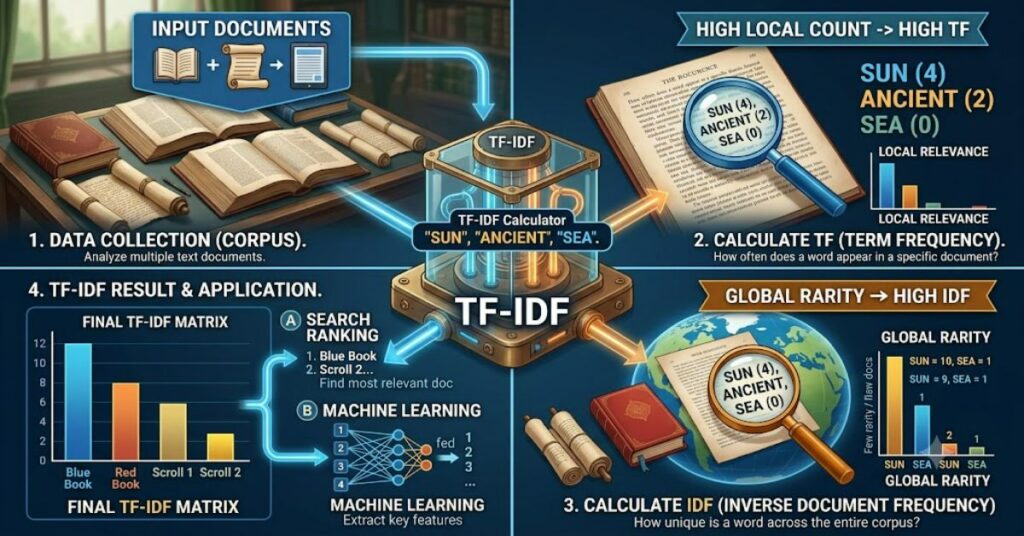
TF-IDF (Term Frequency-Inverse Document Frequency) is a statistical weighting technique used in natural language processing (NLP) and information retrieval. Instead of simply counting how often a word appears, it determines whether that word is genuinely meaningful within a document when compared with an entire collection of documents, known as a corpus.
Words like “the,” “and,” or “is” appear frequently across nearly every document, making them poor indicators of a document’s topic. TF-IDF reduces the importance of these common words while increasing the weight of unique, topic-specific terms.
Despite rapid advances in artificial intelligence and deep learning, TF-IDF remains one of the most practical feature engineering techniques in machine learning. Search engines, recommendation systems, document clustering, spam filtering, and text classification have all benefited from this approach.
This article explains how TF-IDF works, where it excels, where it falls short, and why it still matters in 2026.
What Is TF-IDF?
TF-IDF combines two statistical measures:
- Term Frequency (TF): How often a word appears in a document.
- Inverse Document Frequency (IDF): How rare that word is across the entire document collection.
The combination rewards words that occur frequently in one document but infrequently across many others.
The basic formula is:
TF-IDF = TF × IDF
where
IDF = log(Total Documents ÷ Documents Containing the Term)
A higher score indicates greater importance within that document.
How TF-IDF Works
Imagine three documents about different programming languages.
| Document | Common Terms | Unique Terms |
| Python Guide | programming, code | pandas, NumPy |
| Java Tutorial | programming, code | JVM, bytecode |
| SQL Basics | database, query | joins, indexing |
Words like “programming” appear everywhere, so they receive lower scores.
Words such as “NumPy,” “JVM,” or “indexing” appear in fewer documents, making them more valuable for distinguishing content.
This weighting makes TF-IDF especially useful for keyword extraction and document similarity.
Real-World Applications
TF-IDF continues to power numerous practical systems.
Search Engines
Search engines compare query terms with indexed documents and prioritize pages containing highly relevant weighted keywords.
Document Classification
Machine learning models use TF-IDF vectors to classify emails, news articles, customer reviews, and support tickets.
Spam Detection
Spam filters often rely on weighted word frequencies to distinguish legitimate emails from unwanted messages.
Recommendation Systems
Content recommendation platforms compare document vectors to identify articles with similar themes.
Keyword Extraction
SEO professionals and content analysts use TF-IDF to identify meaningful terms that help describe a page’s primary topic.
Comparison with Other Text Representation Methods
| Method | Strengths | Weaknesses |
| Bag of Words | Simple implementation | Ignores importance of words |
| TF-IDF | Highlights informative terms | Ignores word order and context |
| Word2Vec | Captures semantic relationships | Requires training data |
| BERT Embeddings | Understands context and meaning | Computationally expensive |
While modern embeddings provide richer language understanding, TF-IDF remains attractive because it is transparent, fast, and easy to interpret.
Advantages
TF-IDF offers several practical benefits.
- Easy to implement
- Computationally efficient
- Works well on small datasets
- Produces interpretable features
- Requires minimal computing resources
- Integrates easily with traditional machine learning algorithms
These characteristics make it a popular baseline when building NLP systems.

Limitations and Trade-Offs
Like every statistical technique, TF-IDF has important limitations.
| Limitation | Impact |
| Ignores word order | Cannot understand sentence structure |
| No semantic understanding | Treats synonyms as unrelated |
| Context blindness | Same word always receives identical treatment |
| Sparse vectors | High-dimensional feature space |
| Vocabulary dependence | New words require recalculation |
These limitations explain why transformer models have become dominant for advanced language understanding.
However, for many practical business applications, TF-IDF remains sufficiently accurate while being dramatically faster.
Practical Example
Consider two movie reviews.
Document A:
“The acting was outstanding, emotional, and memorable.”
Document B:
“The movie was entertaining, but the acting was average.”
The word acting appears in both reviews, so its IDF score decreases.
The words outstanding, emotional, and memorable appear less frequently across documents, making them stronger indicators of Document A’s unique content.
This helps machine learning algorithms distinguish similar documents more effectively.
Original Insights
Several practical observations are often overlooked.
First, TF-IDF frequently outperforms larger language models for small classification datasets because simple statistical weighting can reduce overfitting when limited training examples are available.
Second, preprocessing has a greater influence on TF-IDF accuracy than many users realize. Removing stop words, normalizing text, and applying stemming or lemmatization can substantially improve results.
Third, TF-IDF is highly explainable. Unlike deep neural networks, every feature weight can be inspected directly, making it useful in regulated industries where model transparency matters.
The Future of TF-IDF in 2027
TF-IDF is unlikely to replace transformer architectures, but it is also unlikely to disappear.
Organizations increasingly combine traditional statistical techniques with modern embedding models to improve retrieval speed while reducing computational costs. Hybrid search systems often use TF-ID’F for initial document retrieval before applying transformer-based reranking.
As AI deployment expands, lightweight algorithms that reduce infrastructure costs will continue to have practical value. Rather than competing with large language models, TF-ID’F will increasingly complement them.
Key Takeaways
- TF-IDF measures the importance of words within a document collection.
- It balances local frequency with global rarity.
- The technique remains valuable for search, classification, and keyword extraction.
- Modern language models provide richer semantic understanding but require greater computational resources.
- TF-ID’F continues to serve as an effective baseline and component in hybrid NLP systems.
Conclusion
TF-IDF has remained relevant for decades because it solves a fundamental problem: identifying which words truly define a document. By balancing term frequency with document rarity, it produces meaningful representations that support search engines, recommendation systems, spam filters, and text classifiers.
Although deep learning has transformed natural language processing, statistical weighting methods still provide important advantages. They are fast, transparent, inexpensive to compute, and easy to interpret. For many organizations, especially those working with limited data or computing resources, TF-ID’F remains a practical solution.
Rather than viewing TF-ID’F as outdated technology, it is better understood as a foundational technique that continues to complement modern AI systems.
Frequently Asked Questions
What does TF-IDF stand for?
TF-IDF stands for Term Frequency-Inverse Document Frequency, a statistical method that measures how important a word is within a document relative to an entire collection of documents.
Why is TF-ID’F important?
It helps identify meaningful keywords while reducing the influence of common words, improving search, classification, and text analysis.
Is TF-ID’F still used today?
Yes. It remains widely used in search engines, document retrieval, machine learning pipelines, and information retrieval systems, often alongside neural language models.
What is the difference between Bag of Words and TF-ID’F?
Bag of Words counts occurrences only, while TF-ID’F adjusts those counts according to how common each word is across the corpus.
Can TF-ID’F replace modern AI models?
No. It cannot understand context or semantics like transformer models, but it remains valuable because of its speed, simplicity, and interpretability.
Methodology
This article was prepared by synthesizing established concepts from information retrieval and natural language processing. The explanation is based on foundational research, standard NLP documentation, and educational resources describing TF-ID’F and its applications. The discussion balances the strengths of TF-ID’F with the capabilities of modern transformer-based models while avoiding unsupported performance claims.’
References (APA)
Jurafsky, D., & Martin, J. H. (2025). Speech and Language Processing (3rd ed., draft). https://web.stanford.edu/~jurafsky/slp3/
Manning, C. D., Raghavan, P., & Schütze, H. (2008). Introduction to Information Retrieval. Cambridge University Press.
Pedregosa, F., et al. (2011). Scikit-learn: Machine Learning in Python. Journal of Machine Learning Research, 12, 2825–2830.
scikit-learn Developers. (2025). Feature extraction from text. https://scikit-learn.org/