
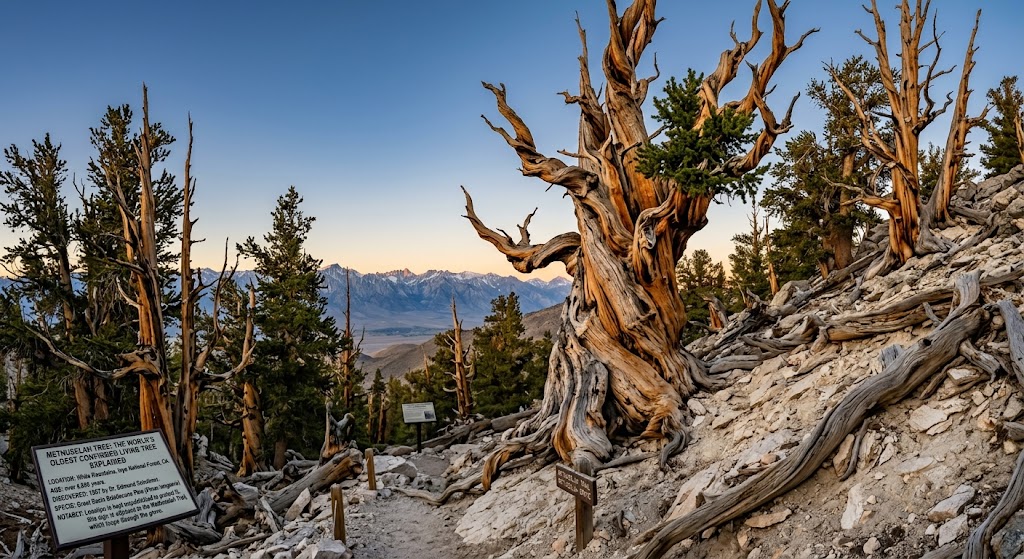
The Methuselah tree stands as one of the most extraordinary living organisms ever documented. Growing in the high elevations of California’s White Mountains, this ancient bristlecone pine has survived for nearly five millennia. It began growing around 2830 BCE, long before major civilizations such as ancient Greece or Rome emerged.
What makes Methuselah scientifically remarkable is not just its age, but the precision with which it has been verified. Through dendrochronology—the study of annual tree rings—researchers confirmed its status as the world’s oldest known non-clonal living tree.
The tree is part of a broader ecosystem of bristlecone pines that thrive in extremely harsh conditions. These conditions slow biological decay, allowing certain individuals to survive far longer than typical tree species. Methuselah has become a symbol of endurance and natural resilience, attracting global scientific interest while remaining physically protected from public access.
What Is the Methuselah Tree?
The Methuselah tree is a Great Basin bristlecone pine, one of the longest-living tree species on Earth. It grows within the Ancient Bristlecone Pine Forest at elevations above 10,000 feet (3,000 meters).
This environment appears hostile but is actually key to its survival. Low temperatures, rocky soil, and limited rainfall reduce competition and slow biological processes. These conditions allow bristlecone pines to live for thousands of years without being overtaken by faster-growing species.
Why the Methuselah Tree Lives So Long
The extreme longevity of Methuselah is the result of multiple interacting biological and environmental factors.
Slow Growth Rate
Methuselah grows at an extremely slow pace due to limited water and nutrients. This slow growth produces dense wood that resists decay and structural failure.
Harsh Climate Conditions
The cold, dry, high-altitude environment reduces the presence of insects, fungi, and bacteria that typically damage trees.
Resin-Rich Wood Structure
The tree produces natural resins that protect it from pathogens and environmental degradation.
Partial Survival Mechanism
Even when parts of the tree die, living sections continue to function, allowing survival over millennia despite physical damage.
Age and Scientific Profile
| Feature | Details |
| Scientific Name | Pinus longaeva |
| Common Name | Great Basin Bristlecone Pine |
| Estimated Age | ~4,857 years |
| Germination Period | ~2830 BCE |
| Location | White Mountains, California |
| Elevation | 10,000+ feet |
| Status | Oldest confirmed non-clonal living tree |
Scientific Verification and Discovery
Methuselah’s age was confirmed through dendrochronology, a scientific method that counts and analyzes tree rings. Each ring represents one year of growth, creating a natural timeline of environmental conditions.
Researchers collected core samples using minimally invasive techniques. These samples were cross-referenced with other bristlecone pine chronologies to confirm accuracy.
This method is considered the most reliable form of age verification for trees, far more accurate than size-based estimation methods used in earlier botanical studies.
Why the Location Is Not Public
The exact location of the Methuselah tree is intentionally kept secret by conservation authorities.
This decision was made after earlier cases where ancient trees were damaged due to tourism and vandalism. Protecting Methuselah ensures it is not exposed to:
- Bark removal or carving
- Soil compaction around roots
- Uncontrolled tourism
- Environmental disturbance
- Illegal collection of plant material
Visitors can still explore thousands of ancient bristlecone pines in the surrounding forest without risking damage to this specific tree.
Methuselah Compared to Other Ancient Trees
| Tree | Estimated Age | Location | Notes |
| Methuselah | ~4,857 years | USA (California) | Oldest confirmed non-clonal tree |
| Prometheus | ~4,900 years | USA (Nevada) | Cut down in 1964 |
| Sarv-e Abarqu | ~4,000 years | Iran | Ancient cypress tree |
| General Sherman | ~2,200 years | USA (California) | Largest tree by volume |
| Jōmon Sugi | 2,000–7,000 years (est.) | Japan | Age still debated |
Scientific Importance
Methuselah is not only a biological curiosity but also a major scientific resource.
Climate Reconstruction
Tree rings preserve detailed records of rainfall, drought cycles, and temperature fluctuations over thousands of years. Scientists use these records to study long-term climate patterns.
Ecological Adaptation
The tree demonstrates how life adapts to extreme stress environments over extended periods.
Biological Aging Research
Bristlecone pines help researchers understand how organisms slow aging and resist decay under environmental pressure.
Cultural and Historical Context
Methuselah has existed through major milestones of human civilization:
- Before the rise of ancient Egypt’s Old Kingdom
- Before the construction of Stonehenge
- Before the development of classical civilizations
- Long before modern nation-states existed
This deep historical perspective makes it a powerful symbol of continuity and natural endurance.
Risks and Conservation Challenges
Despite its resilience, Methuselah faces modern environmental threats:
- Climate change and rising temperatures
- Increased wildfire frequency
- Air pollution
- Human interference in surrounding ecosystems
- Long-term soil degradation
Conservation efforts focus on protecting the entire bristlecone pine ecosystem rather than just individual trees.
The Future of the Methuselah Tree in 2027
By 2027, scientific research on ancient trees is expected to rely more heavily on non-invasive imaging, satellite monitoring, and climate modeling tools.
These technologies will allow researchers to monitor tree health without physical disruption. However, climate change remains the most significant uncertainty. Shifting precipitation patterns and rising temperatures may gradually affect bristlecone pine ecosystems.
Long-term conservation strategies will likely prioritize ecosystem stability over tourism or access expansion.
Key Takeaways
- Methuselah is the oldest verified non-clonal living organism.
- Its survival depends on extreme environmental conditions and biological adaptation.
- Tree-ring analysis provides a detailed climate record spanning thousands of years.
- The tree’s location is protected to prevent human damage.
- It remains a key scientific resource for climate and aging research.
- Conservation now focuses on preserving entire ecosystems, not just individual trees.
Conclusion
The Methuselah tree represents one of nature’s most remarkable achievements. Surviving nearly five thousand years in a harsh mountain environment, it has quietly witnessed the rise of civilizations and the transformation of Earth’s climate.
Its significance extends far beyond age. Methuselah serves as a natural archive of climate history and a living example of biological resilience. Scientists continue to study it to better understand how life adapts and endures under extreme stress.
Protecting this tree is not just about preserving a single organism—it is about safeguarding a living record of Earth’s past. As environmental challenges grow, Methuselah stands as a reminder that resilience and time can produce extraordinary results when ecosystems are allowed to thrive undisturbed.
Frequently Asked Questions
How old is the Methuselah tree?
It is approximately 4,857 years old, dating back to around 2830 BCE.
Where is it located?
In California’s White Mountains, but its exact location is kept confidential for protection.
Why is it so long-lived?
Due to slow growth, harsh climate conditions, and resin-rich wood that resists decay.
Is it the oldest tree in the world?
It is the oldest confirmed non-clonal living tree.
What species is it?
A Great Basin bristlecone pine (Pinus longaeva).
Methodology
This article is based on peer-reviewed dendrochronology research, U.S. Forest Service documentation, and established scientific studies on bristlecone pine longevity. Data was cross-verified using published climate reconstruction research and botanical field studies. Location-sensitive information was excluded to align with conservation protocols.
References (APA)
- Ferguson, C. W. (1969). A 7,104-year annual tree-ring chronology for bristlecone pine. University of Arizona Press.
- Speer, J. H. (2010). Fundamentals of Tree-Ring Research. University of Arizona Press.
- U.S. Forest Service. (2024). Ancient Bristlecone Pine Forest. https://www.fs.usda.gov/
- National Park Service. (2024). Great Basin Bristlecone Pine. https://www.nps.gov/
- IUCN. (2024). Pinus longaeva species assessment. https://www.iucnredlist.org/