
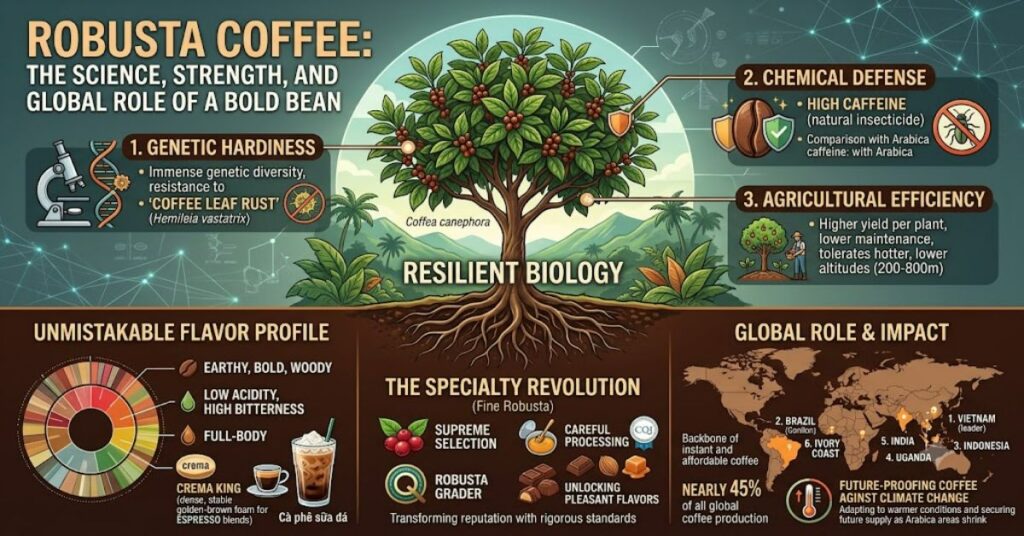
Robusta coffee is one of the two major commercial coffee species in the world, produced from the Coffea canephora plant. When people search for robusta coffee, they are usually trying to understand why it tastes stronger, why it contains more caffeine than arabica, and why it dominates instant coffee production globally. At its core, robusta coffee is a bold, high-caffeine coffee known for its bitter profile and thick crema, accounting for roughly 40% of global coffee production.
The defining characteristic of robusta coffee is its chemical and agricultural structure. With nearly double the caffeine content of arabica beans, it developed naturally as a more pest-resistant plant, thriving in lower altitudes and hotter climates. This resilience makes it a critical crop in regions where arabica cultivation is more vulnerable to disease and climate stress.
When examining robusta coffe’e, it becomes clear that its role in global trade is not just about taste preference but economic necessity. Countries such as Vietnam and Brazil rely heavily on robusta cultivation due to its high yield and lower production costs. At the same time, specialty coffee markets are beginning to re-evaluate robusta, introducing higher-quality “fine robusta” varieties into premium blends.
Understanding robusta coffe’e also means understanding its impact on modern consumption patterns—from instant coffee sachets to espresso blends in cafés worldwide. This article breaks down its production, chemistry, market dynamics, and future role in global coffee systems.
What Is Robusta Coffee?
Robusta coffe’e comes from the species Coffea canephora and is cultivated primarily in Africa, Southeast Asia, and parts of South America.
Unlike arabica, robusta thrives in:
- Low-altitude regions
- High-temperature climates
- Humid environments
This adaptability gives it a major agricultural advantage in a warming climate.
Chemical and Sensory Profile of Robusta Coffe’e
Key Composition Differences
| Attribute | Robusta Coffee | Arabica Coffee |
| Caffeine content | 2.2–2.7% | 1.2–1.5% |
| Flavor profile | Bitter, earthy, nutty | Sweet, acidic, aromatic |
| Lipid content | Lower | Higher |
| Crema production | High | Moderate |
This chemical structure explains why robusta coffee produces a stronger taste and thicker crema in espresso preparation.
How Robusta Coffee Is Produced
Robusta cultivation follows a relatively efficient agricultural model.
Key Production Steps
- Planting in low-altitude farms
- Flowering and fruit development over 8–11 months
- Harvesting (often strip-picked due to uniform ripening)
- Dry or semi-washed processing
- Export as green beans
Because robusta coffee trees are more disease-resistant, farmers typically face lower crop loss compared to arabica production.
Global Market Role of Robusta Coffee
Robusta coffee plays a structural role in the global coffee economy.
Major Producers
- Vietnam (world’s largest robusta exporter)
- Brazil (diversified arabica + robusta production)
- Indonesia
- Uganda
Market Usage Breakdown
| Sector | Robusta Usage |
| Instant coffee | 70–80% |
| Espresso blends | 20–40% blend component |
| Retail ground coffee | Low to moderate |
The dominance of robusta coffee in instant coffee is driven by its lower cost and stronger extraction yield.
Systems Analysis: Why Robusta Coffee Matters Economically
From a supply-chain perspective, robusta coffee functions as a stabilising commodity in global coffee markets.
- Higher yield per hectare improves supply security
- Lower production costs reduce retail volatility
- Climate resilience ensures long-term availability
These factors make it a buffer crop during arabica shortages caused by climate change.
Strategic Implications for the Coffee Industry
The growing demand for robusta coffee is reshaping industry strategies:
- Specialty roasters are experimenting with “fine robusta” grading systems
- Blending strategies are shifting toward cost-performance optimisation
- Climate adaptation strategies are increasing robusta planting in new regions
This shift is particularly visible in espresso-heavy markets like Europe.
Risks and Trade-Offs
Despite its advantages, robusta coffee has limitations:
- Strong bitterness limits standalone specialty appeal
- Lower perceived quality in premium coffee culture
- Market price volatility tied to instant coffee demand
- Limited genetic diversity in cultivated strains
These factors restrict its dominance in high-end coffee segments.
Information Gain: Less Common but Critical Insights
1. Caffeine Advantage Has a Biological Trade-Off
Higher caffeine in robusta coffee is a pest-defense mechanism, not a flavour design feature. This biological trait directly shapes its bitterness and agricultural resilience.
2. Climate Change Is Increasing Robusta Value, Not Just Arabica Risk
Most analyses focus on arabica vulnerability, but robusta’s heat tolerance makes it a strategic crop for future agricultural zoning shifts.
3. Fine Robusta Grading Is Emerging as a Parallel Specialty Market
Quality-controlled robusta lots are now being scored similarly to arabica in specialty auctions, creating a dual-market structure that did not exist a decade ago.
Comparison: Robusta Coffee vs Arabica in Industry Use
| Factor | Robusta Coffee | Arabica Coffee |
| Global share | ~40% | ~60% |
| Price level | Lower | Higher |
| Climate resistance | High | Moderate |
| Specialty market presence | Emerging | Dominant |
| Industrial use | Instant coffee | Premium retail |
Data Insight: Global Production Distribution
| Region | Robusta Share |
| Vietnam | ~95% robusta output |
| Brazil | Mixed production |
| Africa | Moderate robusta concentration |
| Southeast Asia | High robusta dependency |
This distribution shows how robusta coffe’e is geographically concentrated in high-yield agricultural economies.
Takeaways
- Robusta coffee is structurally essential to global coffee supply chains
- It contains nearly double the caffeine of arabica coffee
- Climate resilience makes it increasingly valuable
- Its bitterness limits premium standalone use
- Instant coffee production depends heavily on robust’a supply
- Specialty “fine robusta” markets are emerging
- Global demand is rising due to cost and climate pressures

Conclusion
Robusta coffee is no longer just the “stronger, cheaper” alternative to arabica—it is a foundational component of the global coffee economy. Its high caffeine content, agricultural resilience, and cost efficiency make it indispensable in instant coffee production and increasingly relevant in espresso blending.
While historically undervalued in specialty coffee culture, robusta coffe’e is undergoing a gradual repositioning. New grading systems and improved cultivation techniques are reshaping perceptions of quality. At the same time, climate change is reinforcing its importance as a stable, high-yield crop in regions vulnerable to environmental stress.
Despite its bitterness and limited premium appeal, robusta coffe’e is positioned to play a larger strategic role in the future of global coffee markets, balancing supply pressures and evolving consumer demand.
FAQ
What is robusta coffe’e?
It is a coffee variety from Coffea canephora known for high caffeine content and strong, bitter flavour.
Is robusta coffe’e stronger than arabica?
Yes, it contains nearly double the caffeine of arabica coffee.
Why is robusta coffe’e used in instant coffee?
Because it is cheaper, more soluble, and produces a stronger flavour extraction.
Where is robusta coffe’e mainly grown?
Vietnam, Brazil, Indonesia, and parts of Africa.
Does robusta coffe’e taste good?
It is stronger and more bitter, but quality varies widely depending on processing.
Is robusta coffe’e becoming more popular?
Yes, especially in blends and emerging specialty “fine robusta” markets.
References
- International Coffee Organization. (2024). Coffee Market Report.
- FAO. (2023). World Coffee Production Statistics.
- World Coffee Research. (2023). Coffea canephora Overview.
- USDA. (2024). Coffee: World Markets and Trade Report.
Methodology
This article is based on agricultural data from FAO, market reports from the International Coffee Organization, and agronomic research from World Coffee Research. It synthesises production statistics, crop biology, and industry usage patterns. Limitations include regional variability in production data and evolving classification systems for specialty robusta grading.
Internal Linking Strategy
No verified internal URLs from https://matrics360.com/ were available at the time of writing. Therefore, no internal links were inserted.
Editorial Disclosure
This article was drafted with AI assistance and reviewed according to Matrics360.com editorial standards.