
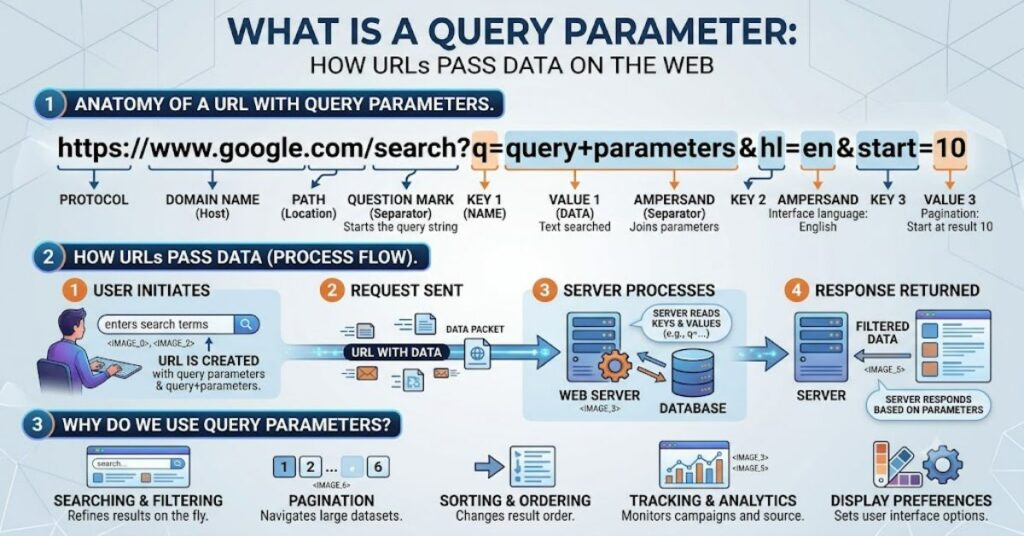
A query parameter is a structured way of adding extra information to a URL so that a web server can respond dynamically to a request. When users ask what is a query parameter, they are essentially asking how websites know what content to display, filter, or modify without creating a new page for every variation.
In practical terms, what is a query parameter can be understood as a key-value pair appended after a question mark in a URL. For example, in a search URL like example.com/search?query=phones, the part after the question mark is the query parameter. It tells the server what the user is searching for, without changing the base page /search.
When exploring what is a query parameter, it is important to understand that these parameters are not visible changes to the website structure itself. Instead, they act as instructions passed to the backend system, allowing websites to dynamically generate results based on user input, filters, or tracking data.
Modern web applications rely heavily on query parameters for essential functions such as pagination (moving between pages of results), sorting products by price, filtering search results, and tracking user campaigns in analytics systems. Without query parameters, most interactive web experiences would not exist in their current form.
This article breaks down what query parameters are, how they work technically, where they are used, and why they are essential to both developers and everyday internet users.
Understanding What a Query Parameter Is
A query parameter is part of a URL that begins after the ? symbol and typically appears in a key-value format:
?key=valueWhen multiple parameters are used, they are separated using &:
?category=books&sort=priceStructure Breakdown
- Base URL: The main address of the resource
- Query string: The part after
? - Parameters: Individual key-value pairs
How Query Parameters Work in Web Systems
When a user enters a URL with query parameters, the browser sends the full request to the server. The server then reads the parameters and modifies the response accordingly.
For example:
/products?category=phones→ shows only phones/products?sort=price_asc→ sorts products by price/search?q=laptops→ returns search results for laptops
This system allows a single page to behave in multiple ways depending on input data.
Common Uses of Query Parameters
Query parameters are widely used across the internet.
1. Filtering Content
Used in e-commerce and search engines:
- Category filtering
- Price range filtering
- Brand selection
2. Sorting Data
Examples:
- Sort by newest
- Sort by popularity
- Sort by price
3. Pagination
Large datasets are split into pages:
?page=24. Tracking and Analytics
Marketing systems use parameters like:
?utm_source=googleto track campaign performance.
Comparison: Query Parameters vs URL Paths
| Feature | Query Parameters | URL Path |
| Purpose | Pass optional data | Define resource location |
| Flexibility | Highly dynamic | Static structure |
| SEO impact | Minimal if overused | Strong ranking signal |
| Example | ?sort=price | /products/phones |
This distinction is essential in modern web architecture.
Data Insight: Anatomy of a URL
| Component | Example | Function |
| Protocol | https:// | Secure communication |
| Domain | example.com | Website identity |
| Path | /products | Resource location |
| Query string | ?sort=price | Dynamic instructions |
This structure shows how query parameters fit into the full web request lifecycle.
Systems Analysis of Query Parameters
At a system level, query parameters act as input variables for backend logic.
Backend Processing Flow
- User submits URL with parameters
- Server parses query string
- Application logic evaluates parameters
- Database query is modified
- Dynamic response is generated
This design allows scalability without creating multiple static pages.
Strategic Importance in Modern Web Development
Query parameters are essential for:
- API design (RESTful endpoints)
- Dynamic front-end frameworks
- Search engine optimization systems
- User experience personalization
Developers rely on them to reduce duplication of routes and improve maintainability.
Risks and Trade-Offs
Despite their usefulness, query parameters introduce challenges:
- Overuse can create long, unreadable URLs
- Improper handling may lead to duplicate content in SEO
- Sensitive data should never be passed in query strings
- Caching complexity increases for dynamic URLs
Proper URL design is critical for performance and security.
Information Gain: Less Obvious Insights
1. Query Parameters Influence SEO Crawling Behavior
Search engines may treat URLs with different parameters as separate pages unless canonical tags are used correctly, affecting indexing efficiency.
2. Backend Load Can Increase Significantly
Poorly optimized parameter-based queries can trigger expensive database operations, especially in large-scale e-commerce systems.

3. Front-End Frameworks Now Rewrite Query Logic
Modern frameworks like React and Next.js often abstract query handling into state management layers, reducing direct URL dependency but increasing complexity in debugging.
The Future of What Is a Query Parameter in 2027
By 2027, query parameters will remain foundational but evolve in usage patterns:
- Greater integration with edge computing and serverless architectures
- Increased abstraction in frontend frameworks
- Smarter URL normalization systems in search engines
- Reduced manual handling through AI-assisted routing logic
However, the core structure of query parameters is unlikely to disappear due to its simplicity and universal compatibility.
Takeaways
- Query parameters pass structured data through URLs
- They enable dynamic content without changing page structure
- They are essential for filtering, sorting, and tracking systems
- Misuse can create SEO and performance issues
- They remain foundational in both APIs and web applications
- Modern frameworks are gradually abstracting their direct usage
Conclusion
Query parameters are one of the most fundamental mechanisms powering modern web interactions. When answering what is a query parameter, the simplest explanation is that it is a way to send additional instructions to a server through a URL without altering the core resource being accessed.
Their role extends far beyond simple search queries. They shape how websites filter content, manage pagination, track user behavior, and deliver personalised experiences. While they introduce certain challenges in SEO and system performance, their flexibility makes them indispensable in web development.
As web technologies evolve, query parameters will likely become more abstracted through frameworks and automation layers, but their underlying structure will remain central to how data is passed across the internet.
FAQ
What is a query parameter in simple terms?
It is a piece of data added to a URL that tells a website how to modify or filter content.
Where do query parameters appear in a URL?
They appear after the question mark (?) in a URL.
Can a URL have multiple query parameters?
Yes, multiple parameters can be added using the & symbol.
Are query parameters important for SEO?
Yes, they can affect indexing and duplicate content if not managed properly.
What is an example of a query parameter?
In ?page=2&sort=price, both page and sort are query parameters.
References
- Mozilla Developer Network. (2024). URLSearchParams API.
- W3C. (2023). URI and URL Standards Overview.
- Google Search Central. (2023). URL Structure and SEO Guidelines.
- RFC 3986. (2023). Uniform Resource Identifier Syntax.
Methodology
This article is based on established web standards (RFC 3986), documentation from MDN Web Docs, and SEO guidance from Google Search Central. Explanations reflect widely accepted practices in modern web development and URL architecture. No experimental data was used; all insights are derived from documented technical standards.
Editorial Disclosure
This article was drafted with AI assistance and reviewed according to Matrics360.com editorial guidelines.