
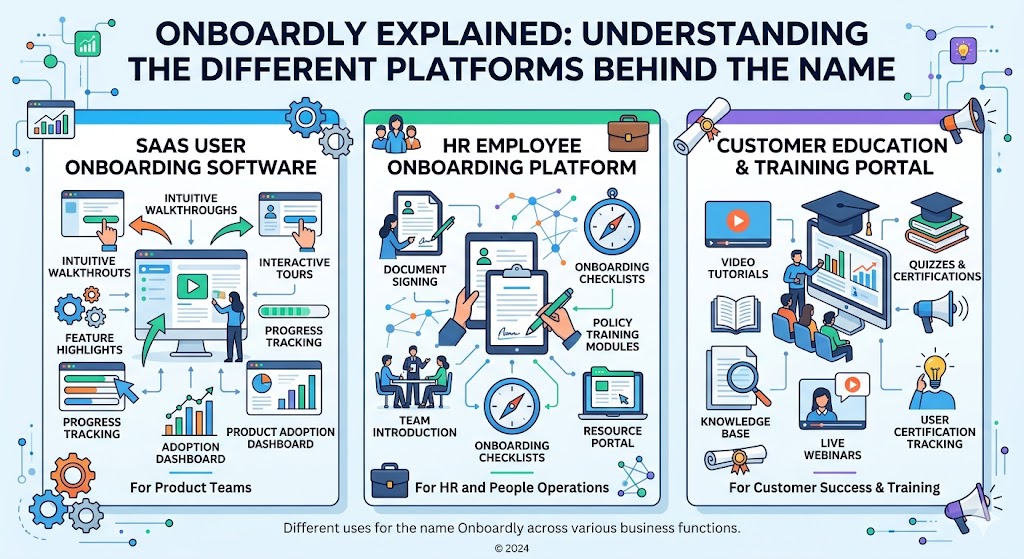
If you’ve searched for onboardly, you’ve probably discovered a surprisingly confusing situation. Unlike many software brands that represent a single platform, Onboardly has been used by multiple businesses, agencies, and software tools focused on customer onboarding, automation, human resources, and customer success.
This creates a challenge for decision-makers. A founder looking for customer acquisition support may find a completely different service than an HR manager seeking employee onboarding automation. The shared branding makes it easy to assume all references point to the same company when, in reality, they often do not.
The modern software market contains thousands of SaaS products competing for attention. Similar naming conventions are increasingly common, particularly among companies operating within onboarding, workflow automation, and customer experience categories. As a result, understanding the specific Onboardly platform being referenced becomes essential before evaluating features, pricing, integrations, or long-term suitability.
This article examines the various meanings associated with the term, explores common use cases, analyses strategic considerations, and highlights the risks businesses should consider when evaluating onboarding-focused technology solutions.
What Does Onboardly Actually Mean?
The term generally appears in three primary contexts:
- Customer onboarding software
- Employee onboarding and HR automation tools
- Marketing and growth consulting agencies
While these categories share similar objectives—helping users successfully adopt a process or product—their operational functions differ substantially.
A customer success platform focuses on user adoption, retention, and lifecycle management.
An HR onboarding platform manages employee workflows, compliance documents, training programmes, and organisational integration.
A consulting agency provides strategic services rather than software.
This distinction often gets overlooked during initial research.
Why Onboarding Has Become a Strategic Priority
The rise of SaaS business models has dramatically increased the importance of onboarding.
Customer acquisition costs continue to rise across digital channels. Retaining users after acquisition has become equally important as attracting them.
Poor onboarding frequently leads to:
- Higher churn rates
- Lower product adoption
- Reduced customer lifetime value
- Increased support costs
- Lower customer satisfaction
For employees, ineffective onboarding can result in:
- Longer time-to-productivity
- Reduced engagement
- Higher turnover
- Compliance risks
- Training inefficiencies
Businesses increasingly view onboarding as a revenue protection function rather than merely an administrative process.
Comparing Common Onboardly Use Cases
| Use Case | Primary Goal | Key Users | Success Metric |
| Customer Success | Product adoption | SaaS companies | Retention rate |
| HR Onboarding | Employee integration | HR departments | Time-to-productivity |
| Workflow Automation | Process efficiency | Operations teams | Task completion |
| Agency Services | Growth support | Start-ups | Revenue growth |
| Training Platforms | Knowledge transfer | Learning teams | Course completion |
This comparison highlights why understanding the specific platform behind the name matters.
Key Features Businesses Should Evaluate
Regardless of the particular solution, several features deserve attention.
Workflow Automation
Modern onboarding systems automate repetitive administrative tasks.
Examples include:
- Document collection
- Account provisioning
- Task assignment
- Progress tracking
- Notification management
Automation reduces manual workload while improving consistency.
Integration Capabilities
Software rarely operates independently.
Strong onboarding systems typically integrate with:
- CRM platforms
- HR information systems
- Communication tools
- Project management software
- Analytics dashboards
Integration quality often determines long-term adoption success.
Analytics and Reporting
Effective onboarding requires measurable outcomes.
Useful metrics include:
| Metric | Business Value |
| Completion Rate | Tracks adoption |
| Time to Activation | Measures efficiency |
| User Retention | Indicates onboarding quality |
| Employee Productivity | Assesses workforce readiness |
| Support Ticket Volume | Reveals friction points |
Without reporting capabilities, optimisation becomes difficult.
Strategic Benefits of Onboarding Platforms
Improved User Experience
A structured onboarding journey reduces confusion and accelerates adoption.
Operational Efficiency
Automation eliminates repetitive manual processes.
Better Compliance Management
HR onboarding solutions frequently assist with documentation requirements and audit readiness.
Stronger Retention
Users who understand products quickly tend to remain active longer.
Scalability
Growing organisations need repeatable onboarding processes that function consistently across larger teams.
Risks and Trade-Offs
Despite the benefits, onboarding platforms introduce several challenges.
Over-Automation
Automation can remove valuable human interaction.

Customers and employees often require personalised support during critical transitions.
Integration Complexity
Software integration frequently takes longer than expected.
Businesses may underestimate implementation requirements.
Data Privacy Concerns
Platforms handling employee or customer data must comply with privacy regulations and security standards.
Vendor Dependency
Once workflows become embedded within a platform, switching providers can become costly and disruptive.
Three Insights Often Missing From Onboardly Discussions
1. The Biggest Failure Point Is Process Design
Many organisations assume technology will solve onboarding problems.
In practice, poor workflows remain poor workflows even after automation.
Technology amplifies existing processes rather than fixing broken ones.
2. User Resistance Matters More Than Software Features
Adoption often fails because employees or customers resist change.
This challenge receives far less attention than feature comparisons.
3. Data Quality Determines Automation Success
Automation systems rely heavily on accurate information.
Incomplete records, inconsistent naming conventions, or outdated customer data can undermine onboarding performance.
This operational issue frequently receives less attention than pricing or integrations.
Real-World Applications
SaaS Companies
Software providers commonly use onboarding systems to guide users through account setup, product activation, and feature adoption.
Human Resources Teams
HR departments automate employee paperwork, training schedules, and compliance requirements.
Professional Services Firms
Consultancies often use onboarding workflows to standardise client intake and project initiation.
Remote Organisations
Distributed teams particularly benefit from structured onboarding experiences that reduce reliance on in-person interactions.
Market Trends Driving Growth
Several business trends continue increasing demand for onboarding technology.
Remote Work Expansion
Remote and hybrid work environments require structured digital onboarding.
Customer Experience Focus
Companies increasingly compete on experience rather than price alone.
Workforce Mobility
Higher employee turnover increases the importance of efficient onboarding processes.
AI-Assisted Workflows
Artificial intelligence is beginning to personalise onboarding journeys and automate routine support tasks.
The Future of Onboardly in 2027
By 2027, onboarding platforms are likely to become more intelligent, personalised, and predictive.
Several developments appear probable:
- Greater AI-driven workflow recommendations
- Automated content personalisation
- Enhanced behavioural analytics
- Increased regulatory scrutiny regarding employee data
- More integration with customer success ecosystems
However, technology alone will not determine success.
Businesses that combine automation with human guidance are likely to achieve stronger outcomes than organisations relying entirely on software.
The most successful onboarding strategies will balance efficiency with meaningful engagement.
Key Takeaways
- Onboardly is an umbrella term that may refer to several distinct products or services.
- Businesses should identify the specific platform before evaluating features.
- Onboarding technology improves efficiency but cannot compensate for poor processes.
- Integration quality often matters more than feature quantity.
- Data quality directly impacts automation effectiveness.
- Human interaction remains important despite increasing automation.
- AI will influence onboarding platforms, but organisational adoption will remain the primary success factor.
Conclusion
The term onboardly highlights a growing challenge within modern software markets: multiple products often share similar branding while serving entirely different business needs.
Rather than focusing solely on a product name, organisations should evaluate specific functionality, implementation requirements, integration capabilities, and long-term business fit. Whether the objective is employee onboarding, customer success, workflow automation, or growth consulting, the underlying requirements remain distinct.
Successful onboarding is not simply a technology purchase. It is a business process that combines people, systems, communication, and measurable outcomes. Companies that understand this distinction tend to achieve stronger results than those seeking a software-only solution.
As onboarding technology continues evolving through automation and AI, organisations will benefit most from solutions that enhance human decision-making rather than replace it.
FAQ
What is Onboardly?
Onboardly commonly refers to onboarding-focused software platforms, automation tools, customer success solutions, or business agencies that share a similar brand name.
Is Onboardly a customer onboarding platform?
In some cases, yes. However, multiple products use the name, so users should verify which platform is being referenced.
Can Onboardly be used for HR onboarding?
Certain onboarding solutions associated with the name focus on employee onboarding, workflow management, and HR automation.
What should businesses evaluate before choosing an onboarding platform?
Key considerations include integrations, reporting capabilities, automation features, security standards, scalability, and implementation requirements.
Is onboarding software suitable for small businesses?
Yes. Smaller organisations often benefit from process standardisation and automation, especially when growth accelerates.
How will onboarding technology change by 2027?
Greater AI integration, predictive analytics, workflow personalisation, and enhanced automation are expected to shape the next generation of onboarding platforms.
Methodology
This article was developed using publicly available information regarding onboarding technology, customer success systems, HR automation platforms, and workflow management practices. The analysis focuses on common onboarding use cases associated with products and services using the Onboardly name.
Limitations include the existence of multiple entities sharing similar branding and the possibility of product changes after publication. Readers should independently verify current platform features, pricing, integrations, and regulatory compliance requirements before making purchasing decisions.
Counterarguments have been considered, including the view that onboarding technology can create unnecessary complexity if implemented without clear business objectives.
References
- Gartner. (2024). Customer onboarding and digital adoption trends. Gartner Research.
- Microsoft. (2024). Work Trend Index Annual Report. Microsoft.
- Society for Human Resource Management (SHRM). (2024). Employee onboarding best practices. SHRM.
- Deloitte. (2024). Global Human Capital Trends. Deloitte Insights.
- McKinsey & Company. (2024). The state of AI and workplace automation. McKinsey Digital.
Editorial Disclosure
This article was drafted with AI assistance and should be reviewed and independently verified before publication. All references, data points, internal links, and platform-specific claims should be validated by the editorial team at Matrics360.com prior to publication.
Top of Form
Bottom of Form