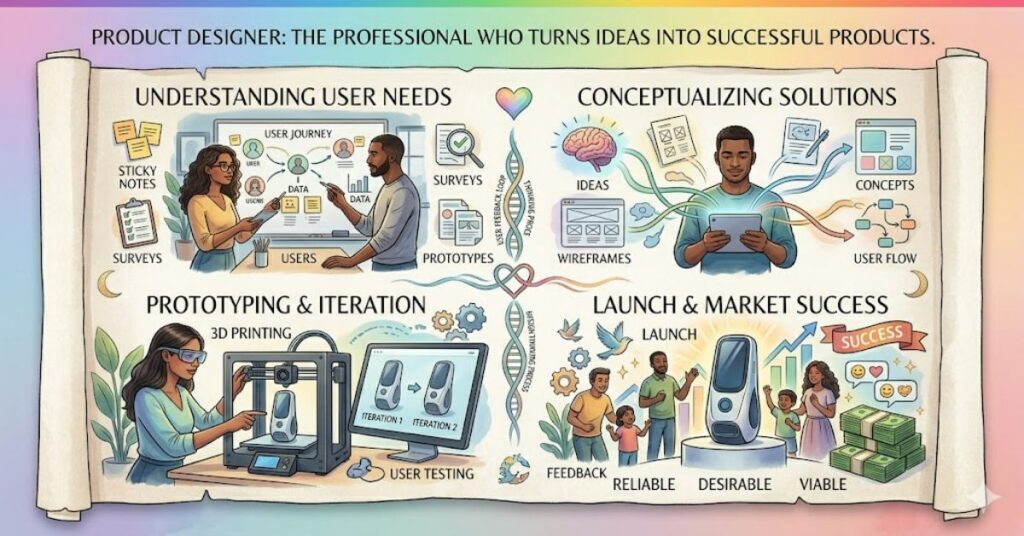
A product designer is responsible for guiding a product from an initial idea to a finished solution that serves users and supports business objectives. Whether working on a mobile application, software platform, consumer device, or digital service, these professionals sit at the intersection of customer needs, technical feasibility, and commercial success.
The role has evolved significantly during the past decade. Traditional design positions often focused primarily on aesthetics and visual presentation. Today’s design specialists conduct user research, create wireframes, build prototypes, analyse customer behaviour, collaborate with engineers, and contribute to strategic business decisions.
Companies ranging from startups to global technology giants increasingly depend on product-focused design teams to remain competitive. Research from major employment platforms and industry reports consistently shows strong demand for professionals who can improve user experiences while supporting organisational growth.
Understanding what this role involves is valuable for aspiring designers, business leaders, and anyone interested in how successful products reach the market. This article examines responsibilities, required skills, career opportunities, challenges, industry trends, and the future of the profession.
What Does a Product Designer Do?
At its core, product design focuses on solving problems.
Rather than simply creating attractive interfaces, professionals in this field identify user pain points and develop solutions that improve experiences while meeting business requirements.
Typical responsibilities include:
- Conducting user research
- Analysing customer behaviour
- Creating user journeys
- Developing wireframes
- Designing prototypes
- Testing product concepts
- Collaborating with developers
- Working with product managers
- Monitoring post-launch performance
- Refining products based on feedback
The modern role combines several disciplines that were previously separate, including UX design, UI design, interaction design, and aspects of product strategy.
The Product Lifecycle Perspective
One of the defining characteristics of this profession is involvement throughout the entire product lifecycle.
| Stage | Primary Responsibility |
| Research | Understand user needs and market opportunities |
| Discovery | Define problems worth solving |
| Ideation | Generate concepts and solutions |
| Design | Create interfaces and experiences |
| Development | Collaborate with engineers |
| Testing | Validate assumptions and usability |
| Launch | Support go-to-market readiness |
| Optimisation | Improve performance after release |
Unlike specialists who focus on a single phase, product-focused designers maintain visibility across the entire process.
Key Skills Every Product Designer Needs
Success requires a blend of creative, analytical, and collaborative abilities.
User Research
Understanding users forms the foundation of good design.
Common research methods include:
- Interviews
- Surveys
- Usability testing
- Behavioural analytics
- Customer feedback analysis
Research helps teams avoid designing based solely on assumptions.
UX Design
User experience design focuses on making products intuitive and enjoyable.
Key UX activities include:
- Information architecture
- User flows
- Journey mapping
- Interaction design
- Accessibility evaluation
UI Design
User interface design addresses visual presentation.
This includes:
- Typography
- Colour systems
- Layouts
- Components
- Responsive design
Technical Understanding
Although most designers do not write production code, understanding development constraints improves collaboration.
Knowledge of:
- HTML
- CSS
- JavaScript concepts
- APIs
- Design systems
can significantly improve communication with engineering teams.
Business Awareness
An often-overlooked requirement is commercial understanding.
Design decisions influence:
- Revenue
- Customer acquisition
- Retention
- Conversion rates
- Product adoption
Strong practitioners understand these metrics and incorporate them into decision-making.
Product Designer vs Other Design Roles
Confusion often exists regarding different design positions.
Comparison Table
| Role | Primary Focus | Scope |
| Product Designer | Entire product lifecycle | Broad |
| UX Designer | User experience | Medium |
| UI Designer | Visual interface design | Narrow |
| Graphic Designer | Visual communication | Narrow |
| Product Manager | Business strategy and roadmap | Broad |
| Interaction Designer | User interactions | Medium |
A product designer typically incorporates elements from multiple disciplines while maintaining a strategic perspective.
Real-World Examples of Product Design Success
Several well-known products demonstrate the impact of effective design thinking.
Airbnb
Airbnb’s growth is frequently linked to its emphasis on user-centred experiences. The company invested heavily in simplifying property listings, booking flows, and trust-building features.
Spotify
Spotify’s personalised recommendations and intuitive navigation illustrate how design decisions influence user retention and engagement.
Notion
Notion’s flexible workspace platform demonstrates how thoughtful information architecture can simplify complex workflows.
These examples highlight a common theme: successful products prioritise solving real user problems.
The Strategic Business Value of Product Design
Many organisations once viewed design as a final-stage activity.
Today, leading companies involve designers much earlier.
Revenue Impact
Well-designed experiences can improve:
- Conversion rates
- Customer satisfaction
- Subscription renewals
- Customer lifetime value
Cost Reduction
Poor usability often creates hidden expenses.
These include:
- Increased support tickets
- Higher onboarding costs
- Lower retention rates
- Additional development rework
Investing in design frequently reduces these operational costs.
Competitive Advantage
Markets become increasingly crowded each year.
User experience often becomes a key differentiator when products offer similar functionality.
Common Challenges Product Designers Face
Despite its rewards, the profession presents significant challenges.
Balancing User Needs and Business Goals
Users and businesses do not always want the same things.
Designers frequently navigate trade-offs between:
- Simplicity and monetisation
- User privacy and data collection
- Accessibility and development timelines
Limited Resources
Many teams face constraints involving:
- Budget
- Staffing
- Technical limitations
- Time-to-market pressures
Successful professionals learn to prioritise effectively.
Stakeholder Alignment
Product development often involves multiple stakeholders with competing priorities.
Designers must communicate clearly and build consensus among:
- Executives
- Product managers
- Engineers
- Marketing teams
- Customer support teams
Structured Industry Insights
Current Product Design Landscape
| Industry Trend | Impact on Designers |
| AI-assisted design tools | Increased productivity |
| Remote collaboration | Greater global opportunities |
| Accessibility standards | Expanded design requirements |
| Design systems | Improved consistency |
| Data-driven decision-making | Stronger analytical expectations |
| Mobile-first experiences | Ongoing optimisation focus |
Original Insight 1: AI Will Not Replace Strategic Designers
A growing misconception suggests artificial intelligence will eliminate design roles.
In practice, AI accelerates tasks such as wireframing, content generation, and asset creation. However, understanding human behaviour, organisational priorities, and market positioning still requires human judgement.
The profession is evolving rather than disappearing.
Original Insight 2: Research Skills Are Becoming More Valuable Than Visual Skills Alone
Many aspiring designers focus heavily on interface aesthetics.
Yet organisations increasingly prioritise professionals who can uncover customer problems and validate solutions before development begins.
Research capability often produces greater business impact than visual refinement alone.
Original Insight 3: Cross-Functional Communication Is Emerging as a Core Competitive Skill
As products become more complex, success depends on alignment between teams.
Designers who can communicate effectively with executives, engineers, marketers, and customers often create greater value than those focused solely on design execution.
Career Path and Salary Expectations
Career progression varies across organisations.
A typical pathway includes:
- Junior Designer
- Product Designer
- Senior Product Designer
- Lead Product Designer
- Design Manager
- Director of Design
- Chief Design Officer
Compensation depends on:
- Location
- Industry
- Experience level
- Portfolio quality
- Company size
Technology companies generally offer the highest salaries due to strong competition for experienced talent.
Educational Background and Certifications
There is no single route into the profession.
Common educational paths include:
- Design degrees
- Human-computer interaction programmes
- Psychology studies
- Computer science education
- Self-directed learning
Popular skill-building resources include:
- Google UX Design Certificate
- Nielsen Norman Group training
- Interaction Design Foundation courses
- University design programmes
Employers increasingly prioritise portfolios over formal qualifications.
The Future of Product Designer Careers in 2027
The future of product designer careers appears positive, although the role will continue evolving.

Several trends are likely to influence the profession by 2027:
AI-Augmented Workflows
Artificial intelligence tools will automate repetitive tasks such as wireframe generation, content drafting, and basic prototyping.
Human designers will spend more time on strategy, research, and decision-making.
Greater Accessibility Requirements
Regulatory attention toward digital accessibility continues increasing worldwide.
Designers will need stronger knowledge of accessibility standards and inclusive design principles.
More Data-Driven Design
Analytics platforms will become increasingly integrated into design workflows.
Teams will rely on behavioural data to validate assumptions and prioritise improvements.
Increased Product Complexity
As products incorporate AI features, automation, and personalisation systems, designers will play a larger role in helping users understand and trust technology.
The profession’s future appears less focused on visuals alone and more focused on systems thinking, research, and strategic problem-solving.
Key Takeaways
- Product design extends far beyond visual interface creation.
- Research and problem identification drive successful outcomes.
- Business objectives and user needs must remain balanced.
- AI will change workflows but is unlikely to replace strategic designers.
- Communication skills are becoming increasingly valuable.
- Accessibility and ethical design considerations continue growing.
- Organisations increasingly view design as a business function rather than a support activity.
Conclusion
The modern product designer occupies one of the most influential positions in product development. By combining user research, design expertise, technical awareness, and business understanding, these professionals help organisations create solutions that customers genuinely value.
The role has expanded considerably from its traditional roots. Today’s practitioners contribute throughout the product lifecycle, from discovery and validation to launch and optimisation. Their work influences customer satisfaction, operational efficiency, competitive differentiation, and long-term business growth.
As technology advances and customer expectations rise, demand for individuals who can bridge design, strategy, and engineering is expected to remain strong. While tools powered by artificial intelligence will change how design work is performed, the ability to understand people, solve complex problems, and align stakeholders will remain distinctly human strengths.
For those considering a career in the field, developing research capabilities, communication skills, and strategic thinking may prove just as important as mastering design software.
FAQ
What is a product designer?
A product designer oversees the creation and improvement of physical or digital products. The role includes research, ideation, prototyping, testing, collaboration with engineering teams, and post-launch optimisation.
Is product design the same as UX design?
Not exactly. UX design focuses primarily on user experience, while product design typically includes business strategy, product lifecycle management, and broader organisational goals.
Do product designers need coding skills?
Coding is not always required, but understanding development concepts improves collaboration with engineers and helps designers create realistic solutions.
What tools do product designers use?
Common tools include Figma, Sketch, Adobe Creative Cloud, Miro, Notion, Jira, and various user research platforms.
Is product design a good career in 2025?
Yes. Demand remains strong across technology, finance, healthcare, education, and consumer services as organisations prioritise user-centred product development.
How long does it take to become a product designer?
Many professionals enter the field within one to three years through formal education, bootcamps, self-study, or related design experience.
What industries hire product designers?
Technology firms, financial institutions, healthcare companies, e-commerce businesses, education providers, government organisations, and startups regularly hire product design professionals.
Methodology
This article was developed using publicly available information from recognised design industry organisations, educational institutions, professional training providers, and employment market reports. The analysis focuses on established industry practices rather than promotional claims from individual companies.
Sources were selected based on relevance, authority, and recent publication dates where available. Career insights were compared across multiple industry references to minimise bias.
Limitations include variations in job titles, responsibilities, and compensation across different organisations and geographic regions. Product design remains a rapidly changing field, meaning specific tools and workflows may evolve over time.
A balanced perspective has been maintained by considering both the opportunities and challenges associated with the profession.
References
Interaction Design Foundation. (2024). What is product design? Retrieved from https://www.interaction-design.org
Nielsen Norman Group. (2024). Product design and user experience practices. Retrieved from https://www.nngroup.com
Google UX Design Certificate. (2024). Foundations of user experience design. Retrieved from https://grow.google
U.S. Bureau of Labor Statistics. (2024). Occupational outlook handbook. Retrieved from https://www.bls.gov
World Wide Web Consortium (W3C). (2024). Web accessibility initiative guidelines. Retrieved from https://www.w3.org
Editorial Disclosure
This article was drafted with AI assistance and reviewed and verified by [Author Name]. All data, citations, and claims should be independently confirmed by the editorial team at Matrics360.com before publication.