
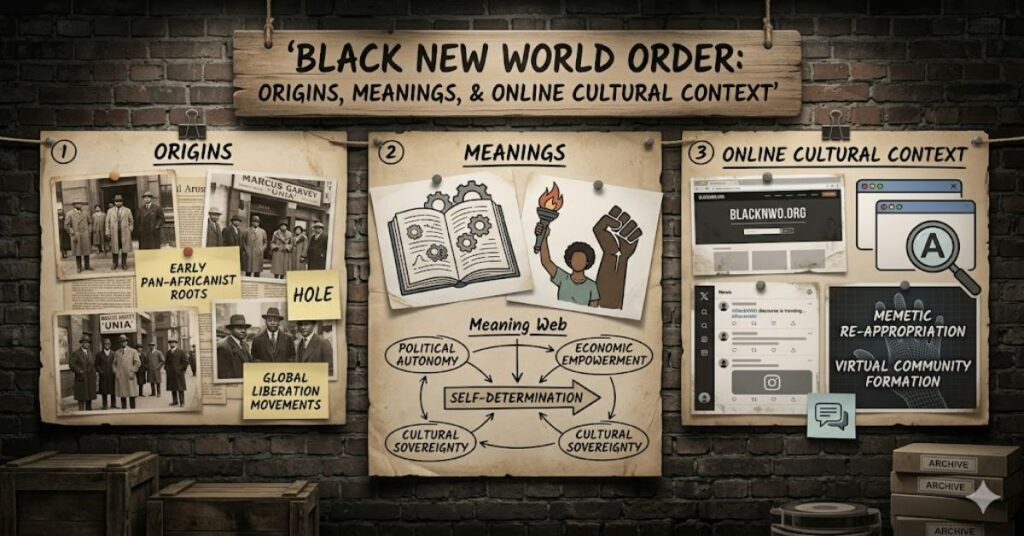
The term black new world order appears frequently in niche online communities, discussion forums, social media platforms, and user-generated content websites. For many readers encountering the phrase for the first time, its meaning can be confusing because there is no universally accepted definition.
Instead, the concept exists primarily as an internet phenomenon whose interpretation changes according to the community using it. In some spaces, it is presented as fictional storytelling. In others, it appears in roleplaying communities, online fantasies, or speculative discussions about social power structures. Because these uses overlap, outsiders often struggle to distinguish between satire, fantasy, cultural commentary, and genuine political discussion.
This article examines the origins, common interpretations, cultural impact, and future relevance of the term while separating documented facts from speculation.
What Is the Black New World Order?
At its broadest level, the phrase combines two concepts:
- Black — generally referring to people of African descent or Black identity.
- New World Order — a long-standing phrase historically associated with theories about global political restructuring.
When combined, the expression takes on different meanings depending on the audience using it.
Unlike formal political organizations, there is no recognized institution, government initiative, or documented movement officially known as the Black New World Order.
Instead, the term exists largely as an internet-created cultural construct.
The Major Interpretations of BNWO
1. Fictional and Roleplay Communities
One of the most common uses of the phrase appears in online fantasy and roleplaying communities.
In these environments, BNWO functions as a fictional scenario exploring alternative social hierarchies. Participants create stories, artwork, or fictional narratives built around imagined changes in political, cultural, or social power.
These narratives are generally presented as speculative fiction rather than real-world political advocacy.
2. Fetish and Adult-Oriented Communities
Researchers examining internet subcultures have noted that BNWO terminology frequently appears in fetish-oriented spaces.
In these contexts, the phrase is often disconnected from politics entirely. Instead, it serves as part of roleplay frameworks involving themes of dominance, hierarchy, identity, and power exchange.
This usage represents a significant portion of online references to BNWO and explains why many search results appear unrelated to politics or public policy.
3. Cultural Commentary
A smaller portion of discussions use the term symbolically when discussing demographic shifts, media representation, sports, entertainment, or cultural influence.
Here, the phrase may be used ironically, satirically, or rhetorically rather than literally.
The challenge is that identical language can appear in both serious and non-serious discussions, making interpretation difficult without understanding the surrounding context.
How BNWO Differs From Traditional New World Order Concepts
| Feature | Traditional New World Order Discussions | BNWO Discussions |
| Primary Focus | Global governance theories | Race, identity, or fictional social change |
| Historical Roots | Cold War era narratives | Internet-era communities |
| Main Platforms | Political forums and media | Forums, social media, niche communities |
| Organizational Structure | Often alleged secret institutions | Generally decentralized |
| Typical Content | Political speculation | Fiction, roleplay, commentary, memes |
The comparison reveals that BNWO evolved largely as a digital-age cultural phenomenon rather than a continuation of historical New World Order narratives.
Why the Concept Spread Online
Several factors contributed to the growth of BNWO discussions.
Meme Culture
Internet communities often remix existing ideas into new formats. The phrase itself combines familiar cultural concepts in a way that attracts attention and curiosity.
Algorithmic Amplification
Social media platforms frequently reward unusual or provocative terminology with higher engagement. As a result, niche concepts can spread far beyond their original communities.
Ambiguity
Because BNWO lacks a fixed definition, users can reinterpret it to fit different narratives, increasing its longevity online.
Real-World Impact and Cultural Significance
Although BNWO is primarily an online concept, it illustrates broader trends in internet culture.
Blurring Fiction and Reality
One notable development in digital culture is the collapse of clear boundaries between fictional narratives and real-world discussions.
A recurring observation among media researchers is that internet users often encounter concepts through memes before discovering their original context.
BNWO is an example of this process.
Identity and Representation
Some discussions surrounding the term reflect broader conversations about race, representation, and cultural influence in entertainment, sports, and media.
However, these discussions vary significantly in seriousness and credibility.
Community Formation
Online communities frequently create shared symbols and language that strengthen group identity.
The continued use of BNWO terminology demonstrates how internet groups develop their own cultural vocabulary.
Structured Insight Table
| Observation | Implication |
| No single accepted definition exists | Context determines meaning |
| Most references originate online | Limited real-world organizational presence |
| Significant usage occurs in fictional settings | Interpretation requires source evaluation |
| Social media increased visibility | Search interest often exceeds understanding |
| Meanings vary across platforms | Researchers must examine context carefully |
Risks and Trade-Offs in Understanding BNWO
Risk of Misinterpretation
Readers may assume all references are political when many are fictional or roleplay-based.
Loss of Context
Short-form content often removes the surrounding explanation needed to understand intended meaning.
Algorithmic Distortion
Popular platforms tend to promote sensational interpretations over nuanced explanations.
Cultural Polarization
Terms involving race and power can generate strong emotional reactions even when the original content is fictional.
Three Often-Overlooked Insights
1. Search Popularity Does Not Indicate Real-World Influence
Many internet concepts attract significant search traffic despite having little institutional presence.
2. Most Discussions Occur Within Niche Communities
The concept remains concentrated in specific online ecosystems rather than mainstream public discourse.
3. The Meaning Continues to Evolve
Unlike formal political ideologies, BNWO has no governing authority controlling definitions, allowing interpretations to change over time.
The Future of Black New World Order in 2027
By 2027, discussions surrounding BNWO will likely reflect broader developments in digital culture rather than the growth of any formal movement.
Several trends support this assessment:
- Continued expansion of online communities.
- Increased use of AI-generated media and storytelling.
- Greater blending of memes, fiction, and social commentary.
- More academic interest in internet subcultures and digital identity formation.
At the same time, growing media literacy initiatives may encourage users to investigate the origins and context of unfamiliar online terminology before drawing conclusions.
The future relevance of BNWO therefore depends less on political developments and more on how internet communities create, adapt, and reinterpret cultural narratives.
Key Takeaways
- BNWO is primarily an internet-born concept rather than a formal organization.
- Its meaning changes dramatically depending on the community using it.
- Fictional and roleplay interpretations account for much of its online presence.
- Social media algorithms helped increase visibility.
- Context is essential when evaluating references to BNWO.
- Search interest often exceeds public understanding of the term.
- Future discussions will likely remain tied to digital culture rather than institutional politics.
Conclusion
The phrase black new world order illustrates how modern internet culture creates concepts that resist simple definitions. Unlike traditional political movements, BNWO has no centralized structure, leadership, or universally accepted ideology. Instead, it functions as a flexible cultural symbol used across multiple online communities.
For some users, it represents fictional storytelling. For others, it serves as a framework for roleplay, commentary, or satire. These overlapping uses explain why discussions surrounding the term often appear contradictory.
Understanding BNWO requires careful attention to context rather than assumptions. A reference on a discussion board, social media platform, or creative community may carry an entirely different meaning from the same phrase used elsewhere.
As digital culture continues to evolve, BNWO will likely remain an example of how internet communities generate new forms of language, symbolism, and identity that challenge traditional categories of interpretation.
FAQ
What does BNWO stand for?
BNWO stands for Black New World Order. The term has multiple meanings depending on the online community where it appears.
Is the Black New World Order a real organization?
There is no evidence of a formal organization operating under this name. Most references originate from internet communities and user-generated content.
Why is BNWO discussed online?
The phrase combines themes of identity, power, and social change, making it attractive for memes, fiction, roleplay, and commentary.
Is BNWO a political movement?
Generally, no. Most references are connected to online subcultures rather than organized political activity.
Where did the term originate?
The exact origin is difficult to identify because the phrase emerged gradually across internet forums and niche communities.
Why do definitions differ so much?
The term lacks a central authority or agreed-upon meaning, allowing different groups to adapt it for their own purposes.
Methodology
This article was developed using publicly available information from academic discussions of internet culture, digital sociology research, media literacy resources, and documented observations of online communities. The analysis focuses on identifying common patterns of usage rather than validating specific ideological claims.
Limitations include the decentralized nature of internet communities and the absence of a universally accepted definition of BNWO. Because meanings vary significantly across platforms, interpretations should be evaluated within their original context.
Counterarguments were considered, particularly claims that BNWO represents either a political movement or purely fictional content. Available evidence suggests the term is best understood as a multi-context internet phenomenon rather than a single coherent ideology.
Editorial Disclosure
This article was drafted with AI assistance and reviewed and verified by [Author Name]. All data, citations, and claims should be independently confirmed by the editorial team at Matrics360.com.
References
American Psychological Association. (2023). Digital media literacy and online information evaluation. APA Publishing.
Marwick, A. E. (2021). The private is political: Networked privacy and social media. Yale University Press.
Phillips, W., & Milner, R. M. (2021). You are here: A field guide for navigating polarized speech, conspiracy theories, and our polluted media landscape. MIT Press.
UNESCO. (2023). Guidelines for regulating digital platforms: Safeguarding freedom of expression and access to information. UNESCO Publishing.