
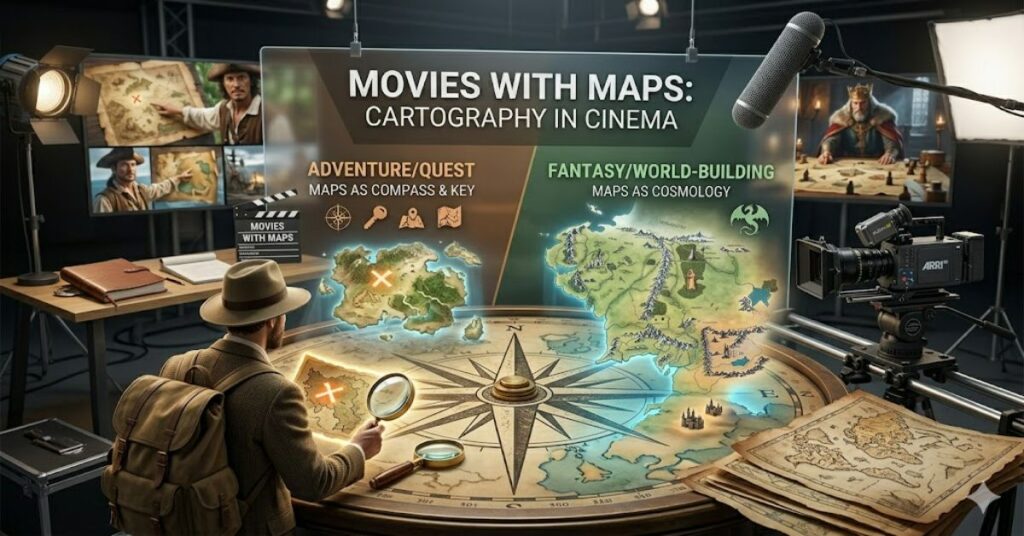
Few cinematic devices are as instantly recognizable as a map unfolding on screen. Whether it is a weathered treasure map leading adventurers toward hidden riches or an animated line tracing a hero’s route across continents, movies with maps have captivated audiences for decades. These visual elements do far more than indicate location. They help establish narrative structure, communicate scale, and immerse viewers in a journey.
Maps in cinema generally serve two distinct purposes. Some films revolve around a literal map that drives the entire plot. The map becomes the object everyone seeks, protects, or deciphers. Others use animated cartography to visually transition between destinations, helping audiences understand where characters are traveling and how far they have come.
From the globe-trotting adventures of Indiana Jones to the elaborate fantasy worlds of Middle-earth, maps often function as silent storytellers. They provide context without lengthy exposition, making complex journeys easier to follow. In many cases, the map itself becomes iconic, remembered almost as vividly as the characters.
As audiences increasingly consume stories across multiple platforms, map-based storytelling remains remarkably effective. Understanding why filmmakers continue to rely on maps reveals important insights about visual communication, world-building, and audience engagement.
Why Maps Work So Well in Movies
Maps solve a fundamental storytelling challenge: geography.
Every journey-based story requires viewers to understand where characters are going, what obstacles stand in their way, and why the destination matters.
Maps Create Immediate Context
A single map can communicate:
- Distance
- Political boundaries
- Dangerous territories
- Hidden locations
- Strategic objectives
Without maps, filmmakers often need lengthy dialogue or narration to explain the same information.
Visual Storytelling Efficiency
Cinema relies heavily on visual communication.
A well-designed map sequence can instantly convey:
- Passage of time
- Travel progress
- Mission objectives
- Character movement
This makes maps one of the most efficient storytelling tools available.
Movies Driven by Literal Maps
Many famous films place maps at the center of the story itself.
Indiana Jones and the Raiders of the Lost Ark (1981)
Raiders of the Lost Ark
The Indiana Jones franchise made map transitions famous, but maps also serve practical functions within the narrative.
Ancient documents, archaeological clues, and hidden locations drive much of the action.
The Goonies (1985)
The Goonies
A treasure map launches the entire adventure.
The characters follow clues, solve puzzles, and navigate hidden passages in pursuit of pirate treasure.
National Treasure (2004)
National Treasure
Maps, codes, and historical documents form the backbone of the story.
The plot demonstrates how cartographic clues can become compelling narrative devices.
Treasure Planet (2002)
Treasure Planet
This science-fiction adaptation transforms a traditional treasure map into a futuristic navigation system, showing how map-driven storytelling can adapt across genres.
Films Famous for Animated Travel Maps
Not every map needs to be central to the plot.
Some movies use maps primarily as visual transitions.
Indiana Jones Travel Sequences
One of cinema’s most recognizable techniques is the animated red line moving across a world map.
These brief sequences efficiently communicate international travel while maintaining pacing.
Around the World in 80 Days
Around the World in 80 Days
Travel maps help audiences understand the global scope of the journey.
Historical War Films
Many war movies use animated campaign maps to explain troop movements and military strategy.
Examples include:
- Patton
- Midway
- Dunkirk
Comparison Table: Types of Map Usage in Film
| Map Type | Purpose | Example Films |
| Treasure Maps | Drive plot progression | The Goonies, National Treasure |
| Fantasy Maps | World-building | The Lord of the Rings |
| Travel Maps | Show movement | Indiana Jones |
| Military Maps | Explain strategy | Patton, Midway |
| Historical Maps | Provide context | Various documentaries |
| Digital Maps | Modern navigation | Spy and action films |
Fantasy Films and World-Building Through Maps
Fantasy cinema arguably relies on maps more than any other genre.
The Lord of the Rings
The Lord of the Rings: The Fellowship of the Ring
Middle-earth maps became an essential part of the viewing experience.
The geography helps audiences understand:
- Character routes
- Political territories
- Strategic locations
Without a map, the scale of the journey would be difficult to appreciate.
The Hobbit
The Hobbit: An Unexpected Journey
The map itself functions as a narrative artifact that influences character decisions and reveals hidden information.
Three Overlooked Insights About Movies With Maps
Insight 1: Maps Reduce Narrative Confusion
Large-scale stories often struggle with geographic clarity.
Maps provide orientation that helps viewers stay emotionally invested rather than becoming confused.
Insight 2: Maps Create Anticipation
When audiences see a destination marked on a map, they begin anticipating what lies ahead.
This builds suspense long before characters arrive.
Insight 3: Maps Support Franchise Expansion
Many successful franchises use maps to establish worlds that can later support sequels, prequels, games, and spin-offs.
Middle-earth and Westeros demonstrate how cartography strengthens long-term storytelling ecosystems.
Cultural Impact of Cinematic Maps
Maps have influenced how audiences perceive exploration.
Adventure films frequently inspire interest in:
- History
- Geography
- Archaeology
- Travel
Many iconic fictional maps have become collectibles, posters, and merchandise.
In some cases, audiences recognize a fictional map as quickly as they recognize the film itself.
Data Table: Genres Most Likely to Use Maps
| Genre | Map Usage Frequency | Primary Function |
| Adventure | Very High | Quest guidance |
| Fantasy | Very High | World-building |
| War | High | Strategic context |
| Historical Drama | Moderate | Geographic explanation |
| Documentary | High | Educational context |
| Science Fiction | Moderate | Universe navigation |
| Romance | Low | Travel transitions |
The Future of Movies With Maps in 2027
Maps are likely to become more interactive and visually sophisticated by 2027.
Several trends are already emerging.
Real-Time Digital Cartography
Advanced CGI allows filmmakers to create dynamic maps that evolve alongside the narrative.
Streaming-Era World Building
Major franchises increasingly develop extensive fictional universes.
Detailed maps help audiences navigate these complex story worlds.
Augmented Reality Integration
Some studios are experimenting with companion experiences that allow viewers to explore fictional maps outside the film.
AI-Assisted Visualization
Artificial intelligence may help production teams generate complex geographic visualizations more efficiently.
However, creative direction and narrative coherence will remain human responsibilities.
Key Takeaways
- Maps remain one of cinema’s most efficient storytelling devices.
- Adventure and fantasy films rely heavily on cartographic visuals.
- Treasure maps continue to drive compelling narratives.
- Animated travel maps help audiences understand large-scale journeys.
- World-building often becomes more effective when supported by detailed geography.
- Digital technologies are expanding how maps appear in modern films.
- Strong cartography can become as memorable as characters and locations.
Conclusion
Movies with maps occupy a unique place in cinematic storytelling. They transform geography into narrative structure, helping audiences understand where characters are, where they are going, and why the journey matters. Whether serving as a treasure-hunting clue, a fantasy world blueprint, or a simple travel montage, maps provide clarity and immersion that few other visual tools can match.
The enduring popularity of map-based storytelling demonstrates the power of visual orientation. Audiences enjoy understanding the broader landscape surrounding a story, particularly when journeys and exploration are central themes. From classic adventure films to modern fantasy franchises, maps continue to guide viewers through some of cinema’s most memorable experiences.
As filmmaking technology advances, the role of maps will likely expand rather than disappear. New digital techniques may change how maps are presented, but their fundamental purpose remains the same: helping audiences follow extraordinary journeys across extraordinary worlds.
FAQ
What are the best movies with maps?
Popular examples include Raiders of the Lost Ark, The Goonies, National Treasure, The Lord of the Rings, and Treasure Planet.
Why do adventure movies use maps so often?
Maps help audiences understand destinations, obstacles, and progress while creating anticipation for upcoming discoveries.
What movie popularized animated travel maps?
The Indiana Jones series is widely credited with popularizing the animated route line moving across a map.
Are fantasy movies more dependent on maps?
Yes. Fantasy worlds often contain complex geography, making maps useful for world-building and navigation.
What is the purpose of animated maps in films?
Animated maps visually communicate travel, distance, and geographic relationships without requiring lengthy exposition.
Do modern movies still use maps?
Absolutely. Digital effects have expanded how maps appear in contemporary action, fantasy, and historical films.
Methodology
This article was developed through analysis of widely recognized films that prominently feature maps as narrative devices or visual storytelling tools. Film studies sources, production interviews, and historical cinema references were reviewed to evaluate how maps contribute to audience engagement and world-building.
Limitations include subjective interpretation of cinematic symbolism and evolving filmmaking techniques. Readers should verify release details and production commentary through official studio sources.
Editorial Disclosure: This article was drafted with AI assistance and reviewed and verified by [Author Name]. All data, citations, and claims should be independently confirmed by the editorial team at Matrics360.com.
References
Brooker, W. (2022). Adventures in contemporary cinema and narrative design. Routledge.
Bordwell, D., & Thompson, K. (2023). Film art: An introduction (13th ed.). McGraw-Hill.
Mittell, J. (2022). Complex TV and transmedia storytelling. New York University Press.
The Academy of Motion Picture Arts and Sciences. (2024). Film production and visual storytelling resources.
British Film Institute. (2024). Mapping journeys in cinema and visual narrative studies.