
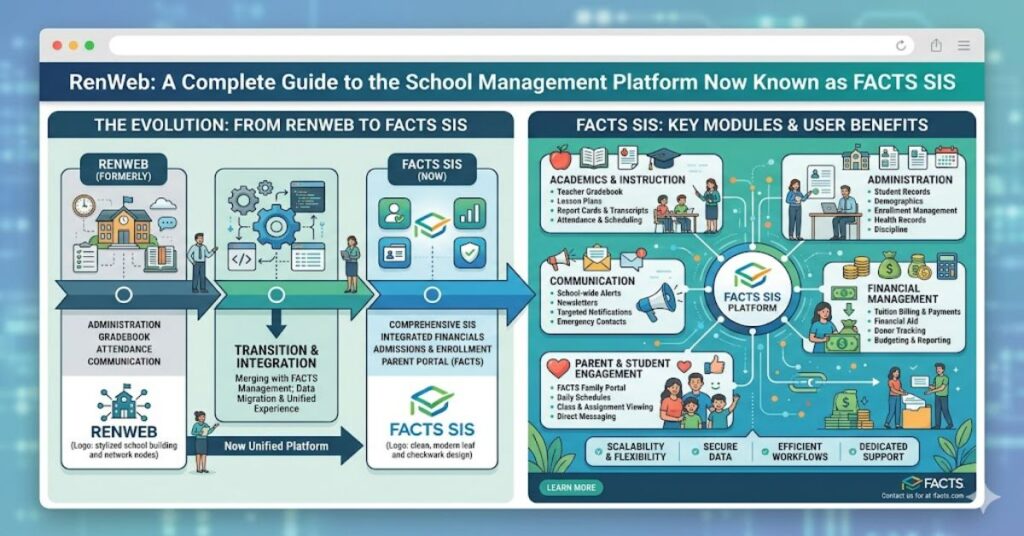
For many private and independent schools, RenWeb has long been synonymous with digital school administration. Although the platform now operates under the FACTS Student Information System (SIS) brand, educators, parents, and administrators still frequently search for RenWeb when looking for information about student records, attendance tracking, grading systems, and tuition management.
At its core, RenWeb was designed to simplify school operations by providing a secure portal where administrators, teachers, parents, and students could access critical educational information. Over time, the platform expanded beyond basic record keeping and became part of a broader educational technology ecosystem managed by FACTS.
Today, schools use FACTS SIS to manage enrolment, curriculum planning, communication workflows, financial operations, and student performance monitoring. The platform serves thousands of institutions across North America and has become particularly popular among faith-based, independent, and private schools.
This guide examines how the platform works, its key features, benefits, limitations, strategic value for schools, and what the future may hold for school management systems as educational technology continues to mature.
What Is RenWeb?
RenWeb began as a school information management platform focused on helping schools organise administrative processes digitally.
Following its acquisition and integration into the FACTS family of educational solutions, the platform became known as FACTS SIS. Despite the rebranding, many users continue to refer to it by its original name because of its long-standing recognition in the education sector.
The system acts as a central database where schools can manage:
- Student records
- Attendance tracking
- Gradebooks
- Scheduling
- Tuition billing
- Parent communication
- Staff management
- Academic reporting
Rather than maintaining separate systems for administration, finance, and communication, schools can manage multiple workflows through one platform.
How FACTS SIS Works
The system operates through role-based access.
Different stakeholders receive different permissions depending on their responsibilities.
Administrators
School leaders can:
- Generate reports
- Monitor attendance trends
- Manage admissions data
- Review financial information
- Configure school-wide settings
Teachers
Faculty members can:
- Record attendance
- Update grades
- Communicate with parents
- Access curriculum resources
- Track student progress
Parents
Parent portals provide visibility into:
- Academic performance
- Homework assignments
- Attendance records
- School announcements
- Tuition balances
Students
Students can access:
- Class schedules
- Assignment deadlines
- Grades
- Academic resources
- School communications
This multi-user structure helps create transparency while maintaining appropriate data security controls.
Key Features of RenWeb and FACTS SIS
Student Information Management
The platform stores comprehensive student records including:
- Demographics
- Emergency contacts
- Academic history
- Health information
- Behaviour records
Centralised record keeping reduces administrative duplication and improves information accessibility.
Attendance Monitoring
Attendance management remains one of the most frequently used features.
Schools can:
- Record daily attendance
- Track tardiness
- Monitor absenteeism
- Generate compliance reports
This functionality supports both operational efficiency and regulatory requirements.
Gradebook and Assessment Tools
Teachers can record and calculate grades digitally.
Features include:
- Weighted grading
- Assignment tracking
- Progress reporting
- Academic analytics
Parents gain real-time visibility into student performance rather than waiting for periodic report cards.
Tuition and Financial Management
FACTS is particularly known for integrating financial management into educational administration.
Capabilities include:
- Tuition collection
- Payment plans
- Billing schedules
- Financial aid administration
This integration is one reason many private schools adopt the system.
Comparison Table: RenWeb vs Traditional School Administration
| Feature | RenWeb / FACTS SIS | Traditional Manual Systems |
| Student Records | Centralised digital database | Paper files and spreadsheets |
| Attendance Tracking | Real-time updates | Manual entry |
| Parent Communication | Instant portal access | Phone calls and letters |
| Tuition Management | Integrated billing | Separate financial systems |
| Reporting | Automated reports | Manual compilation |
| Data Accessibility | Cloud-based access | Limited office access |
| Audit Trail | Digital history logs | Difficult to track changes |
Real-World Impact on School Operations
One of the most significant changes introduced by systems like RenWeb has been the reduction of administrative workload.
Before widespread adoption of school management software, many institutions relied on paper-based systems. Teachers recorded attendance manually, report cards required extensive administrative effort, and parents often waited weeks for academic updates.
Digital platforms changed these workflows substantially.
Example: Parent Engagement
Educational technology research consistently shows that increased parent engagement correlates with improved student outcomes.
By providing continuous access to grades and attendance records, systems such as FACTS SIS encourage greater family involvement in student learning.
Example: Administrative Efficiency
School administrators can generate reports in minutes that previously required hours of manual compilation.
This efficiency allows staff to focus more on educational priorities and less on clerical tasks.
Structured Insight Table: Benefits and Trade-Offs
| Area | Benefit | Potential Challenge |
| Data Management | Centralised information | Requires accurate migration |
| Parent Communication | Increased transparency | Risk of information overload |
| Academic Tracking | Real-time performance monitoring | Teacher training needed |
| Financial Operations | Automated billing | Integration complexity |
| Reporting | Faster compliance reporting | Data quality dependency |
| Accessibility | Anywhere access | Internet reliance |
Risks and Limitations Schools Should Consider
No educational technology platform is perfect.
Schools evaluating FACTS SIS should understand potential challenges.
Training Requirements
New users often require onboarding support.
Teachers accustomed to traditional systems may need time to adapt to digital workflows.
Data Migration Risks
Moving historical records into a new system can be complex.
Poorly managed migrations may result in:
- Duplicate records
- Missing information
- Data inconsistencies
Dependence on Connectivity
Cloud-based systems depend heavily on internet access.
Temporary outages can affect availability during critical periods.
Privacy and Security Responsibilities
Student information is highly sensitive.
Schools must ensure:
- Strong password policies
- Role-based permissions
- Compliance with applicable privacy regulations
Technology providers can support security, but institutions remain responsible for governance practices.
Three Overlooked Insights About RenWeb and School Technology
Many articles focus only on features. However, several less-discussed factors deserve attention.
1. Adoption Often Matters More Than Features
A sophisticated platform provides little value if staff members use only a fraction of its capabilities.
Schools frequently achieve better outcomes through strong training programmes than through purchasing additional software modules.
2. Parent Expectations Continue to Rise
Modern families increasingly expect real-time academic visibility.
The demand for immediate access to grades and attendance is reshaping school communication standards.
3. Data Quality Determines Reporting Accuracy
Automated reports create efficiency, but inaccurate input produces unreliable outputs.
Schools that establish strong data governance policies typically derive greater value from information systems.
Strategic Importance for Independent Schools
Private and independent schools often operate with lean administrative teams.
As a result, efficiency gains can have significant organisational impact.
FACTS SIS supports strategic goals such as:
- Improved family engagement
- Better operational visibility
- Streamlined tuition collection
- Enhanced reporting capabilities
- More informed decision-making
These benefits extend beyond administration and influence the overall educational experience.
The Future of RenWeb in 2027
The future of school management systems will likely focus on deeper integration, automation, and analytics.
By 2027, several trends appear likely:
Enhanced Data Analytics
Schools are increasingly seeking predictive insights rather than simple reporting.
Future platforms may identify:
- Attendance risk patterns
- Academic intervention opportunities
- Enrolment forecasting trends
Greater Mobile Accessibility
Parents and students increasingly expect mobile-first experiences.
Future updates will likely prioritise app functionality and real-time notifications.
Expanded Integration Ecosystems
Educational institutions continue adopting specialised learning technologies.
Student information systems will need stronger integration with:
- Learning management systems
- Assessment platforms
- Communication tools
- Financial software
Increased Focus on Privacy
As educational data grows more valuable, regulatory scrutiny is likely to increase.
Schools will need stronger governance frameworks alongside technological improvements.
While these trends appear credible, implementation speed will vary depending on institutional budgets, infrastructure, and regulatory developments.
Key Takeaways
- RenWeb remains a recognised name despite its transition to FACTS SIS.
- The platform combines academic, administrative, and financial workflows into one system.
- Parent engagement is strengthened through real-time access to student information.
- Successful implementation depends heavily on staff training and change management.
- Data quality directly influences reporting effectiveness and decision-making.
- Cloud-based accessibility offers convenience but increases reliance on internet connectivity.
- Future development is expected to emphasise analytics, integrations, and privacy controls.
Conclusion
RenWeb’s evolution into FACTS SIS reflects broader changes in educational technology. Schools increasingly require integrated platforms that can manage academic records, attendance, communication, and financial operations from a single location.
For private and independent schools, the system offers a practical solution to many administrative challenges. Teachers gain streamlined workflows, parents receive improved visibility into student progress, and administrators benefit from centralised reporting and operational oversight.
At the same time, schools must recognise that technology alone does not guarantee success. Effective training, strong data governance, and thoughtful implementation remain essential. The most successful institutions view student information systems not merely as software but as strategic infrastructure supporting educational outcomes.
As school operations become increasingly digital, platforms like FACTS SIS are likely to remain central components of modern educational administration.
FAQ
What happened to RenWeb?
RenWeb was rebranded and integrated into FACTS Student Information System (FACTS SIS). The platform’s core functionality remains focused on school administration, student records, and communication.
Is RenWeb the same as FACTS SIS?
Yes. RenWeb now operates under the FACTS SIS brand and forms part of the broader FACTS education technology ecosystem.
Who uses RenWeb?
Private schools, independent schools, faith-based institutions, and some charter schools commonly use the platform for student information management and tuition administration.
Can parents access grades through RenWeb?
Yes. Parent portals allow families to view grades, attendance records, assignments, announcements, and other academic information.
Does FACTS SIS include tuition management?
Yes. One of the platform’s distinguishing features is its integration of tuition billing, payment plans, and financial aid administration.
Is RenWeb cloud-based?
FACTS SIS primarily operates as a cloud-based solution, enabling authorised users to access information through web-connected devices.
What are the biggest challenges when implementing FACTS SIS?
The most common challenges include staff training, data migration, user adoption, and maintaining data accuracy across departments.
Methodology
This article was developed using publicly available information from official FACTS documentation, educational technology resources, and school administration industry materials. The analysis focuses on the platform’s documented functionality, operational use cases, and broader trends in student information systems.
No proprietary school data, internal performance metrics, or unpublished information was used. Where future developments are discussed, they are based on observable trends in educational technology, digital administration, and data management practices rather than speculative forecasts.
A balanced perspective has been maintained by considering both the benefits and operational challenges associated with school management systems.
Editorial Disclosure: This article was drafted with AI assistance and reviewed and verified by the editorial team. All data, citations, and claims should be independently verified before publication.
References (APA Style)
FACTS. (2025). FACTS Student Information System. Retrieved from https://factsmgt.com
FACTS. (2025). School administration and student information solutions. Retrieved from https://factsmgt.com
International Society for Technology in Education. (2024). Digital transformation in K-12 administration. Retrieved from https://iste.org
National Center for Education Statistics. (2024). Use of educational technology in school administration. Retrieved from https://nces.ed.gov
United States Department of Education. (2024). Educational technology and student information systems guidance. Retrieved from https://www.ed.gov