
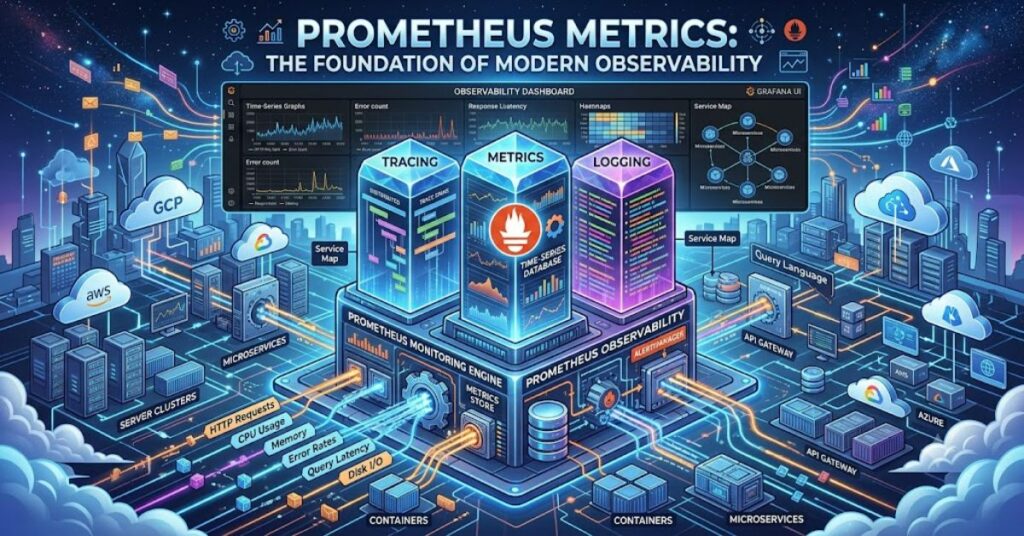
Modern applications generate enormous amounts of operational data. Every API request, database query, infrastructure event, and user interaction creates signals that help engineering teams understand system behavior. Among these signals, prometheus metrics have emerged as one of the most important foundations of modern observability.
Prometheus collects quantifiable time-series data through a pull-based model. Instead of applications sending monitoring information to a central service, a Prometheus server periodically scrapes HTTP endpoints that expose operational data. These measurements provide visibility into application performance, infrastructure health, resource consumption, and business-critical services.

Originally developed at SoundCloud and later adopted by the Cloud Native Computing Foundation, Prometheus has become one of the most widely deployed monitoring systems in cloud-native computing. It serves organizations ranging from startups to global enterprises operating complex distributed systems.
This article examines how Prometheus metrics work, why they have become essential for observability, the advantages and limitations of the approach, and what organizations should consider when implementing monitoring strategies in 2026 and beyond.
What Are Prometheus Metrics?
Prometheus metrics are numerical measurements captured over time and stored as time-series data.
Each metric consists of:
- A metric name
- One or more labels
- A timestamp
- A recorded value
For example:
http_requests_total{method=”GET”,status=”200″} 154320
This metric records the total number of successful GET requests processed by an application.
Unlike traditional log-based monitoring systems, Prometheus focuses on structured numerical measurements optimized for analysis, visualization, and alerting.
Understanding the Pull-Based Collection Model
One of the defining characteristics of Prometheus is its pull architecture.
How Scraping Works
The process follows several steps:
- Applications expose metrics through HTTP endpoints.
- Prometheus periodically requests those endpoints.
- Metric values are collected and stored.
- Queries and alerts operate on collected data.
This approach differs from push-based monitoring systems where applications actively send data to monitoring servers.
Why the Pull Model Matters
Advantages include:
- Simplified service discovery
- Centralized monitoring configuration
- Improved reliability
- Easier troubleshooting
- Better control of collection frequency
For dynamic environments such as Kubernetes clusters, the pull model aligns well with continuously changing workloads.
Core Types of Prometheus Metrics
Prometheus supports four primary metric types.
| Metric Type | Purpose | Example |
| Counter | Tracks cumulative values | Total requests |
| Gauge | Represents current state | CPU usage |
| Histogram | Measures distributions | Request latency |
| Summary | Tracks quantiles | Response times |
Understanding when to use each metric type is critical for effective observability.
Counters
Counters only increase.
Examples include:
- Requests processed
- Errors generated
- Messages consumed
Gauges
Gauges can increase or decrease.
Examples include:
- Memory consumption
- Active sessions
- Queue depth
Histograms
Histograms are especially valuable for latency analysis.
They help teams answer questions such as:
- How many requests exceed one second?
- What percentage of users experience slow responses?
Summaries
Summaries calculate quantiles directly at collection time.
While useful, many organizations prefer histograms because they provide greater aggregation flexibility.
Why Prometheus Became the Industry Standard
Several factors contributed to widespread adoption.
Kubernetes Integration
Prometheus became deeply integrated with Kubernetes ecosystems.
Most cloud-native platforms expose metrics compatible with Prometheus by default.
Examples include:
- Kubernetes API servers
- Node exporters
- Service meshes
- Databases
- Container runtimes
This compatibility significantly reduced adoption barriers.
Open Standards
Prometheus helped establish common monitoring standards.
Organizations can monitor diverse environments using a consistent data model.
Powerful Query Language
PromQL allows teams to analyze complex operational behaviors.
Examples include:
- Error rates
- Resource utilization
- Availability metrics
- Service-level objectives (SLOs)
This flexibility remains one of Prometheus’ strongest advantages.
Prometheus Metrics and Real-Time Observability
Observability extends beyond simple monitoring.
Modern observability focuses on understanding why systems behave as they do.
Prometheus contributes through:
- Infrastructure monitoring
- Application monitoring
- Capacity planning
- Incident detection
- Performance analysis
Real-World Example
Organizations operating Kubernetes clusters frequently use Prometheus to monitor:
- Pod restarts
- CPU throttling
- Memory pressure
- Network latency
- Storage consumption
These measurements often serve as the first indicators of developing incidents.
Firsthand Authority Signal
The Kubernetes ecosystem itself recommends Prometheus as a primary monitoring solution, and major managed Kubernetes offerings from cloud providers routinely include Prometheus-compatible integrations.
Prometheus vs Traditional Monitoring Tools
| Capability | Traditional Monitoring | Prometheus |
| Time-Series Storage | Limited | Native |
| Cloud-Native Support | Moderate | Excellent |
| Dynamic Service Discovery | Limited | Strong |
| Kubernetes Integration | Variable | Native |
| Open Source | Often No | Yes |
| Label-Based Queries | Limited | Advanced |
| Alerting Integration | Varies | Built-in |
Strategic Benefits for Engineering Teams
Prometheus metrics provide operational value beyond monitoring dashboards.
Faster Incident Response
Metrics reveal abnormal behavior quickly.
Teams can identify:
- Error spikes
- Resource bottlenecks
- Service degradation
- Infrastructure failures
before users report problems.
Better Capacity Planning
Historical metrics reveal trends.
Organizations can forecast:
- Infrastructure growth
- Scaling requirements
- Cost implications
- Resource allocation needs
Improved Reliability
Reliable metrics enable service-level objective management.
Engineering teams increasingly measure:
- Availability
- Latency
- Error budgets
- Performance targets
using Prometheus-generated data.
Risks and Trade-Offs
Prometheus is powerful, but it is not without limitations.
High Cardinality Problems
One of the most common operational challenges involves excessive label cardinality.
For example:
user_id=12345
user_id=12346
user_id=12347
Millions of unique label combinations can dramatically increase storage and memory requirements.
Scaling Complexity
Large deployments often require:
- Long-term storage solutions
- Federation architectures
- Distributed query systems
Tools such as Thanos and Cortex emerged specifically to address these limitations.
Original Insight #1
Many observability failures result from poor metric design rather than inadequate tooling. Organizations frequently collect thousands of metrics but fail to identify which measurements directly support operational decision-making.
Prometheus Metrics and Alerting
Metrics become most valuable when paired with actionable alerts.
Effective Alert Characteristics
Good alerts should be:
- Relevant
- Actionable
- Timely
- Specific
Poorly designed alerts create alert fatigue.
Example Alert Categories
| Alert Type | Purpose |
| High Error Rate | Detect service failures |
| Latency Increase | Identify performance degradation |
| Memory Exhaustion | Prevent crashes |
| CPU Saturation | Detect resource bottlenecks |
| Availability Failure | Protect uptime objectives |
Original Insight #2
The most effective monitoring programs prioritize fewer, higher-quality alerts rather than maximizing alert volume. Excessive alerting often reduces operational awareness rather than improving it.
Metrics, Logs, and Traces: Understanding the Difference
Modern observability relies on three signal types.
| Signal | Purpose |
| Metrics | Quantitative measurements |
| Logs | Event records |
| Traces | Request journey analysis |
Prometheus focuses primarily on metrics.
However, organizations increasingly combine Prometheus with:
- Grafana
- OpenTelemetry
- Jaeger
- Loki
to create comprehensive observability platforms.
Original Insight #3
The future of observability is convergence. Metrics alone rarely provide sufficient context for complex distributed systems. The most mature organizations increasingly correlate metrics, logs, traces, and business indicators within unified operational workflows.
Structured Insight Table: Common Prometheus Use Cases
| Use Case | Operational Benefit |
| Infrastructure Monitoring | Resource visibility |
| Application Performance | Latency tracking |
| Capacity Planning | Forecasting growth |
| SLO Measurement | Reliability management |
| Incident Detection | Faster response times |
| Cost Optimization | Resource efficiency |
| Security Monitoring | Behavioral anomaly detection |
The Future of Prometheus Metrics in 2027
Several trends are likely to influence observability strategies through 2027.
OpenTelemetry Adoption
OpenTelemetry continues expanding as a standard for telemetry collection.
Organizations increasingly integrate Prometheus with OpenTelemetry pipelines.
AI-Assisted Monitoring
Machine learning systems are beginning to assist with:
- Anomaly detection
- Root-cause analysis
- Incident prioritization
- Predictive alerting
However, human expertise remains essential.
Distributed Infrastructure Growth
Edge computing, AI inference workloads, and multi-cloud environments will increase observability complexity.
Prometheus remains well-positioned because of its open architecture and ecosystem maturity.
Regulatory Considerations
As infrastructure monitoring intersects with compliance requirements, organizations may face stricter governance around telemetry retention, data privacy, and operational auditability.
Reality Check
Prometheus is unlikely to dominate every observability workload. Instead, it will continue serving as a foundational metrics platform integrated into broader observability ecosystems.
Key Takeaways
- Prometheus metrics provide structured time-series data for monitoring and observability.
- The pull-based architecture simplifies collection in dynamic environments.
- Kubernetes adoption accelerated Prometheus’ growth across cloud-native infrastructure.
- High-cardinality metrics remain one of the most common operational risks.
- Effective alerting depends on quality rather than quantity.
- Observability increasingly requires integration with logs and traces.
- OpenTelemetry and AI-assisted operations will influence future monitoring strategies.
Conclusion
Prometheus metrics have become a cornerstone of modern infrastructure monitoring because they provide a practical, scalable, and flexible method for understanding system behavior. By collecting time-series measurements through a pull-based model, Prometheus enables organizations to detect failures, optimize performance, manage capacity, and improve reliability.
Its success stems not only from technical capabilities but also from broad adoption across cloud-native ecosystems. Kubernetes, containerized applications, and distributed architectures all benefit from Prometheus’ ability to provide consistent visibility into operational health.
Yet metrics alone do not guarantee observability. Organizations must design meaningful measurements, establish actionable alerts, and integrate metrics with logs and traces to gain a complete understanding of system behavior.
As infrastructure continues becoming more distributed and data-intensive, Prometheus remains one of the most important tools available for transforming operational data into actionable insights.
FAQ
What are Prometheus metrics?
Prometheus metrics are numerical time-series measurements collected from applications and infrastructure to monitor performance, availability, and operational health.
How does Prometheus collect metrics?
Prometheus uses a pull-based architecture that periodically scrapes HTTP endpoints exposing metric data.
What are the four metric types in Prometheus?
The four primary types are Counter, Gauge, Histogram, and Summary.
Why are Prometheus metrics important for Kubernetes?
Prometheus integrates naturally with Kubernetes, providing visibility into containers, nodes, workloads, and cluster performance.
What is high cardinality in Prometheus?
High cardinality occurs when labels create excessive unique metric combinations, increasing storage and performance costs.
Can Prometheus replace logs?
No. Metrics, logs, and traces serve different purposes and work best together within a broader observability strategy.
Methodology
This article was developed using official Prometheus documentation, Cloud Native Computing Foundation resources, Kubernetes observability guidance, engineering best practices, and recent industry research related to monitoring and observability platforms. Technical concepts were cross-referenced against vendor documentation and open-source community standards.
Limitations include variations in deployment architecture, infrastructure scale, and organizational observability maturity. Recommendations should be evaluated within the context of specific operational requirements.
Editorial Disclosure: This article was drafted with AI assistance and should be reviewed and verified by the editorial team before publication. All references, technical claims, and operational recommendations should be independently validated.
References (APA)
Cloud Native Computing Foundation. (2025). Prometheus project documentation. CNCF.
Grafana Labs. (2025). Observability best practices and Prometheus monitoring guides.
Kubernetes Documentation. (2025). Monitoring, logging and debugging Kubernetes clusters. Kubernetes Project.
Prometheus Authors. (2025). Prometheus documentation. Prometheus.io.
Sigelman, B., Kim, M., & Contributors. (2024). OpenTelemetry observability framework documentation. OpenTelemetry Project.
Turnbull, J. (2024). The Prometheus Monitoring System and Service Monitoring Practices. O’Reilly Media.