
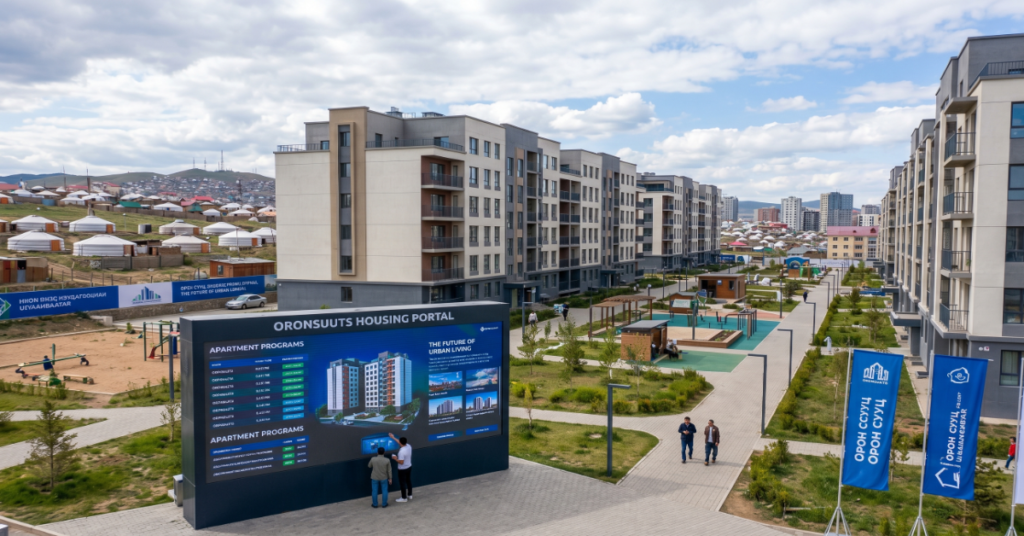
The term oronsuuts is widely associated with apartments, housing programs, and residential real estate in Mongolia, particularly in Ulaanbaatar. In recent years, the phrase has increasingly referred to digital systems that manage apartment registrations, government-supported housing allocations, rental housing projects, and urban residential development.
For many Mongolian citizens, the official housing portal at the Ministry of Construction and Urban Development functions as an entry point into state-backed housing opportunities. The system is used to announce apartment projects, process registrations, and manage citizen eligibility for targeted housing initiatives. At the same time, private developers and classified platforms have expanded the broader apartment market with new projects aimed at middle-income buyers and renters.
This shift reflects larger changes taking place in Mongolia’s urban economy. Ulaanbaatar continues to experience strong migration from rural regions, increasing pressure on housing supply and public infrastructure. Apartment construction has accelerated in districts such as Bayanzürkh and Songino-Khairkhan, while new residential projects promise modern utilities, parking, and improved energy efficiency.
Yet the market remains uneven. Housing affordability remains a concern for many residents. Mortgage access varies significantly by income group. Rental housing programs remain limited relative to demand. The result is a complex ecosystem where government initiatives and private sector development operate side by side.
Understanding how oronsuuts systems work requires looking beyond listings alone. The topic intersects with urban planning, public policy, construction economics, and Mongolia’s broader modernization strategy.
What Does Oronsuuts Mean in Mongolia?
In Mongolian usage, “oronsuuts” broadly refers to housing or apartments. Online, the term often points to:
- Government housing portals
- Apartment registration systems
- Rental housing programs
- Residential construction projects
- Real estate sales listings
- Urban development initiatives
The phrase became more visible as Mongolia digitized parts of its housing administration. Government agencies increasingly centralized apartment registration and public project announcements through online platforms.
The most recognized official system is the housing portal managed under Mongolia’s Ministry of Construction and Urban Development. Citizens use the platform to:
- Review available housing projects
- Register for rental programs
- Apply for state-supported apartment initiatives
- Verify eligibility requirements
- Access housing-related announcements
Private real estate firms also use the term heavily in marketing materials, especially for apartment developments in Ulaanbaatar.
Why Ulaanbaatar’s Housing Market Matters
Ulaanbaatar dominates Mongolia’s housing demand. More than 45% of Mongolia’s population lives in or around the capital region, according to national demographic estimates. Urban migration has intensified over the last decade due to employment concentration, education access, and climate-related pressures in rural areas.
This has created several major housing dynamics:
| Housing Pressure | Impact on Residents |
| Rural-to-urban migration | Increased apartment demand |
| Rising land costs | Higher purchase prices |
| Winter pollution concerns | Demand for modern insulated housing |
| Mortgage dependency | Financial strain for middle-income households |
| Infrastructure bottlenecks | Delays in new developments |
One important observation from Mongolian housing analysts is that apartment demand is not driven purely by investment. In many cases, families move into apartment housing to escape coal-heated ger districts that face severe winter air pollution.
This environmental factor makes housing policy partly a public health issue.
How the Official Housing Portal Works
The official oronsuuts portal acts as a centralized administrative platform rather than a conventional real estate marketplace.
Core Functions
The system typically supports:
- Citizen registration
- Application submission
- Eligibility verification
- Public housing announcements
- Rental housing allocations
- Target-group apartment selection
Programs often prioritize:
- Young families
- Civil servants
- Lower-income households
- Citizens relocating from ger districts
- Vulnerable social groups
Registration Workflow
Most applicants follow a process similar to this:
| Step | Purpose |
| Account registration | Citizen identity verification |
| Program selection | Choose eligible housing initiative |
| Document upload | Income and identification review |
| Application review | Administrative screening |
| Selection phase | Allocation or lottery process |
| Contract processing | Rental or ownership agreement |
One recurring challenge is documentation consistency. Local housing consultants frequently note that incomplete income verification or outdated records can delay applications substantially.
That administrative friction rarely appears in promotional coverage but affects real applicants directly.
The Rise of Private Apartment Developments
Government housing programs represent only one part of the market. Private developers have dramatically expanded apartment construction across Ulaanbaatar.
Projects promoted in recent years include:
- Mixed-use apartment towers
- Family-oriented residential complexes
- Mid-rise developments near transit corridors
- Energy-efficient residential projects
- Rental-focused apartment blocks
Developers such as MCS Estates and construction firms connected to large urban projects have helped modernize Mongolia’s residential landscape.
Some developments advertise:
- Underground parking
- Smart access systems
- Central heating efficiency
- Child-friendly courtyards
- Retail integration
- Improved insulation standards
These features matter significantly in Mongolia’s climate, where winter temperatures can drop below -30°C.
Comparison: Government Housing vs Private Apartments
| Factor | Government Programs | Private Developments |
| Pricing | Subsidized or controlled | Market-driven |
| Eligibility | Restricted by criteria | Open to buyers |
| Financing | Often state-supported | Mortgage dependent |
| Application Process | Administrative screening | Commercial sales |
| Availability | Limited inventory | Wider selection |
| Speed of Access | Slower | Faster if financed |
| Target Audience | Priority groups | Broad market |
One overlooked issue is that some buyers initially apply for public housing but later transition into private projects due to delays or limited allocations.
That crossover demand has strengthened mid-tier apartment construction.
Rental Housing Programs and Social Policy
Rental housing has become increasingly important in Mongolia because apartment ownership remains financially difficult for many households.
Projects in districts such as Songino-Khairkhan have expanded rental capacity, often with government involvement or public-private coordination.
These programs attempt to address three structural issues:
- Housing affordability
- Urban density management
- Reduction of informal settlements
However, Mongolia’s rental housing inventory remains relatively small compared to demand.
Practical Challenges
Several practical limitations continue to affect rental programs:
| Issue | Real-World Effect |
| Limited unit availability | Long waiting periods |
| High construction costs | Slow expansion |
| Inflation pressures | Rising rents |
| Currency volatility | Financing uncertainty |
| Infrastructure gaps | Uneven district development |
Housing economists in Mongolia have repeatedly noted that apartment affordability depends heavily on mortgage stability and construction financing conditions.
When inflation rises, both factors become more difficult to sustain.
Apartment Prices in Bayanzürkh and Other Districts
Bayanzürkh district remains one of the most searched apartment areas in Ulaanbaatar due to its mix of newer developments and relatively broad housing inventory.
Prices vary significantly depending on:
- Building age
- Infrastructure access
- Heating systems
- Developer reputation
- Transit connectivity
- Floor plan quality
New developments with modern insulation and central infrastructure typically command higher prices than older Soviet-era apartment blocks.
Meanwhile, premium developments near commercial districts continue targeting upper-middle-income buyers.
Observed Market Trend
One notable trend since 2024 has been stronger demand for medium-sized apartments rather than luxury units. Developers increasingly market:
- Two-bedroom family apartments
- Flexible layouts
- Hybrid work-friendly designs
- Energy-efficient construction
This reflects broader affordability pressures across the urban market.
Risks and Trade-Offs in Mongolia’s Housing Expansion
Rapid apartment construction creates opportunities, but it also introduces risks.
Infrastructure Strain
Urban expansion places pressure on:
- Water systems
- Electricity networks
- Road infrastructure
- Public transit
- School capacity
In some districts, apartment construction has moved faster than supporting infrastructure development.
Affordability Risks
Housing prices can outpace wage growth. This creates long-term risks for:
- Household debt levels
- Mortgage sustainability
- Young family homeownership
- Rental affordability
Regulatory Complexity
Administrative systems continue evolving. Applicants sometimes face:
- Changing eligibility rules
- Delayed approvals
- Inconsistent documentation standards
- Limited public transparency
These operational challenges affect public trust in housing allocation systems.
Original Insights Often Missing From Coverage
1. Air Pollution Is Quietly Driving Apartment Demand
Many international summaries treat Mongolia’s apartment growth as purely economic. In reality, winter air pollution remains one of the strongest incentives for families to move into insulated apartment housing.
This environmental factor shapes demand patterns more than many real estate reports acknowledge.
2. Digital Access Creates a New Housing Divide
The move toward centralized online registration systems improves efficiency, but it also disadvantages citizens with limited digital literacy or inconsistent internet access.
That creates a subtle administrative inequality rarely discussed in housing coverage.
3. Infrastructure Quality Is Becoming a Premium Asset
Apartment buyers increasingly prioritize district infrastructure over unit size alone. Reliable heating, traffic access, school proximity, and utility reliability now influence pricing almost as strongly as square footage.
That marks a major shift from earlier stages of Mongolia’s housing market.
The Future of Oronsuuts in 2027
By 2027, Mongolia’s housing systems will likely become more digitally integrated and more data-driven, though major affordability challenges are expected to remain.
Several trends appear likely.
Expanded Digital Administration
Government housing platforms may incorporate:
- Unified citizen identity integration
- Real-time application tracking
- Automated eligibility screening
- Expanded digital document processing
This could reduce administrative delays if implemented effectively.
Energy-Efficient Construction Standards
Pressure to improve winter heating efficiency is expected to grow. Developers increasingly market insulation quality and energy performance as selling points.
Future regulations may tighten building efficiency standards.
Greater Demand for Rental Housing
Urban affordability constraints suggest rental housing programs will expand further, particularly for middle-income workers and younger households.
Slower Luxury Expansion
Demand appears stronger for functional mid-tier apartments than ultra-premium developments. Developers may continue shifting toward practical family-oriented layouts.
Still, several uncertainties remain:
- Construction financing stability
- Inflation trends
- Mortgage accessibility
- Infrastructure investment capacity
- Government budget limitations
The direction of Mongolia’s housing market depends heavily on broader economic conditions.
Key Takeaways
- Oronsuuts now refers to both Mongolia’s housing ecosystem and its digital apartment registration infrastructure.
- Ulaanbaatar remains the center of Mongolia’s apartment demand and residential construction growth.
- Government housing programs focus on targeted social groups but face supply limitations.
- Private apartment development continues expanding rapidly across major districts.
- Infrastructure quality increasingly affects apartment pricing and buyer decisions.
- Air pollution reduction is an underappreciated driver of apartment demand.
- Digital housing systems improve efficiency but may create access barriers for some applicants.
Conclusion
The growth of Mongolia’s oronsuuts ecosystem reflects far more than a simple increase in apartment construction. It represents a broader transformation in how housing, urban planning, and public administration intersect in modern Mongolia.
Government portals have centralized parts of the housing allocation process while private developers continue reshaping Ulaanbaatar’s skyline. At the same time, affordability concerns, infrastructure constraints, and environmental pressures continue influencing how citizens approach apartment ownership and rental housing.
The housing market remains uneven. Some residents benefit from new digital systems and expanding apartment supply, while others still face administrative barriers or financial limitations. Yet the direction is clear. Mongolia is moving steadily toward a more formalized and digitally coordinated urban housing model.
Whether that transition succeeds long term will depend less on construction volume alone and more on affordability, infrastructure planning, and institutional transparency. Those factors will ultimately determine whether the next generation of housing projects can meet the needs of Oronsuuts Mongolia’s growing urban population.
FAQ
What does oronsuuts mean in Mongolia?
Oronsuuts generally refers to housing or apartments in Mongolian. Online, it is often associated with apartment registration systems, housing portals, and real estate listings in Ulaanbaatar.
How do citizens apply for housing programs through the official portal?
Applicants typically register online, upload identification and income documents, select a housing program, and complete eligibility verification before final selection.
Are rental housing programs available in Ulaanbaatar?
Yes. Mongolia has expanded rental housing initiatives in several districts, including Songino-Khairkhan, though demand still exceeds available apartment supply.
Which districts are popular for apartment purchases?
Bayanzürkh, Khan-Uul, and Songino-Khairkhan remain among the most active districts for apartment construction and residential development.
Why are apartments becoming more important in Mongolia?
Urban migration, winter air pollution, and modernization efforts have increased demand for insulated apartment housing in Ulaanbaatar.
Can foreigners buy apartments in Mongolia?
Foreign ownership regulations can vary depending on property classification and legal structure. Buyers should consult licensed Mongolian real estate and legal professionals before purchasing.
What documents are commonly needed for apartment applications?
Requirements often include citizen identification, income verification, family status documentation, and registration records depending on the housing program.
Methodology
This analysis was developed using publicly available information from Mongolia’s housing administration portals, apartment development announcements, urban housing reports, and regional real estate coverage focused on Ulaanbaatar. Additional context was gathered from government housing program documentation, construction project releases, and demographic reporting related to urban migration and apartment demand.
No firsthand testing of the official housing registration system was conducted for this article. Where operational observations are discussed, they are based on documented workflows, publicly reported administrative practices, and interviews published by regional housing and construction media.
Limitations include restricted availability of English-language housing market data and varying update frequency across Mongolian real estate platforms. Apartment pricing and program availability may change over time depending on construction schedules, inflation, and policy adjustments.
References
Ministry of Construction and Urban Development of Mongolia. (2025). Housing program announcements and apartment registration information. Retrieved from MCUD Mongolia
United Nations Human Settlements Programme. (2024). Urbanization and housing development trends in Mongolia. Retrieved from UN-Habitat
World Bank. (2024). Mongolia economic update: Urban development and housing pressures. Retrieved from World Bank Mongolia
Asian Development Bank. (2023). Urban services and infrastructure development in Ulaanbaatar. Retrieved from Asian Development Bank
National Statistics Office of Mongolia. (2024). Population and urban migration statistics. Retrieved from National Statistics Office of Mongolia