
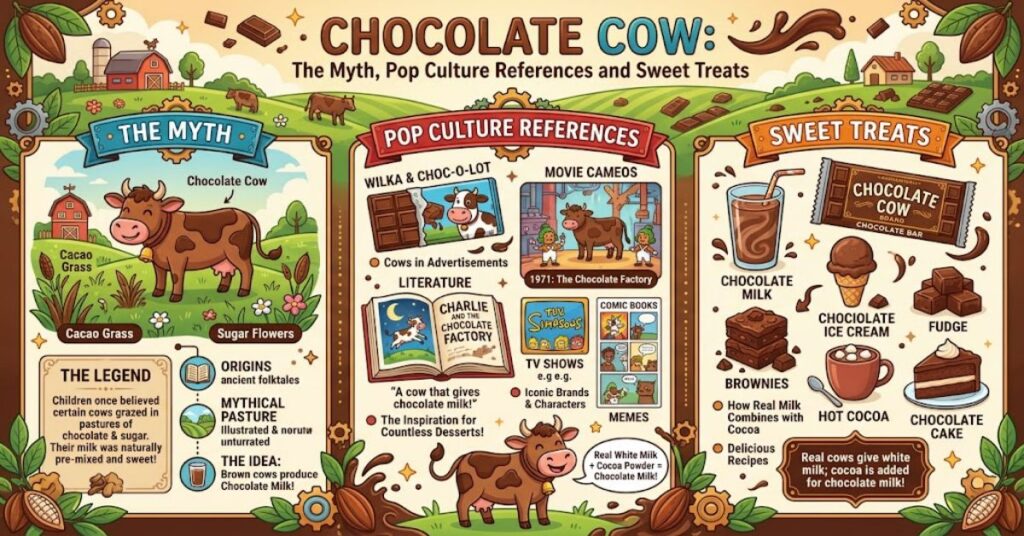
The term chocolate cow can mean several different things, depending on where you encounter it. It may refer to the familiar joke that brown cows produce chocolate milk, a cow-shaped chocolate confection, or a phrase used in entertainment and gaming. There is no single universal meaning, which is why the surrounding context matters.
The agricultural myth is particularly recognisable. Children sometimes wonder whether brown cows produce chocolate milk, but cows produce milk whose composition depends on biological processes, not the colour of their coats. Chocolate milk is made by combining ordinary milk with cocoa or chocolate ingredients.
In food retail, the phrase can describe novelty sweets shaped like cows or chocolate products featuring farm animals. These products vary by manufacturer, and the wording alone does not identify a specific brand.
Online, the same words can take on a different role. A game, social media post, fictional character or humorous conversation might use the expression without referring to a real animal or a particular confectionery product.
This guide explains the origins of the common misconception, the food-related meanings, and how the phrase appears in online culture. It also separates established facts from interpretations that require more context, helping readers understand what they are likely to find when searching for the term.
Why Do People Think Brown Cows Make Chocolate Milk?
The misconception is easy to understand. Chocolate milk is brown, and some familiar dairy breeds have brown coats. For someone who has never seen milk being processed, connecting the colour of the animal with the colour of the drink may seem logical.
The science tells a different story. Milk is produced in the mammary glands, where nutrients from the animal’s bloodstream are used to create milk containing water, fat, proteins, lactose and minerals. Coat colour does not determine whether milk contains cocoa.
The American Farm Bureau Foundation for Agriculture explains that dairy breeds such as Jersey, Brown Swiss and Holstein produce ordinary milk. Chocolate flavour is introduced later by mixing milk with cocoa or chocolate ingredients (American Farm Bureau Foundation for Agriculture, n.d.).
An interesting cultural detail emerged in 2017, when media reports discussed a survey suggesting that 7% of American adults believed chocolate milk came from brown cows. However, researchers at the University of Florida and the University of Oregon questioned how confidently the survey result could be interpreted. Their analysis highlighted the difference between a genuinely held belief and a response influenced by humour or the wording of a question (Griffin & Campbell, 2017).
This distinction matters. A surprising survey statistic can attract attention, but it does not automatically prove that a particular misconception is widespread. The chocolate cow joke is memorable partly because it is simple enough for children to understand and adults to repeat.
Chocolate Cow as a Candy or Confectionery Product
Outside agricultural discussions, the phrase has a literal meaning: chocolate formed into the shape of a cow.
Chocolate makers use moulds to create animals, seasonal figures and novelty gifts. A cow-shaped confection can be made from milk, dark or white chocolate, with contrasting chocolate used to create spots, eyes and other details.
For example, Li-Lac Chocolates sells a handmade chocolate cow in milk or dark chocolate. Its product description identifies the confection as a farm-animal gift, illustrating how the phrase can refer to an actual product rather than a farming myth (Li-Lac Chocolates, n.d.).
The same words can also describe chocolate bars with cow-themed branding. Milka’s Happy Cow product combines milk chocolate and white chocolate, using the contrast between the two colours as part of its visual appeal. Product availability varies by market.
This reveals a useful distinction for shoppers: a chocolate cow may be a three-dimensional confection, a themed chocolate bar or simply a description used by a retailer. The name alone does not establish the ingredients, size or manufacturer.
Before purchasing one as a gift, check the product label for allergens, weight, storage instructions and the type of chocolate used. Moulded sweets may look similar but differ substantially in composition and price.
Different Meanings of Chocolate Cow
| Context | What the phrase means | What to look for |
| Agriculture | A joke or misconception about chocolate milk | Explanations of dairy production |
| Confectionery | A cow-shaped chocolate sweet | Product shape, ingredients and manufacturer |
| Chocolate branding | A cow-themed bar or other sweet | Brand name and packaging |
| Gaming and online culture | A possible joke, character or fictional reference | The game, platform or original post |
| Everyday conversation | A humorous expression | The surrounding sentence |
This table highlights why searching the phrase without context can produce mixed results. Someone looking for a novelty gift needs product information, while someone researching dairy production needs a scientific explanation.
There is also an important difference between a verified product and an unconfirmed cultural reference. A manufacturer may document its confection on an official product page, but a phrase appearing in a comment or game discussion does not establish that it represents a widely recognised character or franchise.
Chocolate Cow in Pop Culture and Gaming
The phrase fits naturally into online humour because it combines an everyday farm animal with an impossible or unexpected food association. It can appear in memes, children’s jokes, game names, user-created characters or informal conversations.
However, the term does not identify one universally recognised gaming character or entertainment franchise. Without a specific title, platform or reference, assigning it to a particular game would risk confusing unrelated uses.
For readers researching a pop culture reference, three checks help narrow the meaning:
- Identify the source: Look for the game, video, social media account or publication where the phrase appeared.
- Check the spelling: Similar names may refer to different products, characters or fictional settings.
- Confirm the date and creator: An original post or official game description is stronger evidence than an unsourced repost.
These checks are useful beyond this particular phrase. Search engines combine results based on overlapping words, not necessarily because all results describe the same subject. A confectionery listing and a gaming discussion can therefore appear together even when they have no connection.
What Chocolate Cow Reveals About Food Marketing
Cow imagery has a strong connection with dairy products. Brands use animal illustrations, pastoral scenes and familiar farm colours to suggest milk, creaminess and traditional production. Chocolate products can borrow these visual cues even when the phrase has no connection to how the ingredients are made.
The design of a product can also shape expectations. A bar combining white and brown chocolate may visually suggest a spotted cow, while a solid chocolate figure uses the animal’s silhouette as the main selling point.
There are three practical insights here.
First, visual branding is not a substitute for ingredient information. A cow illustration may communicate a dairy association, but it does not establish the proportion of milk solids, cocoa or sugar in a product.
Second, the product format affects the buying decision. A moulded chocolate animal is often purchased as a novelty gift, while a chocolate bar is usually intended for everyday consumption. The same descriptive phrase can therefore lead to very different expectations about price and portion size.
Third, search intent matters to both buyers and publishers. A page about the agricultural myth should answer the question directly, while a product page should state the manufacturer, ingredients and availability. Mixing these purposes without clear headings can leave readers uncertain about what they are viewing.
These distinctions help explain why the term attracts interest despite having no single fixed definition.
The Future of Chocolate Cow in 2027
By 2027, the phrase is likely to remain useful as a food-related joke, a product description and an occasional online reference. Its future will depend less on technological change than on how retailers, confectioners and internet users employ familiar imagery.
For confectionery, product discovery will continue to depend on clear descriptions, accurate photographs and ingredient information. Digital retail makes it easier to find unusual shapes and themed gifts, but stock and delivery options will still depend on the seller and location.
Food education will also remain relevant. Agricultural organisations can use simple misconceptions to explain where food comes from, how dairy production works and why processing changes the appearance and flavour of ingredients.
There is no reliable evidence that chocolate cow will become a distinct global entertainment trend in 2027. Any claim that a particular game, brand or character will dominate searches would be speculative without documented audience or search data.
The most dependable approach is to treat the phrase as context-dependent. A specific product, source or cultural reference should determine the meaning rather than assumptions based on the words alone.
Key Takeaways
- The chocolate milk myth confuses an animal’s appearance with the way milk is produced.
- Chocolate cow can describe a real confection, including solid chocolate figures shaped like cattle.
- Cow-themed packaging is a marketing choice, not evidence of a product’s precise ingredients or nutritional value.
- Survey findings about agricultural knowledge need context, especially when humour may influence responses.
- Gaming and pop culture references should be tied to an identifiable source before being presented as established facts.
- Product descriptions, ingredient labels and manufacturer information help distinguish similar-looking sweets.
- Search results can mix unrelated meanings, making context essential when researching unusual phrases.
Conclusion
Chocolate cow is a simple phrase with several possible meanings. It can prompt a conversation about dairy science, describe a novelty chocolate gift or appear as a humorous reference in online culture. Understanding which meaning applies requires attention to context rather than assuming that every result refers to the same subject.
The agricultural misconception is the clearest starting point. Cows do not produce chocolate milk naturally; chocolate ingredients are added during food processing. Meanwhile, confectioners use cow-shaped moulds and dairy-inspired branding to create products that appeal to shoppers looking for distinctive sweets and gifts.
The phrase’s broader appeal shows how food, humour and familiar imagery can overlap. It also offers a useful lesson in interpreting online information: a memorable name is not enough to establish a product’s identity or a cultural reference’s origin.
For readers, the most reliable approach is straightforward. Check scientific explanations for farming questions, manufacturer information for confectionery, and original sources for gaming or entertainment references. That method separates established facts from playful assumptions without removing the humour that makes the expression memorable.
Frequently Asked Questions
What does chocolate cow mean?
It can refer to a cow-shaped chocolate confection, a cow-themed chocolate product, the myth that brown cows produce chocolate milk, or an informal online reference. The intended meaning depends on context.
Do brown cows produce chocolate milk?
No. Dairy cows produce milk naturally, regardless of coat colour. Chocolate milk is made by adding cocoa or chocolate ingredients to ordinary milk.
Is there a chocolate cow candy?
Yes. Confectioners make chocolate figures shaped like cows, and some brands sell cow-themed chocolate bars. Products differ in ingredients, size and availability.
What is Milka Happy Cow chocolate?
Milka Happy Cow is a milk-and-white-chocolate product. Its contrasting colours create a cow-inspired appearance. Availability and packaging may vary between markets.
Is Chocolate Cow a video game character?
The phrase may appear in gaming or online discussions, but it does not identify one universally established character. A game title or original source is needed to confirm a specific reference.
Why do chocolate brands use cows on their packaging?
Cow imagery helps communicate associations with milk, dairy ingredients and farm life. It can also make a product recognisable, but the packaging alone does not establish its nutritional composition.
How can I find the right chocolate cow product?
Search using additional details such as the manufacturer, country, chocolate type or packaging. Check the ingredient list, allergen information and seller details before buying.
References
American Farm Bureau Foundation for Agriculture. (n.d.). Do brown cows produce chocolate milk?
Griffin, L., & Campbell, T. (2017). Take that chocolate milk survey with a grain of salt. University of Florida.
Li-Lac Chocolates. (n.d.). Cow: Chocolate novelty gift. Product information.
Strauss Group. (n.d.). Cow Chocolate. Company and product information.
Methodology
This article was prepared using agricultural education material, university commentary on survey interpretation and confectionery product descriptions. These sources support the distinction between the chocolate milk misconception, real chocolate products and context-dependent cultural references.
No independent product testing, interviews or original field research were conducted. The examples demonstrate documented uses of the phrase rather than an exhaustive catalogue of every product or online reference. The existence of a particular gaming character or emerging cultural trend should not be assumed without further evidence.
Product availability, ingredients and branding can change. Before publication, a human editor should verify the references against their original sources, confirm any brand-specific claims, and check the publication’s author credentials.
Editorial disclosure: This article was drafted with AI assistance and requires human editorial review and verification before publication.