
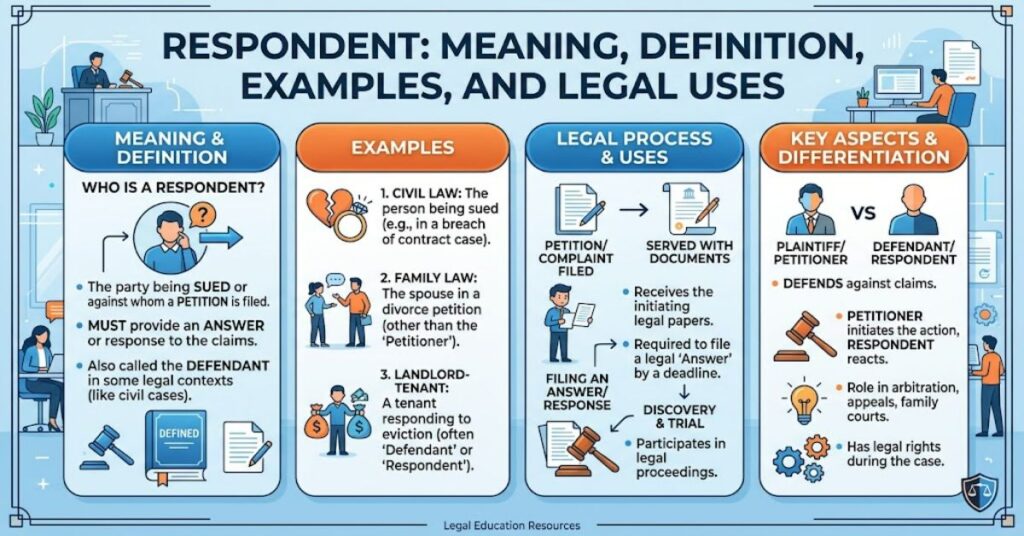
The word respondent describes someone who responds to a question, request, survey, or formal claim. Its precise meaning depends on the situation in which it appears. In everyday communication, a respondent may be anyone who answers a question. In academic research, the term usually refers to a participant who provides information through a questionnaire or interview. In legal proceedings, it commonly identifies the party required to answer an application, petition, or appeal.
Understanding this distinction helps readers interpret documents, research reports, questionnaires, and court-related information correctly. Although respondent and participant can sometimes describe the same person, they are not always interchangeable. A participant may take part in an experiment or activity, while a respondent specifically provides answers or responses.
The term also appears in business research, customer feedback programmes, public opinion polls, and government surveys. In these settings, respondents help organisations understand public attitudes, identify customer needs, and evaluate services.
This guide explains the main definitions, compares the word with related terms, and explores how it is used in different fields. It also examines important considerations when collecting responses, interpreting survey results, or reading legal documents.
What Does Respondent Mean?
A respondent is a person who responds to a question, communication, survey, or formal proceeding. The word comes from the idea of responding, meaning to answer or react to something.
For example, if a researcher asks 500 people to complete a questionnaire about public transport, the people who submit answers are respondents. Similarly, when a court application requires another party to reply, that party may be called the respondent.
The shared meaning is straightforward: a respondent provides a response. However, the purpose and consequences of that response differ across contexts.
A survey response may contribute to statistical analysis, while a legal response may address allegations or arguments presented by another party.
How the Term Is Used in Different Contexts
1. Respondent in Surveys and Research
In research, respondents are people who answer questions designed to collect information. Researchers may gather responses through online forms, telephone interviews, face-to-face interviews, or written questionnaires.
For example, a university studying student satisfaction might ask students about teaching quality, facilities, and assessment methods. Students who complete the questionnaire become respondents.
Their answers can help researchers identify patterns, compare groups, and evaluate experiences. However, results depend on the quality of the questions, the selection of respondents, and the number of people who participate.
A large survey is not automatically representative. If responses mainly come from one demographic group, the findings may not accurately reflect the wider population.
2. Respondent in Legal Proceedings
In law, a respondent is generally the person or organisation answering a formal application, petition, or appeal. The precise definition depends on the legal system and type of proceeding.
For example, in certain appellate proceedings, one party challenges a decision while the opposing party responds to that challenge. The latter may be identified as the respondent.
The term is not identical to defendant in every situation. A defendant is commonly the party against whom a civil claim or criminal charge is brought, while a respondent often appears in proceedings initiated by an application or appeal.
Legal terminology varies by jurisdiction, so readers should examine the specific court document rather than assume the roles are interchangeable.
3. Respondent in Business and Customer Feedback
Businesses use respondents to describe people who answer customer satisfaction surveys, product questionnaires, and market research studies.
A company might ask customers to rate delivery speed, product quality, or customer service. The responses can reveal recurring complaints and areas for improvement.
However, feedback requires careful interpretation. Customers who are particularly satisfied or dissatisfied may be more likely to answer than those with neutral opinions. This response bias can affect conclusions.
4. Respondent in Education
Educational institutions may use questionnaires to understand student experiences, teaching methods, and learning environments.
For example, a school might ask parents about communication with teachers. Parents who submit completed forms are respondents.
Their feedback can inform decisions, but it should be considered alongside other evidence, such as attendance records, academic outcomes, and direct discussions.
Respondent vs. Participant, Defendant, and Interviewee
These terms overlap, but each has a distinct emphasis.
| Term | Meaning | Typical context |
| Respondent | Someone who answers or replies | Surveys, research, legal proceedings |
| Participant | Someone who takes part in an activity or study | Experiments, studies, events |
| Defendant | A party against whom a legal claim or criminal charge is brought | Civil or criminal proceedings |
| Interviewee | A person answering an interviewer’s questions | Journalism, recruitment, research |
| Recipient | Someone who receives something | Communication, deliveries, correspondence |
The best term depends on the person’s role. Someone completing a questionnaire is a respondent. Someone taking part in a practical experiment is a participant, although that person may also answer research questions. A person interviewed for a job is an interviewee.
Important Facts About Respondents
| Factor | Explanation |
| Main function | Provides an answer or response |
| Research method | Surveys, interviews, questionnaires |
| Legal role | Responds to an application or appeal in relevant proceedings |
| Data quality | Depends on accurate answers and suitable research design |
| Common limitation | Non-response and response bias can distort findings |
One important distinction is between the number of people invited and the number who actually respond. Researchers must not treat these figures as equivalent.
For example, if 1,000 people receive a questionnaire and 300 complete it, the response rate is 30%. That figure alone does not establish whether the findings are reliable or representative. The sampling method, question design, and characteristics of non-respondents also matter.
Risks and Practical Considerations
Respondents can provide valuable information, but their answers may be incomplete, inaccurate, or influenced by the way questions are written.
Leading questions can encourage particular answers. Confusing wording may produce inconsistent interpretations. Privacy concerns may also discourage people from providing honest information.
Researchers can reduce these risks by using neutral questions, explaining how information will be handled, testing questionnaires before launch, and reporting limitations transparently.
In legal contexts, the main concern is different. A respondent may face deadlines, procedural requirements, and legal consequences when answering an application. Anyone involved in an actual proceeding should consult the relevant rules or a qualified legal professional.
The Future of Respondents in 2027
By 2027, online surveys, mobile questionnaires, and automated research tools are likely to remain important ways of collecting responses. Organisations may increasingly use artificial intelligence to organise open-ended answers and identify recurring themes.
These tools can improve processing speed, but they cannot automatically guarantee accuracy. Automated systems may misinterpret sarcasm, cultural expressions, or ambiguous wording. Researchers will still need to check results and protect respondents’ personal information.
Privacy rules and expectations around informed consent will also remain important. The specific obligations will depend on the jurisdiction, type of data, and purpose of collection.
The most useful approach will combine efficient digital methods with transparent practices, careful analysis, and respect for the people providing information.
Frequently Asked Questions
1. What is a respondent in simple words?
A respondent is someone who answers a question, survey, or formal request. The meaning can vary depending on whether the word appears in research, everyday communication, or a legal document.
2. What is a respondent in research?
In research, a respondent is someone who provides answers to a questionnaire, survey, or interview. Researchers analyse these answers to understand opinions, experiences, or behaviours.
3. Is a respondent the same as a participant?
Not always. A respondent specifically provides a response, while a participant takes part in an activity or study. One person can fulfil both roles.
4. What does respondent mean in court?
A respondent is generally the party answering an application, petition, or appeal. The exact legal meaning depends on the jurisdiction and type of proceeding.
5. What is the difference between a respondent and a defendant?
A defendant is commonly a party facing a civil claim or criminal charge. A respondent typically answers an application or appeal. Their roles depend on the legal procedure involved.
6. Can one survey have many respondents?
Yes. Surveys can include hundreds or thousands of respondents. The usefulness of the results depends on sampling, response quality, and whether the answers represent the population being studied.
Conclusion
The term respondent has a consistent central meaning: a person or organisation that answers or responds to something. Its specific role, however, depends on context. In surveys, respondents supply information that researchers analyse. In business, they provide feedback that can inform decisions. In legal proceedings, they generally answer an application, petition, or appeal.
Distinguishing respondents from participants, interviewees, and defendants helps prevent misunderstandings. It is especially important when interpreting research findings or reading legal documents, where terminology can affect how information is understood.
Respondents are valuable sources of information, but their answers must be interpreted carefully. Survey design, response rates, privacy, and potential bias all influence the usefulness of collected data. Likewise, legal terminology should be understood within the applicable jurisdiction and procedure.
Ultimately, knowing what a respondent is makes it easier to understand questionnaires, research reports, customer feedback, and formal proceedings.
Methodology
This article uses established definitions and general terminology associated with survey research, communication, and legal procedure. The explanations distinguish common usage from context-specific meanings and avoid treating legal terminology as identical across jurisdictions. The examples are illustrative rather than claims of firsthand research or legal practice. Before publication, an editor should verify legal definitions against the relevant jurisdiction’s court rules and confirm any research-methodology claims against authoritative academic sources. This article was drafted with AI assistance and requires editorial review before publication.