
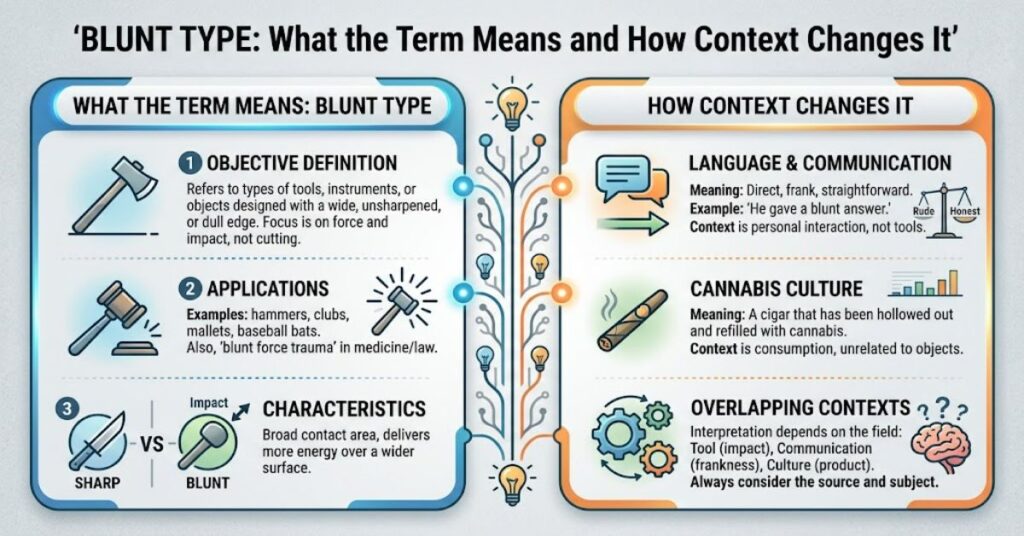
The phrase “blunt type” looks straightforward, but its meaning depends heavily on context. In ordinary English, blunt can describe something with a dull edge, such as a blunt blade, or a person who communicates directly without trying to soften their words. In slang, particularly in discussions about cannabis, a blunt is a large cigarette or cigar containing cannabis. Cambridge Dictionary records both the ordinary adjective meanings and the cannabis-related noun usage.
That makes searches for “blunt type” unusually broad. Someone looking for a definition may be asking about a physical object, a personality or communication style, or cannabis terminology. Treating all three meanings as interchangeable creates confusion.
The cannabis meaning also requires additional context in the UK. Cannabis is a Class B controlled drug, and GOV.UK states that possession, supply, production, import and export are unlawful except where permitted under the relevant licensing framework.
This guide separates the meanings, explains how the terminology is used, and considers the practical distinction between a blunt object, a blunt communication style and a cannabis blunt. It also covers health and legal considerations without presenting recreational drug use as a practical activity.
What Does “Blunt Type” Mean?
There is no single technical definition of “blunt type”. Instead, the phrase combines the word blunt with a category or classification.
The most common interpretations fall into three groups:
| Context | Meaning of “blunt” | Typical example |
| Physical object | Dull or lacking a sharp point or edge | A blunt knife |
| Communication | Direct, plain-spoken or insufficiently tactful | A blunt answer |
| Cannabis slang | A cigar or cigar wrapper containing cannabis | A cannabis blunt |
The first two meanings are standard English. The third is slang usage that has become established enough to appear in major dictionaries. Cambridge Dictionary defines the cannabis-related noun as a large cigarette or cigar containing cannabis.
The important point is that “blunt type” does not automatically identify cannabis. A sentence such as “What blunt type of tool is this?” could relate to a physical object, while “He has a blunt type of personality” concerns communication.
Blunt as a Physical Description
The physical meaning of blunt is generally the simplest.
An object is blunt when its edge or point is not sharp. A blunt pencil may struggle to create a precise line, while a blunt cutting instrument is less capable of making a clean cut.
The term is relative rather than absolute. An object can be less sharp than intended without being completely rounded. In technical or practical settings, the distinction between sharp, dull and blunt may depend on the object’s intended function.
This meaning appears across everyday language, engineering, tools and safety discussions. The central idea is reduced sharpness.
A useful distinction is that bluntness describes geometry or condition, not necessarily poor quality. A deliberately rounded object may be designed to minimise injury, while a cutting tool may become blunt through wear.
Blunt as a Personality or Communication Style
Blunt can also describe the way someone communicates.
A blunt person tends to state an opinion directly rather than using diplomatic language. That does not automatically mean the person is dishonest or intentionally rude. Directness and tact are separate characteristics.
For example, saying “That proposal has serious weaknesses” is more blunt than saying “There may be a few areas that could be reconsidered.” Both statements can communicate essentially the same assessment, but the first is more direct.
The social effect depends on context. Direct communication may be valued in situations where clarity matters, while the same style can appear insensitive in personal conversations.
This is why calling someone “blunt” can be descriptive without necessarily being a complete judgement of their personality.
Blunt Type in Cannabis Terminology
In cannabis terminology, a blunt generally refers to cannabis contained in a cigar or cigar wrapper. The US Centers for Disease Control and Prevention includes blunts among methods of smoking cannabis and describes them as cigars or cigar wrappers that have been partly or completely refilled with cannabis.

The term has a different meaning from a standard cigarette or a typical cannabis joint, although everyday terminology can vary by region and community.
The distinction can also matter because the wrapper may introduce tobacco exposure. A conventional cigar is made using tobacco leaf or a material containing tobacco, and cigar smoke contains toxic compounds and cancer-causing chemicals.
This makes “blunt type” a potentially misleading phrase if it is used as though every blunt has identical contents or health implications. The materials, cannabis composition and tobacco exposure can vary.
Cannabis Blunts and Health Considerations
The method of smoking does not remove the risks associated with inhaling smoke.
The CDC states that smoked cannabis can harm lung tissue and that cannabis smoke contains many of the same toxins, irritants and carcinogens found in tobacco smoke. It also associates cannabis smoking with respiratory symptoms including coughing, mucus production and bronchitis.
The wrapper can create an additional issue where tobacco is involved. Tobacco contains nicotine, which is addictive, and cigar smoke exposes users to toxic substances even when the smoke is not deeply inhaled.
| Consideration | Why it matters |
| Cannabis smoke | Can irritate and damage respiratory tissue |
| Tobacco wrapper | May add nicotine and tobacco-related toxic exposure |
| THC | Can impair perception, judgement and other functions |
| Unknown products | Illicit cannabis may have uncertain strength or composition |
| Repeated smoking | Can increase cumulative exposure to smoke-related harms |
The NHS also warns that the risks of THC-containing cannabis products are not fully understood and notes that illegally obtained cannabis can have unknown strength and contents.
The practical lesson is that the word blunt describes a form of cannabis consumption, not a measure of safety.
Legal Context in the UK
For UK readers, the legal distinction is important.
Cannabis is a Class B controlled drug under the Misuse of Drugs Act 1971. GOV.UK states that possessing, supplying, producing, importing or exporting cannabis is unlawful except under the applicable licensing arrangements.
GOV.UK also states that Class B possession can carry a maximum penalty of up to five years in prison, an unlimited fine, or both, while supply and production can carry substantially higher maximum penalties. Actual enforcement and sentencing depend on the circumstances of a case.
The Crown Prosecution Service further identifies supplying or sharing controlled drugs as an offence.
This is one reason an apparently casual slang term can have consequences beyond vocabulary. A person researching the term should distinguish dictionary meaning from the legal status of the activity it describes.
Three Meanings at a Glance
| Meaning | Domain | Core idea | Main context |
| Blunt object | Tools and physical objects | Not sharp | Condition or design |
| Blunt communication | Language and behaviour | Direct and unsoftened | Personality or speech |
| Cannabis blunt | Drug terminology | Cannabis in a cigar or cigar wrapper | Cannabis culture and slang |
This comparison also reveals an important linguistic point: the meanings are related only through the shared word. They should not be treated as different “types” of the same object.
Risks and Trade-Offs in Using the Term
The main risk with “blunt type” is ambiguity.
A health article may use blunt to mean a cannabis product, while an engineering discussion may use it to describe an edge. A workplace conversation may use blunt to describe a manager’s communication style.
Search engines can identify contextual signals, but readers still need to understand the distinction. Writers should therefore define the term early when an article has more than one plausible interpretation.
There is also a cultural issue. Cannabis slang can vary across countries and communities. A term that is familiar in one setting may be misunderstood elsewhere. UK readers may encounter American terminology online, particularly because much cannabis vocabulary has circulated through music, film and social media.
The Future of Blunt Type in 2027
The three core meanings of blunt are unlikely to disappear in 2027. The more significant change will be in how digital platforms distinguish ordinary language from drug-related terminology.
Cannabis policy remains an area of regulatory attention in the UK, but the legal position should not be confused with the growing availability of information about cannabis. GOV.UK continues to identify cannabis as a controlled Class B drug, while NHS guidance distinguishes controlled medical cannabis from recreational or illicit products.
For publishers, the likely challenge is contextual accuracy. Search queries increasingly combine slang with ordinary vocabulary, making precise definitions more useful than assuming a single interpretation.
The safest editorial approach is therefore simple: identify the meaning being discussed, distinguish legal facts from cultural usage, and avoid presenting slang as a technical classification.
Key Takeaways
- “Blunt type” is an ambiguous phrase rather than a single established technical category.
- In ordinary English, blunt can describe a dull object or direct communication.
- In cannabis slang, a blunt refers to cannabis contained in a cigar or cigar wrapper.
- Smoking cannabis can expose the lungs to harmful smoke and toxic compounds.
- Tobacco-containing wrappers can add nicotine and tobacco-related risks.
- Cannabis remains a controlled Class B drug under UK law.
- Context is essential when interpreting the word blunt in online searches and everyday conversation.
Conclusion
The meaning of “blunt type” depends almost entirely on context. In physical descriptions, blunt refers to a lack of sharpness. In communication, it describes direct expression that may leave little room for diplomatic wording. In cannabis terminology, it refers to a cigar or cigar wrapper containing cannabis.
Those meanings should be kept separate because they carry very different practical implications. The cannabis usage, in particular, involves health and legal considerations that do not apply to the ordinary adjective.
For UK readers, the legal position is especially important: cannabis remains a Class B controlled drug, and recreational possession and supply are subject to criminal law. Health evidence also shows that smoking cannabis is not risk-free, particularly for respiratory health.
Understanding the terminology is therefore more useful than treating “blunt” as a single category. The surrounding words, subject and purpose of the discussion determine what the term actually means.
FAQ
What is a blunt type?
“Blunt type” is not a single formal category. Depending on context, blunt can describe a dull object, a direct communication style or a cannabis cigar. The surrounding language determines which meaning applies.
What is a blunt in cannabis terminology?
A cannabis blunt generally refers to cannabis contained in a cigar or cigar wrapper. The CDC recognises blunts as one form of smoked cannabis use.
Is a blunt the same as a joint?
Not necessarily. The terms generally describe different forms of cannabis smoking, with a blunt associated with a cigar or cigar wrapper. Terminology can vary between regions and communities.
What does it mean if someone is blunt?
Calling someone blunt usually means they communicate directly and express their opinions without much softening. The word can describe clarity, but depending on circumstances it can also suggest a lack of tact.
Is cannabis legal in the UK?
Recreational cannabis remains a controlled substance in the UK. Cannabis is classified as Class B, and possession, supply and production are subject to criminal law, subject to specific legal exceptions and licensing arrangements.
Are blunts harmful to the lungs?
Smoking cannabis can expose the lungs to harmful smoke, toxins and irritants. The CDC reports that smoked cannabis can damage lung tissue and is associated with respiratory symptoms.
Methodology
This article was prepared as a terminology and contextual analysis rather than a first-hand product test. Definitions were checked against Cambridge Dictionary, while cannabis-related health information was validated against the US Centers for Disease Control and Prevention and NHS material. UK legal information was checked against GOV.UK, the Misuse of Drugs Act 1971 and Crown Prosecution Service guidance.
No firsthand smoking test, product assessment or personal experience is claimed. This is a limitation because terminology and cannabis practices can vary between communities and jurisdictions. Legal information describes the UK position as available in September 2026 and should not be treated as individual legal advice.
Editorial disclosure: This article was drafted with AI assistance and requires human editorial review. Statistics, legal claims, citations and named sources should be independently confirmed before publication.
References
Cambridge Dictionary. (2026). Blunt. Cambridge University Press & Assessment.
Centers for Disease Control and Prevention. (2024). Cannabis and lung health. CDC.
Centers for Disease Control and Prevention. (2025). Cannabis frequently asked questions. CDC.
Centers for Disease Control and Prevention. (2024). Cigars. CDC.
Crown Prosecution Service. (2026). Drug offences. CPS.
GOV.UK. (2026). Drugs penalties. UK Government.
GOV.UK. (2026). Drug licensing factsheet: Cannabis, CBD and other cannabinoids. UK Government.
NHS. (2026). Medical cannabis. NHS.