
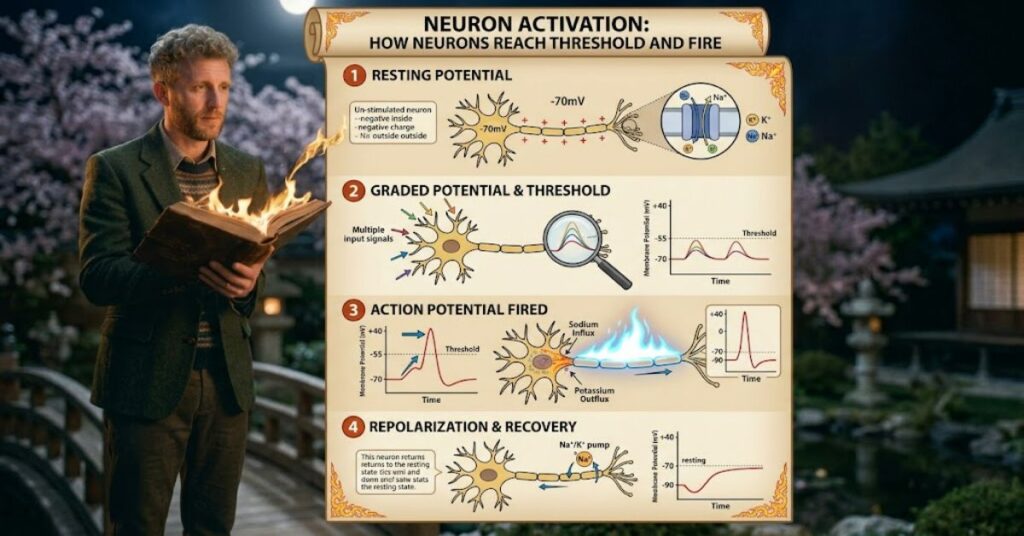
Neuron activation is the process through which a nerve cell responds to incoming signals and, when sufficient electrical change occurs, generates an action potential. In simple terms, neuron activation happens when the membrane potential of a neuron reaches the threshold required for firing. The resulting electrical impulse travels along the axon and allows the neuron to communicate with other cells.
Neurons are specialised for rapid electrical and chemical communication. They receive information through their dendrites and cell body, integrate those signals and may generate an action potential near the beginning of the axon. This electrical event then travels towards the axon terminal, where it can influence communication across a synapse.
The process depends largely on the controlled movement of ions across the cell membrane. Sodium ions are particularly important during the rapid depolarisation phase, while potassium ions contribute strongly to repolarisation and recovery.
Understanding neuron activation is useful because it explains one of the basic mechanisms behind sensation, movement, learning and communication within the nervous system. However, the familiar idea of a neuron simply switching “on” or “off” is an oversimplification. Neurons continuously integrate excitatory and inhibitory inputs before deciding whether to fire.
What Happens During Neuron Activation?
A neuron normally maintains a resting membrane potential, meaning the inside of the cell is electrically negative relative to the outside. The exact voltage varies between neuron types, but a value around −60 to −70 millivolts is commonly used as a general reference.
When signals arrive, they can change this electrical balance. Excitatory inputs usually produce depolarisation, making the membrane less negative. Inhibitory inputs can make firing less likely by opposing depolarisation or increasing the distance from threshold.
If enough excitatory influence accumulates, the membrane potential reaches threshold. Voltage-gated sodium channels then open rapidly, allowing sodium ions to enter the neuron. This produces further depolarisation and creates the rising phase of the action potential.
| Stage | What happens | Main process |
| Resting state | Membrane maintains a negative potential | Ion gradients remain established |
| Depolarisation | Membrane becomes less negative | Sodium enters |
| Threshold | Critical voltage is reached | Action potential begins |
| Repolarisation | Voltage moves back towards resting level | Potassium exits |
| Hyperpolarisation | Membrane briefly becomes more negative | Potassium conductance remains elevated |
| Recovery | Membrane returns towards baseline | Ion channels reset |
This sequence happens extremely quickly, allowing neurons to communicate over long distances in fractions of a second.
How an Action Potential Begins
Threshold is the key control point in neuronal firing.
When depolarisation reaches the required level, voltage-gated sodium channels open. Sodium enters the cell, causing further depolarisation. This positive-feedback mechanism rapidly drives the membrane potential upwards.
Sodium channels then become inactivated. At approximately the same time, potassium channels allow potassium ions to leave the cell. This causes repolarisation, bringing the membrane voltage back towards its resting state.
The membrane may briefly become more negative than its resting level. This period is called hyperpolarisation.
One important characteristic of an action potential is its all-or-none nature. Once threshold is reached, a neuron normally produces a full action potential rather than a smaller version of one. However, this does not mean neural information is simply binary. Information can be represented through firing rate, timing and coordinated patterns of activity across groups of neurons.
Neuron Activation and Threshold
Threshold prevents every tiny electrical fluctuation from producing an action potential.
Neurons constantly receive signals, and many of these signals remain below the level required for firing. The cell effectively integrates these inputs. Several excitatory signals arriving close together may combine, while inhibitory signals can reduce the likelihood of reaching threshold.
The threshold itself should not be viewed as one universal number shared by every neuron. Different neurons have different membrane properties, ion-channel distributions and patterns of connectivity. Their excitability can also change depending on their recent activity and physiological conditions.
This is an important distinction between the simplified classroom model and modern neuroscience. Neurons are dynamic systems rather than fixed electrical switches.
Factors That Influence Neuronal Excitability
Several factors determine whether a neuron will fire.
Synaptic input: Excitatory and inhibitory signals influence the neuron’s membrane potential.
Ion channels: The type, number and location of ion channels affect how easily a neuron generates electrical activity.
Membrane properties: The electrical resistance and capacitance of the cell influence how incoming currents change voltage.
Firing history: After an action potential, neurons temporarily enter periods during which producing another action potential can be difficult or impossible.
Network activity: A neuron’s behaviour is influenced by the surrounding neural circuit. Excitation and inhibition work together to regulate activity.
These factors explain why neuron activation cannot be understood solely by looking at one electrical event. The action potential is the outcome of several interacting mechanisms.
Why Neuron Activation Matters
Once generated, an action potential propagates along the axon. In myelinated neurons, electrical signalling can travel rapidly by effectively jumping between exposed sections of the axon called nodes of Ranvier. This process, known as saltatory conduction, contributes to rapid communication.
At the axon terminal, the electrical signal can trigger the release of neurotransmitters. These chemical messengers cross the synaptic gap and influence another neuron or target cell.
This creates a basic communication chain:
Input → membrane change → threshold → action potential → axon propagation → synaptic communication
The same general principle supports very different functions. Sensory neurons use electrical signalling to transmit information about the environment. Motor neurons help control muscles. Other neural circuits contribute to attention, memory, emotion and complex decision-making.
Three Important Insights About Neuron Activation
1. Firing is the result of integration.
A neuron usually receives many inputs rather than one isolated command. Its final electrical response reflects the combined influence of excitatory and inhibitory signals.
2. Threshold is dynamic.
Neuronal excitability can change because of ion-channel activity, recent firing and longer-term cellular adaptations. A neuron does not necessarily have one permanently fixed threshold throughout its life.
3. Timing matters.
Two neurons can produce similar numbers of action potentials while contributing differently to a neural circuit because their signals occur at different times. Temporal patterns are therefore important to nervous-system function.
Risks and Limitations of the Simplified Model
The basic model of resting potential, threshold and action potential is essential for learning neurophysiology, but it leaves out significant complexity.
Different neuron types express different combinations of ion channels. This affects their firing patterns, recovery periods and responses to stimulation. Some neurons fire regular trains of action potentials, while others can produce bursts or highly specialised patterns.
Electrical activity can also interact with longer-term biological processes. Neuronal activity can influence intracellular signalling, gene expression and synaptic plasticity. This means an electrical impulse is not necessarily an isolated event; repeated activity can contribute to longer-lasting changes within neural circuits.
The Future of Neuron Activation in 2027
By 2027, research into neuron activation is expected to continue moving towards more precise descriptions of how individual cells interact with larger neural networks.
A major research challenge is understanding how neurons maintain stable activity while remaining capable of adaptation. Scientists are increasingly examining excitability across multiple timescales, from rapid ion-channel changes to longer-term cellular adjustments.
Advances in neural recording and stimulation technologies are also allowing researchers to examine neuronal activity with increasingly high spatial and temporal precision. These developments may improve understanding of neurological disorders and support research into future treatments, although translating laboratory findings into routine clinical applications remains complex.
Key Takeaways
- Neurons maintain a resting membrane potential before receiving activating inputs.
- Excitatory signals can move the membrane towards threshold.
- Reaching threshold initiates an action potential.
- Sodium contributes strongly to depolarisation, while potassium supports repolarisation.
- Action potentials are all-or-none electrical events.
- Neuronal excitability varies between cells and can change over time.
- Neural information depends on patterns and timing as well as individual spikes.
Conclusion
Neuron activation is a tightly controlled process that allows nerve cells to transform incoming information into electrical signals. When excitatory inputs bring the membrane to threshold, voltage-gated sodium channels initiate an action potential. Potassium currents then help restore the membrane towards its resting state.
Although this sequence is straightforward, real neural systems are considerably more complex. Neurons receive thousands of inputs, interact with inhibitory and excitatory networks and possess different combinations of ion channels. Their activity can also influence longer-term cellular processes.
The action potential is therefore only one part of neuronal communication. Its importance comes from how it fits into a wider system of electrical signalling, synaptic transmission and network coordination. Understanding that relationship provides the foundation for studying how the nervous system senses, communicates, learns and controls behaviour.
FAQ
What is neuron activation?
Neuron activation is the process through which a nerve cell responds to incoming signals and may generate an action potential when its membrane potential reaches the required threshold.
What triggers neuron activation?
Excitatory synaptic inputs can depolarise a neuron. If their combined effect is strong enough to reach threshold, voltage-gated ion channels generate an action potential.
What happens when a neuron reaches threshold?
Voltage-gated sodium channels open rapidly, allowing sodium ions to enter the cell. This produces rapid depolarisation and starts the action potential.
Is neuron activation the same as an action potential?
No. Activation describes the broader process of a neuron responding to signals. An action potential is the specific electrical event produced after threshold is reached.
Which ions are involved in neuron activation?
Sodium and potassium are the main ions involved in the classic action-potential sequence. Sodium contributes to depolarisation, while potassium contributes to repolarisation.
Can a neuron receive signals without firing?
Yes. A neuron can experience subthreshold changes in membrane potential without generating an action potential. These changes can influence whether it eventually reaches threshold.
Why is neuron activation important?
It allows electrical information to travel through neural circuits. Action potentials enable communication between neurons and help support sensory processing, movement and many higher nervous-system functions.
Methodology
This article was prepared using established neuroscience and biomedical reference material, with emphasis on neuronal membrane potential, action potentials, ion-channel activity, threshold and synaptic communication.
The physiological sequence was cross-checked against established biomedical literature and peer-reviewed neuroscience research. The article distinguishes established physiological mechanisms from broader interpretations about neural-network behaviour.
No firsthand laboratory experiment or original neuronal recording was conducted for this article. The discussion therefore does not present simulated observations as firsthand evidence. A human editor should verify all scientific claims and references against the original publications before publication.
Editorial disclosure: This article was drafted with AI assistance and should be reviewed and independently verified by the RubbleMagazine.co.uk editorial team before publication.
References
Hille, B. (2001). Ion channels of excitable membranes (3rd ed.). Sinauer Associates.
Purves, D., Augustine, G. J., Fitzpatrick, D., Hall, W. C., LaMantia, A.-S., Mooney, R. D., Platt, M. L., & White, L. E. (2018). Neuroscience (6th ed.). Oxford University Press.
StatPearls Publishing. (2023). Physiology, action potential. StatPearls Publishing.
StatPearls Publishing. (2023). Neuroanatomy, neuron action potential. StatPearls Publishing.
Marder, E., & Goaillard, J.-M. (2006). Variability, compensation and homeostasis in neuron and network function. Nature Reviews Neuroscience, 7(7), 563–574.
Ma, H., & colleagues. (2023). Excitation–transcription coupling and neuronal activity-dependent regulation. Nature Reviews Neuroscience.
Marom, S., & Marder, E. (2023). Neuronal excitability and its regulation across multiple timescales. Nature Reviews Neuroscience.