
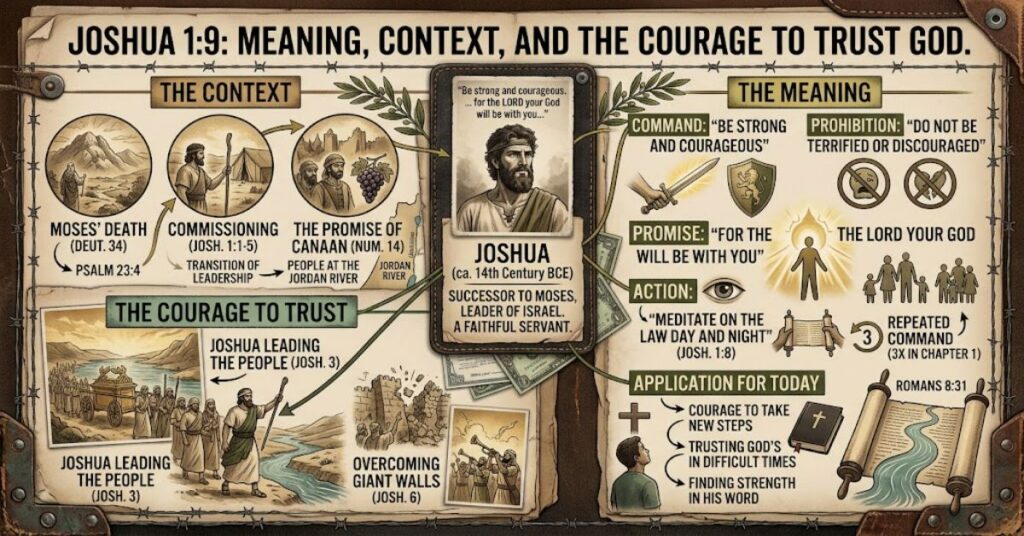
Joshua 1:9 is one of the Bible’s most frequently remembered verses about courage. It tells Joshua to be strong and courageous, not to be afraid or discouraged, and gives a reason for that confidence: the Lord is with him wherever he goes. The verse appears at a major turning point in Israel’s story, immediately after the death of Moses and before Joshua leads the people across the Jordan River.
That setting matters. Joshua 1:9 was not originally delivered as a general motivational slogan. It was part of God’s commissioning of Joshua as the successor to Moses. Joshua faced a demanding leadership assignment, a large population to guide and an uncertain future. God’s instruction therefore connects courage with a specific calling and with confidence in divine presence.
The surrounding verses make that connection even stronger. Joshua is repeatedly told to be strong and courageous, but he is also instructed to follow the law given through Moses and to meditate on it continually. Courage, in this passage, is not separated from obedience.
For modern readers, that distinction is important. The verse can offer genuine encouragement during uncertainty, but its message is deeper than “be brave and everything will work out”. Joshua’s courage is rooted in who God is, what God has commanded and the promise that God will accompany him.
Understanding those three elements helps explain why this short verse has remained influential across generations.
What Does Joshua 1:9 Say?
In the New International Version, the verse reads:
“Have I not commanded you? Be strong and courageous. Do not be afraid; do not be discouraged, for the Lord your God will be with you wherever you go.”
The sentence contains several connected ideas rather than one isolated instruction.
| Element | Meaning in the passage |
| “Have I not commanded you?” | Reminds Joshua that his assignment comes from God |
| “Be strong and courageous” | Calls for firmness and resolve |
| “Do not be afraid” | Addresses immediate fear |
| “Do not be discouraged” | Addresses ongoing loss of confidence |
| “God will be with you” | Provides the foundation for courage |
| “Wherever you go” | Emphasises God’s continuing presence |
The structure is significant. God does not simply tell Joshua to manufacture confidence through positive thinking. The command to be courageous is immediately supported by the assurance of God’s presence.
That is why the final clause is arguably the theological centre of the verse.
The Historical Setting of Joshua 1:9
The book of Joshua begins after the death of Moses. Joshua, who had served as Moses’ assistant, is now given responsibility for leading Israel. God tells him to prepare the people to cross the Jordan River and enter the land promised to them.
The transition would have been enormous.
Moses was the central human leader of Israel during the Exodus, wilderness journey and covenant experience at Sinai. Joshua was not replacing an ordinary administrator. He was stepping into the role of the man through whom Israel had experienced some of its defining moments.
BibleProject describes Joshua as the new leader who takes up Moses’ role as Israel prepares to enter Canaan. It also identifies Joshua 1–5 as the opening movement in which Israel enters the promised land under Joshua’s leadership.
This makes the emotional dimension of the passage easier to understand. Joshua did not need encouragement because his circumstances were easy. He needed it precisely because the responsibility ahead was difficult.
Joshua Was Not Being Asked to Ignore Risk
A common modern reading treats courage as the opposite of fear. The biblical passage is more nuanced.
God explicitly tells Joshua not to be afraid or discouraged. That acknowledgement suggests that fear was a real possibility. The command does not require Joshua to pretend that the situation is harmless.
Instead, courage means continuing faithfully despite the difficulty.
This distinction remains useful today. A person can recognise uncertainty, acknowledge pressure and still choose to act according to deeply held convictions.
Joshua 1:9 therefore speaks less about the absence of fear than about what should govern a person when fear appears.
Why Does God Tell Joshua to Be Strong and Courageous?
The command appears repeatedly in the opening section of Joshua.
In verse 6, courage is connected with Joshua’s responsibility to lead Israel and oversee the inheritance of the land.
In verse 7, courage is linked with obedience to the law.
In verse 9, courage is connected directly with fear, discouragement and God’s presence.
This progression provides an important insight.
| Repetition | Immediate focus | Leadership implication |
| Joshua 1:6 | Leading the people | Courage to accept responsibility |
| Joshua 1:7 | Obeying God’s law | Courage to remain faithful |
| Joshua 1:9 | Rejecting fear and discouragement | Courage rooted in God’s presence |
The repeated command is therefore broader than military bravery.
Joshua needed courage to lead.
He needed courage to obey.
And he needed courage to resist fear.
That three-part pattern makes the verse considerably richer than a simple inspirational statement.
Joshua 1:9 and the Presence of God
The most important reason given for Joshua’s courage is God’s presence.
God had already told Joshua that He would be with him as He had been with Moses. Verse 5 contains the promise that God would not leave or forsake him, while verse 9 repeats the assurance that God would be with him wherever he went.
The repetition creates a clear relationship:
God’s presence → confidence → courage → faithful action
This does not mean Joshua was promised an effortless life. The book that follows contains battles, mistakes, difficult decisions and moments of failure.
BibleProject’s overview is particularly useful here because it presents Joshua as an imperfect leader. Joshua obeys God’s unusual instructions at Jericho, but later makes a serious mistake with the Gibeonites because he and the leaders fail to ask God for counsel.
That detail challenges an overly simplistic interpretation.
God’s presence did not make Joshua incapable of making mistakes.
Instead, the passage presents God’s presence as the foundation from which Joshua was expected to lead faithfully.
Courage in Joshua 1:9 Is Connected to Obedience
Verse 9 cannot be fully separated from verses 7 and 8.
Before telling Joshua not to fear, God instructs him to follow the law given through Moses. Joshua is told not to turn away from it and to keep it central to his life and leadership.
This creates an important biblical relationship between courage and discipline.
Courage without direction can become recklessness.
Confidence without accountability can become arrogance.
Determination without moral boundaries can become destructive.
The passage presents something different: courage shaped by obedience.
Crossway’s commentary similarly highlights that Joshua’s assignment required courage not only to lead but also to obey the Torah and resist being terrified or discouraged.
That makes Joshua 1:9 especially relevant when discussing leadership. Biblical courage is not simply the ability to make bold decisions. It includes the willingness to remain faithful when easier alternatives are available.
What “Be Strong and Courageous” Means Today
The phrase can be applied to modern life, but it should be applied carefully.
Someone facing a difficult career decision might find encouragement in the verse. A person experiencing uncertainty about the future may use it as a reminder not to surrender to fear. A Christian facing a demanding responsibility may see Joshua’s story as an example of trusting God while moving forward.
But the passage does not promise that every decision will produce the outcome a person wants.
Joshua received a particular commission. He was not given a universal guarantee that every plan he personally imagined would succeed.
This is one of the most important distinctions for responsible biblical interpretation.
Courage Is Not the Same as Guaranteed Success
It is easy to quote Joshua 1:9 before starting a business, taking an exam, changing careers or entering another uncertain situation.
The verse can certainly encourage courage in such moments.
However, using it as a promise that God will guarantee a desired result goes beyond what the passage itself says.
Joshua’s confidence was connected to a specific divine commission.
The transferable principle is stronger and more balanced: believers can seek courage by trusting God’s presence and remaining faithful to God’s revealed direction, even when the outcome is uncertain.
That reading avoids turning Scripture into a formula for personal success.
Joshua 1:9 and the Difference Between Fear and Discouragement
The verse mentions both fear and discouragement. These are related but not identical.
Fear can arise when danger appears immediate. Discouragement can develop gradually when a challenge lasts longer than expected.
That distinction makes the wording surprisingly practical.
| Challenge | Possible internal response | Principle illustrated by Joshua 1:9 |
| A difficult decision | Fear of making the wrong choice | Seek courage rather than paralysis |
| Long-term pressure | Discouragement | Continue faithfully rather than surrender |
| Leadership responsibility | Feeling inadequate | Remember the source of the calling |
| Uncertainty | Desire for complete control | Trust without pretending to know the outcome |
| Opposition | Intimidation | Remain focused on faithful action |
The passage therefore addresses both the sudden shock of difficulty and the slow erosion of confidence.
That is one reason the verse continues to resonate with readers.
What Joshua 1:9 Teaches About Leadership
Joshua’s leadership begins with a striking principle: the leader himself remains under God’s authority.
Joshua is not told that leadership means having complete control. He is told to obey.
This creates a useful leadership model:
- Receive responsibility.
- Understand the standards governing that responsibility.
- Remain committed when pressure increases.
- Do not allow fear to determine every decision.
- Remember that leadership is accountable to something beyond personal ambition.
The practical lesson is not limited to religious leadership.
Any form of leadership involves uncertainty, responsibility and pressure. The Joshua narrative suggests that confidence is healthier when it is connected to purpose and accountability rather than ego.
Joshua 1:9 in the Larger Story of Joshua
The verse becomes even more meaningful when viewed against the whole book.
Joshua leads Israel across the Jordan. The people encounter Jericho, Ai and other Canaanite communities. Later chapters describe the distribution of the land and Joshua’s final appeals for faithfulness.
The beginning and end of the book are connected by the theme of covenant faithfulness.
At the beginning, Joshua is instructed to follow God’s law.
At the end, Joshua challenges Israel to remain faithful after entering the land.
This means Joshua 1:9 is not an isolated motivational sentence. It introduces themes that continue throughout the narrative.
The named case study of Joshua’s leadership provides one documented outcome of the commissioning: he moves from Moses’ assistant to national leader and guides Israel into Canaan. Yet the same narrative also records his failure to seek God’s counsel concerning the Gibeonites.
That combination of achievement and failure is important. It prevents the story from becoming a simplistic portrait of an unstoppable hero.
Three Deeper Insights Often Missed in Joshua 1:9
1. The Verse Is About Responsibility as Much as Comfort
Joshua 1:9 is often quoted when someone wants reassurance. Yet the verse appears inside a demanding commission.
The comfort is connected to responsibility.
God’s presence does not remove Joshua’s work. It strengthens him for it.
That distinction changes how the verse can be applied. Encouragement is not necessarily permission to remain passive. In Joshua’s case, reassurance was followed by action.
2. Courage Is Repeated Because the Assignment Is Larger Than Personality
Joshua already had a history of faithfulness. He was one of the spies who had trusted God when others were afraid. BibleProject notes that Joshua and Caleb were the two spies who encouraged Israel to trust God when the other reports created fear.
Yet Joshua still receives repeated commands to be courageous.
This suggests that courage is not simply a permanent personality trait.
Even an experienced person may need renewed confidence when responsibilities change.
3. The Verse Does Not Remove the Need for Wisdom
Joshua eventually makes a major mistake when the Gibeonites deceive Israel. The account says the leaders accepted their agreement without asking the Lord for counsel.
That episode creates an important counterpoint to Joshua 1:9.
Courage does not mean rushing ahead.
Faith does not eliminate the need for discernment.
Confidence in God should not be confused with confidence in one’s own judgement.
This is a particularly valuable lesson for modern readers who may interpret “be courageous” as encouragement to act immediately.
How to Apply Joshua 1:9 Without Misusing It
A balanced approach can turn the verse into a meaningful framework for daily life.
Identify the Fear
Ask what is actually causing fear.
Is it uncertainty, failure, criticism, financial pressure, responsibility or loss of control?
Naming the fear can make it easier to respond thoughtfully rather than react emotionally.
Clarify the Responsibility
Joshua knew what he had been asked to do.
Modern readers can similarly ask what responsibility is actually in front of them rather than becoming overwhelmed by every possible future outcome.
Separate Faith From Wishful Thinking
Faith does not require pretending that every desired result is guaranteed.
A person can trust God while recognising that circumstances may remain difficult.
Let Conviction Shape Action
Joshua’s courage was connected to obedience.
For Christian readers, that means courage should be informed by Scripture rather than reduced to positive self-talk.
Accept That Courage May Be Repeated
Fear does not necessarily disappear after one encouraging moment.
Joshua heard the command more than once.
Likewise, people may need to return repeatedly to their convictions when circumstances become difficult.
Joshua 1:9 Compared With Common Modern Readings
| Reading | Strength | Limitation |
| Motivational slogan | Easy to remember | Can remove the verse from its biblical setting |
| Promise of protection | Highlights God’s presence | Can imply guaranteed freedom from hardship |
| Leadership principle | Recognises Joshua’s responsibility | May overlook the specifically theological context |
| Call to obedience | Fits verses 7–8 | Can understate the comfort of God’s presence |
| Trust in God’s presence | Captures the centre of verse 9 | Still requires careful application to modern circumstances |
The strongest interpretation brings these elements together rather than choosing only one.
Is Joshua 1:9 a Promise for Christians?
Christians often use Joshua 1:9 as a personal encouragement, and there is a meaningful basis for doing so.
However, the original command must first be understood in its historical context.
Joshua was personally commissioned to lead Israel into Canaan. Christians today do not inherit that exact commission.
What can be carried forward is the broader biblical theme of trusting God rather than allowing fear to control faithful action.
The Bible contains other passages that similarly emphasise God’s continuing presence. Cross-references associated with Joshua 1:9 include Deuteronomy 31:6–8 and 23, passages connected to Joshua’s earlier commissioning.
The New Testament also contains its own teachings about God’s presence and faithfulness, allowing Christian readers to place Joshua’s story within a broader biblical framework rather than treating the verse as a standalone promise of personal success.
The Future of Joshua 1:9 in 2027
By 2027, Joshua 1:9 is likely to remain widely used in Christian teaching, devotional content, social media graphics, sermons and personal encouragement. The wording is short, memorable and closely associated with themes of courage and divine presence.
The more important question is how the verse will be interpreted.
Digital religious content increasingly makes individual verses accessible outside their original context. That creates both an opportunity and a risk. Readers can discover Scripture quickly, but isolated quotations can also lose the narrative and theological framework surrounding them.
Resources such as BibleProject increasingly present biblical books as connected narratives rather than collections of disconnected quotations. Its Joshua guide places chapter 1 within a wider structure that moves from Joshua’s appointment through Israel’s entry into the land, battles, land distribution and final covenant renewal.
That contextual approach is likely to remain valuable.
The strongest future use of Joshua 1:9 will not simply be repeating “be strong and courageous”. It will be explaining why Joshua was told to be courageous, what he was being asked to do and where his confidence was supposed to come from.
That distinction matters in an era when short quotations can travel far faster than their original context.
Key Takeaways
- Joshua 1:9 was spoken to Joshua at a major leadership transition after Moses’ death.
- The command to be courageous is grounded in God’s presence rather than human confidence alone.
- The surrounding verses connect courage with obedience to God’s law.
- Joshua’s story shows that faithful leadership does not mean being incapable of mistakes.
- The verse should not be interpreted as a guarantee that every personal ambition will succeed.
- Its enduring value lies in the relationship between responsibility, faithfulness, courage and trust.
- Modern readers benefit most when they apply the principle while respecting the verse’s original context.
Conclusion
Joshua 1:9 remains powerful because it speaks directly to a human experience that has not disappeared: facing responsibility while feeling uncertain about what lies ahead. Joshua stood at a major transition, succeeding Moses and preparing to lead Israel into Canaan. God’s response was not to pretend the assignment would be insignificant. Instead, Joshua was commanded to be strong and courageous and was reminded that the Lord would be with him wherever he went.
The surrounding passage adds an essential dimension. Courage was connected to obedience, attention to God’s law and faithfulness to the responsibility Joshua had received. The verse therefore offers more than a motivational phrase.
For modern Christian readers, the most responsible application is neither to dismiss the verse as belonging only to ancient Israel nor to treat it as a guarantee of personal success. Its lasting lesson is that courage can be grounded in trust, purpose and God’s presence even when circumstances remain difficult.
That balance is what gives Joshua 1:9 its enduring strength.
Frequently Asked Questions
What is the main message of Joshua 1:9?
The central message is that Joshua should remain strong and courageous because God promises to be with him wherever he goes. The command is connected to Joshua’s specific responsibility as Moses’ successor and leader of Israel.
What does Joshua 1:9 mean when it says “be strong and courageous”?
In context, it means Joshua must remain firm and courageous as he accepts leadership, follows God’s instructions and faces the challenges ahead. It is not simply a command to feel confident.
Who was Joshua 1:9 written for?
The immediate recipient was Joshua, Moses’ successor. He was preparing to lead Israel across the Jordan into Canaan. The verse therefore has a specific historical and narrative setting.
Can Christians use Joshua 1:9 as encouragement?
Yes, Christians can draw encouragement from its themes of God’s presence and courage. However, the specific commission given to Joshua should not be treated as a universal guarantee that every personal plan will succeed.
Why is courage repeated in Joshua chapter 1?
God tells Joshua to be courageous repeatedly because the command relates to several responsibilities: leading the people, obeying God’s law and resisting fear and discouragement.
Does Joshua 1:9 mean believers should never feel afraid?
Not necessarily. The verse acknowledges fear and discouragement by directly addressing them. Its emphasis is on how Joshua should respond to those pressures rather than suggesting that a faithful person will never experience fear.
What is the connection between Joshua 1:9 and Joshua 1:8?
Verse 8 tells Joshua to keep and meditate on the Book of the Law, while verse 9 commands him to be courageous and not afraid. Together, the verses connect courage with obedience, attentiveness to God’s word and confidence in God’s presence.
Methodology
This article was developed by examining Joshua 1:9 within the immediate context of Joshua 1:1–9 rather than treating the verse as an isolated quotation. The biblical text was checked against Bible Gateway’s presentation of multiple English translations, while BibleProject’s overview was used to understand the structure and themes of the book of Joshua. Additional interpretive context was checked against published Bible commentary material from Crossway and Bible Gateway.
The analysis distinguishes between what the biblical passage directly states and modern applications drawn from its themes. No claim of personal Bible-study testing, field observation or firsthand religious experience has been made. The named case studies of Joshua’s leadership, the crossing into Canaan, Jericho and the Gibeonite deception are drawn from the biblical narrative and supporting interpretive sources.
A limitation is that Christian traditions can differ in how they interpret Old Testament promises and their application to Christians. This article therefore avoids presenting one denominational interpretation as the only possible reading.
Editorial disclosure: This article was drafted with AI assistance and requires human editorial review before publication. Biblical quotations, references, dates and interpretive claims should be checked against the original sources by the publishing editor.
References
Bible Gateway. (2026). Joshua 1:1–9: New International Version. Bible Gateway.
Bible Gateway. (2026). Joshua 1:9: New International Version. Bible Gateway.
Bible Gateway. (2026). Joshua 1:6–9: NIV Application Commentary. Bible Gateway.
BibleProject. (2026). Book of Joshua: Guide with key information and resources. BibleProject.
Crossway. (2022). 10 key Bible verses on fear. Crossway.
Crossway. (2020). 10 key Bible verses on courage. Crossway.
RubbleMagazine.co.uk. (2026). Internal site search conducted for relevant published articles on faith, prayer and Joshua. RubbleMagazine.co.uk.