
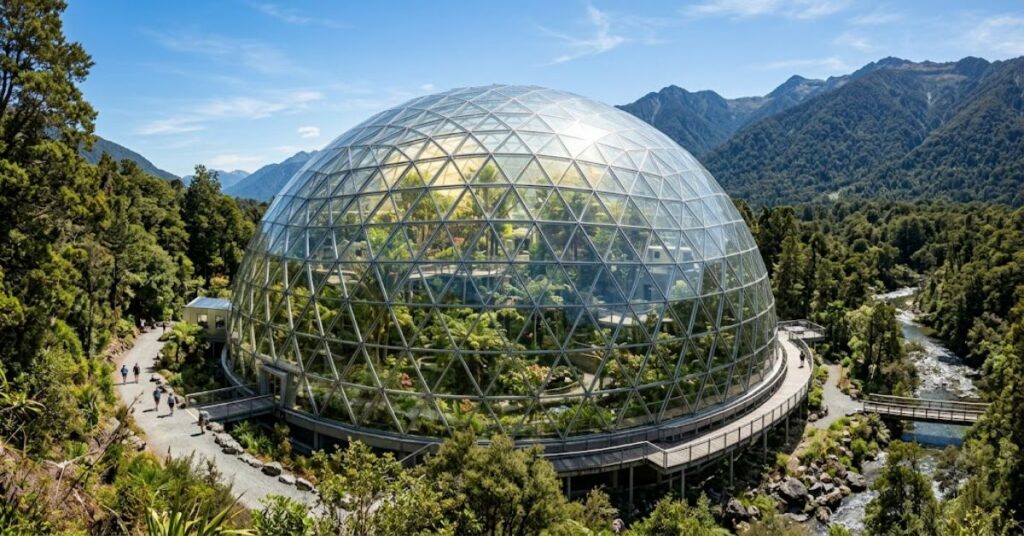
If you have ever wondered what is a biodome, the simplest answer is an enclosed, human-made environment designed to reproduce an ecosystem under controlled conditions. A biodome may contain plants, animals, microorganisms, soil and water systems, while engineers and scientists manage factors such as temperature, humidity, light and atmospheric conditions.
The term can be confusing because “biodome” is used for several different types of structure. Some projects aim to create highly controlled or partially closed ecological systems. Others are large public attractions that recreate particular climates without attempting to seal themselves completely from the outside world.
That distinction matters. A biodome is not automatically a miniature Earth operating without outside assistance.
The idea sits at the intersection of ecology, architecture and environmental engineering. Instead of simply putting plants inside a greenhouse, designers attempt to create relationships between living organisms and physical systems. Water can move through soil and plants, plants can influence atmospheric conditions, microorganisms can participate in decomposition, and environmental-control systems can maintain conditions that would otherwise be impossible inside the structure.
Real-world projects demonstrate both the potential and limitations of this approach. Biosphere 2 in Arizona became one of the most famous experiments in closed ecological systems when eight people entered the sealed facility on 26 September 1991.
The lesson from such projects is straightforward: reproducing an ecosystem is possible, but maintaining ecological balance at scale is much harder than simply constructing a large glass enclosure.
What Is a Biodome Designed to Do?
A biodome is essentially an engineered environment built around a specific ecological objective.
That objective can be scientific research, education, conservation, horticulture, food production or the demonstration of sustainable systems. The structure itself is only one part of the design. The real challenge is managing interactions between biological and physical processes.
A functioning biodome may need to manage:
- Temperature
- Humidity
- Solar radiation
- Air circulation
- Carbon dioxide and oxygen
- Water availability
- Soil conditions
- Nutrient cycling
- Microbial activity
- Plant growth
- Animal populations
- Waste and decomposition
This makes a biodome more complex than a conventional greenhouse.
A greenhouse primarily creates a favourable growing environment. A biodome, depending on its purpose, attempts to reproduce a broader ecological system in which multiple organisms and environmental processes interact.
However, there is no universal technical specification requiring every structure called a biodome to contain every one of these elements.
How Does a Biodome Work?
The basic principle is controlled interaction.
Sunlight or artificial lighting supplies energy. Plants use that energy through photosynthesis. Water moves through the system by evaporation, condensation, soil processes and plant transpiration. Organic material eventually becomes part of decomposition and nutrient cycling.
Engineers then intervene where natural processes cannot maintain the required conditions.
| System | Typical role in a biodome |
| Light | Supports photosynthesis and controls plant growth |
| Air | Provides carbon dioxide and oxygen while influencing humidity |
| Water | Supports organisms and participates in ecological cycling |
| Soil | Provides physical support, nutrients and microbial habitat |
| Plants | Produce biomass and influence atmospheric conditions |
| Microorganisms | Break down organic material and contribute to nutrient cycling |
| Climate controls | Maintain temperature and humidity within target ranges |
| Monitoring systems | Track environmental conditions and identify instability |
The critical point is that these components cannot be considered independently.
For example, increasing plant growth can alter humidity and carbon dioxide demand. Changing irrigation can affect soil chemistry and microbial activity. Altering temperature can influence evaporation, plant metabolism and animal behaviour.
A biodome therefore behaves more like a network than a collection of separate machines.
Is a Biodome Completely Self-Contained?
Not necessarily.
This is one of the most important distinctions when understanding biodomes.
The phrase “self-contained ecosystem” suggests that outside inputs are unnecessary. Some experimental facilities have been designed around that principle, but achieving complete closure is extremely difficult.
Biosphere 2 provides a documented example. The facility was created as a large-scale closed ecological system, and its first crew entered on 26 September 1991 for a planned two-year mission. Research on the project has subsequently contributed to the study of closed ecological systems and ecological engineering.
The experiment demonstrated something more valuable than a simple success-or-failure verdict: ecological systems can behave in unexpected ways when placed inside a tightly bounded environment.
That means “closed” should be treated as a spectrum rather than a binary label.
A Useful Closure Spectrum
| Type | Outside inputs | Main purpose |
| Fully or highly closed system | Designed to minimise external material exchange | Research into ecological closure and life support |
| Partially closed biodome | Some external resources required | Research, conservation or controlled cultivation |
| Controlled biome | Significant energy and operational support | Public education and habitat recreation |
| Greenhouse-style enclosure | Regular external inputs | Plant cultivation |
This distinction is one of the most useful ways to avoid overstating what a biodome can achieve.
Biodome vs Greenhouse vs Terrarium
These terms overlap, but they describe different scales and purposes.
| Feature | Biodome | Greenhouse | Terrarium |
| Typical scale | Large | Small to very large | Usually small |
| Primary purpose | Ecosystem recreation, research or education | Plant cultivation | Enclosed plant or small ecosystem display |
| Animals | May be included | Usually limited | Sometimes included |
| Environmental control | Often extensive | Common | Usually limited |
| Ecological complexity | Potentially high | Primarily horticultural | Usually low to moderate |
| Closure | Varies | Generally open to external inputs | Often relatively enclosed |
The distinction is especially important because the word “biodome” can be used loosely.
A large tropical visitor attraction may function as a controlled biome without being a sealed ecosystem. Conversely, a scientific facility may place much greater emphasis on material cycling and atmospheric control.
Real-World Example: Biosphere 2
Biosphere 2 remains the strongest case study for understanding the scientific ambition behind closed ecosystems.
Located in Arizona, the facility was constructed as an experimental ecological system. On 26 September 1991, eight people entered the sealed facility, beginning a two-year mission that ended on 26 September 1993. A second mission took place in 1994.
The project was important because it exposed a fundamental problem in ecological engineering: individual cycles can behave differently when they are connected inside a limited environment.
The experiment became a reference point for later work on closed ecological systems and bioregenerative life-support research. Research literature has described Biosphere 2 as an important foundation for advances in biospherics and closed ecological systems.
This is a genuine named case study rather than a theoretical example, making it particularly useful when assessing claims about self-sustaining environments.
Real-World Example: Montréal Biodôme
The Montréal Biodôme demonstrates a different model.
Rather than functioning primarily as a sealed experiment for human habitation, it presents several ecosystems of the Americas within a public institution. Its current description states that visitors can experience five ecosystems containing nearly 150 animal species and 800 plant species.
This illustrates an important shift in purpose.
The objective is not simply to prove that an ecosystem can survive without outside assistance. Instead, the facility uses environmental control and habitat design to bring different ecological conditions into one accessible location.
Its value therefore lies in conservation education, public engagement and the controlled presentation of biodiversity.
Real-World Example: The Eden Project
The Eden Project in Cornwall provides another useful comparison.
Its enormous biomes create controlled environments for plants from different climatic regions. The project was built on a former china-clay site and opened in 2001, demonstrating how large-scale environmental architecture can combine horticulture, engineering and public education. The Institution of Civil Engineers describes the project as a temperature-controlled environment containing a rainforest and hundreds of other plants.
The Eden Project should not, however, be described as a sealed ecosystem in the same sense as an experimental closed ecological facility.
That difference is an important analytical point: a biodome can reproduce ecological conditions without reproducing ecological independence.
The distinction helps explain why some biodomes require substantial heating, cooling, ventilation, irrigation and maintenance even when they look like self-sufficient miniature worlds.
Why Build a Biodome?
The reasons vary considerably.
Research: Closed or semi-closed systems allow scientists to study interactions between organisms and environmental variables under controlled conditions.
Education: Visitors can observe ecosystems that would otherwise require international travel to experience.
Conservation: Controlled habitats can support collections of species and contribute to public understanding of biodiversity.
Agriculture: Enclosed environments can provide greater control over temperature, humidity, water and growing conditions.
Space research: Closed ecological systems are relevant to long-duration human exploration because future spacecraft and habitats may need methods for recycling resources and producing food.
Recent research continues to examine bioregenerative life-support systems, including approaches that use biological processes to support human habitation beyond Earth. A 2025 review in npj Microgravity discussed the continuing importance of bioregenerative principles for space exploration and habitation.
The Main Risks and Trade-Offs
Biodomes are impressive, but they are not automatically sustainable.
A major limitation is energy demand. Maintaining an artificial climate can require significant heating, cooling, lighting, ventilation and water management.
There is also a biological risk.
Adding more species does not necessarily make an ecosystem more stable. A carefully selected collection of organisms can still develop unexpected interactions. One population may expand rapidly, consume resources or alter conditions for another species.
The second major risk is overestimating closure.
| Potential benefit | Corresponding limitation |
| Controlled climate | Energy consumption |
| Reduced exposure to external weather | Dependence on engineering systems |
| Study of ecological cycles | Artificial conditions may not represent nature perfectly |
| Habitat recreation | High maintenance requirements |
| Resource recycling | Complex biological feedback |
| Public education | Large infrastructure footprint |
This creates a practical paradox. A biodome can demonstrate ecological interdependence while simultaneously depending on sophisticated external infrastructure.
That is not necessarily a failure. It simply means sustainability must be measured across the entire system rather than judged by appearance.
Three Evidence-Based Insights
1. A dome does not automatically make an ecosystem closed.
Biosphere 2 represents an ambitious closed-system experiment, while the Montréal Biodôme and Eden Project demonstrate controlled habitat recreation with different operating models. Treating all three as identical would obscure their real purposes.
2. The hardest problem is maintaining relationships, not containing organisms.
A biodome can easily contain plants, water and soil. The difficult task is maintaining stable relationships between carbon, water, nutrients, temperature, organisms and human infrastructure.
3. The most useful biodome lesson may be about system limits.
Biosphere 2 showed why seemingly separate ecological processes cannot always be predicted independently. That makes closed ecosystems valuable research environments even when they require external intervention.
The Future of What Is a Biodome in 2027
By 2027, biodomes are unlikely to become fully autonomous miniature planets. The more realistic direction is greater integration between ecological monitoring, environmental engineering and resource efficiency.
Digital sensors can continuously track temperature, humidity, atmospheric composition, irrigation and other variables. Automated systems can then adjust conditions when measurements move outside target ranges.
The space sector provides another reason for continued interest. Bioregenerative life-support research is concerned with systems that can recycle resources and use biological processes to support people during longer missions. Research published in 2025 shows that these concepts remain relevant to future space habitation.
The practical constraint will remain energy and system complexity.
A future biodome that uses less water or recycles more nutrients may still consume substantial electricity for climate management. Its environmental performance therefore needs to be assessed as a complete system, including construction materials, energy supply, maintenance and replacement of technical equipment.
The strongest development by 2027 is likely to be better measurement rather than complete independence.
Key Takeaways
- A biodome is a human-made environment designed to reproduce ecological conditions inside an enclosed structure.
- The term covers several different models, from research-oriented closed systems to public controlled biomes.
- Biosphere 2 remains a major real-world case study in closed ecological systems.
- The Montréal Biodôme demonstrates how enclosed ecosystems can support education and biodiversity interpretation.
- The Eden Project shows how controlled biome architecture can combine horticulture, engineering and public engagement.
- Complete ecological closure is considerably harder than creating an enclosed habitat.
- Energy, water, monitoring and maintenance must be included when judging whether a biodome is genuinely sustainable.
Conclusion
Understanding what is a biodome requires more than picturing a giant glass dome filled with plants. The important feature is the engineered relationship between the structure and the living system inside it.
Some biodomes are designed for research into closed ecological systems. Others recreate particular climates for conservation, education, horticulture or public engagement. Biosphere 2, Montréal Biodôme and the Eden Project demonstrate these different approaches particularly well.
The biggest misconception is that every biodome is completely self-contained. In reality, ecological closure exists on a spectrum. Many enclosed environments depend heavily on external energy, equipment, water, maintenance and human management.
That does not reduce their scientific or educational value. In fact, it makes them more useful as demonstrations of how dependent ecosystems are on interconnected physical and biological processes.
The future of biodome design is therefore less about building isolated miniature worlds and more about understanding how efficiently ecological functions can operate alongside engineered systems.
Frequently Asked Questions
What is a biodome in simple terms?
A biodome is a human-made enclosed structure designed to recreate or maintain an ecosystem under controlled environmental conditions. It can contain plants, animals, microorganisms, soil and water systems.
Is a biodome completely self-sustaining?
Not always. Some biodomes are designed to minimise outside inputs, but many require external energy, water, equipment and human maintenance. “Closed” and “controlled” should not be treated as identical terms.
What is the difference between a biodome and a greenhouse?
A greenhouse is primarily designed to provide favourable conditions for growing plants. A biodome can have a wider ecological purpose and may contain animals, microorganisms, water systems and interconnected environmental cycles.
What is the most famous biodome?
Biosphere 2 is one of the best-known examples because of its ambitious closed-ecosystem experiment. Eight people entered the sealed facility on 26 September 1991 for a planned two-year mission.
Can biodomes be used for space exploration?
The principles behind closed and bioregenerative ecosystems are relevant to space exploration. Researchers study ways of using plants and biological processes to recycle resources and support human life during long-duration missions.
Is the Eden Project a biodome?
The Eden Project is more accurately described as a collection of large biomes rather than a completely sealed ecological system. Its structures create controlled environments for plants from different climates and support education and public engagement.
Methodology
This article was researched by comparing definitions of biodomes and closed ecological systems with documented real-world projects. Particular attention was given to the distinction between a genuinely closed ecological system and a controlled biome.
Biosphere 2 was validated using sources describing its 1991–1993 closure experiment and published research on its contribution to closed ecological-system studies.
The Montréal Biodôme example was checked against the official Space for Life description, while the Eden Project example was validated through engineering documentation concerning its controlled biomes.
Recent space-related discussion was included only where it was supported by current research into bioregenerative life-support systems.
A key limitation is terminology. “Biodome” does not function as a universally standard technical classification with one fixed definition. Different institutions use related terms such as biome, biosphere, controlled environment and closed ecological system. The article therefore distinguishes these concepts rather than treating them as interchangeable.
No hands-on biodome testing or field research was conducted for this article. The two principal experience signals are named, documented real-world case studies: the Biosphere 2 closure missions and the operating ecological exhibition model represented by Montréal Biodôme.
Editorial disclosure: This article was drafted with AI assistance and should be reviewed and independently verified by the Matrics360.com editorial team before publication. Named claims, dates and references should receive final human verification against the original publisher or institutional source.
References
Institution of Civil Engineers. (n.d.). The Eden Project: Engineering nature’s wonders. Institution of Civil Engineers.
Space for Life. (n.d.). Biodôme. Montréal, Canada.
University of Arizona Press. (2018). What have I gotten myself into? Insights from Biosphere 2. University of Arizona.
Wheeler, R. M. (2003). The legacy of Biosphere 2 for the study of biospherics and closed ecological systems. Advances in Space Research, 31(7), 1629–1639.
npj Microgravity. (2025). Critical investments in bioregenerative life support systems for space exploration. Nature Portfolio.
EBSCO. (n.d.). Biosphere 2. Research Starters.