
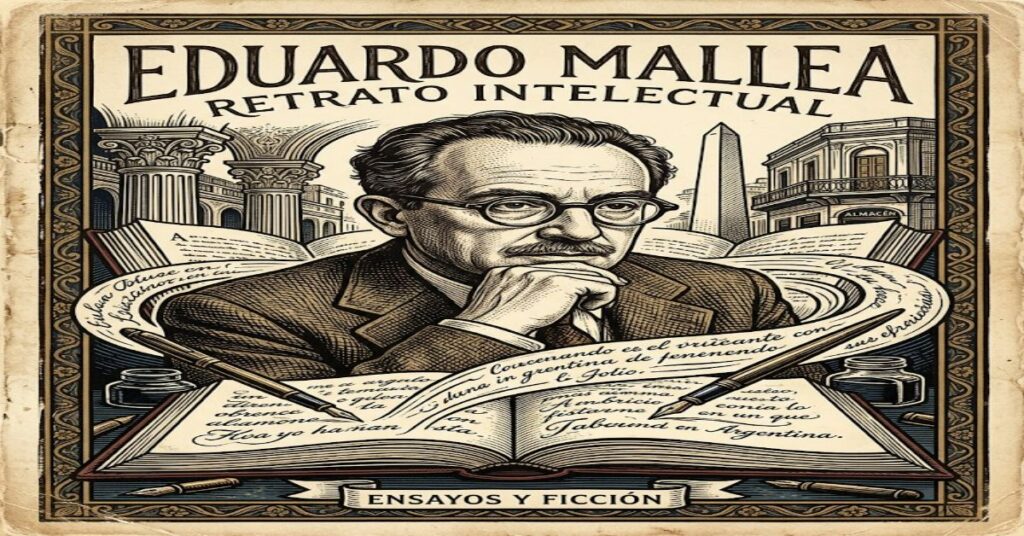
Mallea Eduardo is the search term commonly used for Eduardo Mallea, the Argentine novelist, essayist, cultural critic and diplomat born in Bahía Blanca on 14 August 1903 and who died in Buenos Aires on 12 November 1982. He became one of the most prominent literary figures in Argentina during the 1930s and 1940s, while his influence extended through journalism, cultural criticism and international diplomacy. The Argentine National Library identifies him as a major figure in Argentine literature and records his long association with La Nación, where he directed its literary supplement from 1931 to 1955.
Mallea is particularly associated with Historia de una pasión argentina (1937), an essay that examined the country’s spiritual and moral identity. His fiction, meanwhile, repeatedly returned to solitude, psychological conflict, communication, authenticity and the difficult relationship between individuals and their societies.
His literary position is sometimes described through the language of existentialism. That description is useful, but it needs qualification. Scholarly studies identify clear affinities between Mallea’s work and existentialist concerns, yet also emphasise that his philosophical position differed from the atheistic existentialism associated with Jean-Paul Sartre.
Understanding Mallea therefore requires more than listing his books. His career connects literature, journalism, Argentine national identity, philosophy and international cultural life. It also raises a broader question: why does a writer who once occupied such a central place in Argentine culture become less visible to later generations?
Who Was Eduardo Mallea?
Eduardo Alberto Mallea was born in Bahía Blanca, Argentina, in 1903. He later moved to Buenos Aires, where his literary and journalistic career developed. The National Library of Argentina records that he began publishing articles in newspapers and released his first book, Cuentos para una inglesa desesperada, in 1926.
He initially studied law at the University of Buenos Aires but moved increasingly towards literature and journalism. His early success helped establish him within Buenos Aires’ literary circles.
The Academia Argentina de Letras records that Mallea participated in important literary movements and circles, including the Martín Fierro movement and the group associated with the journal Sur. He was elected a full member of the Academia Argentina de Letras in 1960.
His position at La Nación was especially important. From 1931 through 1955, he directed the newspaper’s literary supplement. During those years he published and promoted writers from different literary currents and became an important intermediary between Argentine readers and international literature.
Eduardo Mallea at a Glance
| Detail | Information |
| Full name | Eduardo Alberto Mallea |
| Born | 14 August 1903 |
| Birthplace | Bahía Blanca, Argentina |
| Died | 12 November 1982 |
| Place of death | Buenos Aires, Argentina |
| Main fields | Fiction, essays, cultural criticism, journalism and diplomacy |
| First major book | Cuentos para una inglesa desesperada (1926) |
| Major essay | Historia de una pasión argentina (1937) |
| Literary institution | Academia Argentina de Letras |
| La Nación role | Director of the literary supplement, 1931–1955 |
| Major themes | Identity, authenticity, solitude, morality and human existence |
His Early Literary Career
Mallea’s first published book, Cuentos para una inglesa desesperada, appeared in 1926. It established him as a serious young writer and helped move his career away from his earlier legal studies. The National Library of Argentina identifies the book as a significant early step in his development.
His early fiction already showed an interest in interior experience rather than simply external action. This tendency would become increasingly important as his writing developed.
The 1930s were decisive. Mallea became involved with the cultural networks surrounding Sur, the influential literary magazine founded by Victoria Ocampo. At the same time, his position at La Nación gave him a powerful platform for literary criticism and cultural journalism.
This combination of creative writing and editorial influence was unusual. Mallea was not merely producing books; he was helping determine which writers and ideas reached Argentine readers.
That influence partly explains why his reputation during the period was so substantial. La Nación later described him as an important interpreter of the national spirit and noted the decisive influence he exercised through the literary supplement.
Historia de una pasión argentina: His Defining Essay
Published by Sur in Buenos Aires in 1937, Historia de una pasión argentina is widely regarded as Mallea’s most important essay on Argentina. Google Books records the original Sur edition as a 1937 publication of 272 pages.
The book is not a conventional political history. It is an intensely personal meditation on Argentina, its people and the moral condition of the nation.
One of Mallea’s central distinctions was between what can be described as a visible Argentina and an invisible Argentina. The visible side represented social performance, appearances, ambition and superficial public identity. The invisible Argentina represented deeper moral qualities, inner conviction and authentic service.
A scholarly study by Gloria Videla de Rivero identifies this distinction as one of the central ideas of the essay and explains how Mallea contrasted the country’s outward social image with a deeper, less visible national character.
The concept is important because it shows how Mallea’s nationalism differed from simple patriotic celebration. He was concerned with what Argentina could become, not merely with praising what it already was.
The Idea of the “Two Argentinas”
Mallea’s two-Argentina framework became one of the most discussed aspects of his work.
| Concept | Mallea’s emphasis | Literary significance |
| Visible Argentina | Social appearance and public performance | Critique of superficial identity |
| Invisible Argentina | Inner authenticity and moral purpose | Ideal of deeper national character |
| Urban society | Ambition, display and competition | Source of alienation |
| Interior/deeper nation | Silence, work and moral seriousness | Source of authenticity |
| Individual | Psychological and ethical struggle | Bridge between national and universal themes |
This framework can be read as both a cultural diagnosis and a moral argument. Mallea was not simply dividing Argentina geographically. The distinction also existed within individuals.
A person could participate in the visible world while searching for an invisible, authentic self. That tension connects his essays to his novels.
This is one reason his work remains relevant to literary scholars. The question he posed was not limited to Argentina: How does a person remain authentic inside a society dominated by appearances?
Mallea and Existentialism
The label “existentialist” is often attached to Mallea because his fiction deals with solitude, anxiety, alienation, moral responsibility and the problem of authentic existence.
The Instituto Cervantes has discussed Mallea within the context of existentialist literature, describing themes of loneliness, anguish and the search undertaken by individuals in the American world.
Academic research gives a more nuanced picture.
A study of Mallea’s writing preserved by the Biblioteca Virtual Miguel de Cervantes identifies parallels between his treatment of individual isolation and thinkers such as Karl Jaspers, Martin Heidegger and José Ortega y Gasset. At the same time, it stresses important differences between Mallea and Sartrean existentialism.
Mallea’s worldview was not simply built around the proposition that existence has no predetermined meaning. His writing retained a strong interest in spiritual possibility, moral development and what he considered the authentic nature of the individual.
That distinction matters.
Calling Mallea an existentialist can help readers understand his concerns, but calling him simply a Latin American version of Sartre would flatten his intellectual position.
Psychological Depth in His Fiction
Mallea’s fiction often places psychological experience above fast-moving plot.
Characters confront loneliness, failed communication, uncertainty, moral conflict and the distance between their inner selves and the social roles they perform. A doctoral study at the University of British Columbia identifies Mallea’s sustained preference for the inner states of human beings as a defining feature of his fictional world.
His novels therefore frequently feel reflective rather than action-driven.
This can be a strength or a weakness depending on the reader.
For readers interested in psychology and philosophical fiction, the sustained attention to consciousness can make his work rewarding. Readers expecting tightly plotted narratives may find the same approach slow or overly abstract.
That tension was recognised by later critics. The Instituto Cervantes’ discussion of La sala de espera, for example, describes how Mallea uses waiting as an existential condition while also observing provincial Argentine life.
Major Works by Eduardo Mallea
Mallea produced a large body of fiction and essays across several decades.
| Work | Year | Form | Main relevance |
| Cuentos para una inglesa desesperada | 1926 | Short stories | Early literary breakthrough |
| Nocturno europeo | 1934 | Novel | Early mature fiction |
| La ciudad junto al río inmóvil | 1936 | Fiction | Major pre-war work |
| Historia de una pasión argentina | 1937 | Essay | National identity and Argentine culture |
| La bahía de silencio | 1940 | Novel | Psychological and existential concerns |
| Todo verdor perecerá | 1941 | Novel | Moral and existential themes |
| El sayal y la púrpura | 1941 | Essays | Cultural and intellectual concerns |
| La torre | 1951 | Novel | Mature fiction |
| Chaves | 1953 | Novel | One of his notable later works |
| La sala de espera | 1953 | Fiction | Waiting, provincial life and existence |
| La vida blanca | 1960 | Essay | Later cultural reflection |
The National Library of Argentina lists La ciudad junto al río inmóvil, La bahía de silencio, Todo verdor perecerá, Chaves and La sala de espera among his important works.
La bahía de silencio and the Problem of Isolation
Published in 1940, La bahía de silencio is one of Mallea’s best-known novels.
The book belongs to the period when his writing increasingly connected national concerns with universal questions about human existence. The Handbook of Latin American Literature places Mallea’s fiction within the broader existential tendency visible in Argentine intellectual life and specifically discusses La bahía del silencio and Todo verdor perecerá.

The central problem is not simply political.
Mallea is interested in people who struggle to communicate, understand themselves and find meaningful relationships within a world that can feel fragmented.
That concern links the personal and national dimensions of his work. A country can suffer from a crisis of identity in much the same way an individual can.
La sala de espera and the Meaning of Waiting
La sala de espera, published in 1953, provides a particularly useful example of Mallea’s technique.
The Instituto Cervantes describes the stories as being connected by characters waiting in a railway station in Buenos Aires province. The waiting room becomes an existential metaphor: people wait for events, decisions and the possibility of a better existence.
This is a good example of Mallea’s ability to turn an ordinary environment into a philosophical setting.
A railway station is familiar and concrete. But waiting introduces uncertainty. The train may arrive, pass by or take someone elsewhere. The physical situation becomes a metaphor for human choice and uncertainty.
This approach also explains why Mallea’s fiction can feel closer to philosophical narrative than conventional realism.
Eduardo Mallea and La Nación
Mallea’s work as a literary editor deserves as much attention as his novels.
He directed the literary supplement of La Nación from 1931 to 1955. During that period, he helped introduce readers to important writers and contributed to the formation of literary taste in Argentina.
The position also placed him at the centre of major political and cultural events.
According to La Nación, Mallea’s editorial career unfolded during the Spanish Civil War, the Second World War and the first Peronist period, all of which generated significant ideological conflicts among writers.
His editorial role therefore cannot be separated from the wider cultural history of Argentina.
He was simultaneously a novelist, essayist, editor and cultural gatekeeper.
Diplomacy and International Cultural Work
Mallea’s career also extended beyond literature.
The Academia Argentina de Letras identifies him as an Argentine diplomat as well as a writer and records his election as an academician in 1960.
The National Library of Argentina records that he was eventually appointed permanent delegate to UNESCO during the government of Pedro Eugenio Aramburu after a campaign of support from writers associated with Sur.
This diplomatic dimension reinforces an important point about Mallea: his interest in culture was not confined to books.
He regarded literature as part of a broader conversation about national identity, moral responsibility and humanity. His diplomatic work gave those concerns an international setting.
Why Mallea Was Once So Influential
Mallea’s reputation reached a high point before the Latin American literary Boom transformed international attention towards writers such as Gabriel García Márquez, Julio Cortázar and others.
La Nación wrote in 2003 that until the middle of the 1960s, Mallea had been one of Argentina’s most internationally significant writers, with translations of his books contributing to his overseas reputation.
His decline in visibility therefore was not simply caused by a lack of productivity.
It was also connected to changing literary tastes.
His work was heavily reflective, philosophical and concerned with national identity. Later literary movements often favoured different narrative strategies, aesthetics and political perspectives.
A 2022 La Nación retrospective observed that although Mallea had once been central to the Argentine literary canon, his books had largely stopped being reissued from the 1990s onwards and his work had consequently become less familiar to later readers.
The Changing Reputation of Eduardo Mallea
| Period | Position of Mallea | Main reason |
| 1920s | Emerging writer | Early stories and literary publications |
| 1930s | Major cultural figure | La Nación, Sur and major essays |
| 1940s | High literary prestige | Major novels and national criticism |
| 1950s | Established intellectual | Continued fiction, criticism and cultural influence |
| 1960s | International reputation begins to change | New literary currents emerge |
| 1990s onward | Less visible to general readers | Fewer reissues and changing critical tastes |
| 2020s | Subject of renewed scholarly interest | Reassessment of overlooked 20th-century writers |
This trajectory offers an important lesson about literary reputation.
Being considered “major” is not permanent. Literary canons change because of publishing decisions, university curricula, translations, criticism, political interpretation and changing reader preferences.
Mallea’s reduced visibility does not automatically mean his work became less valuable. It means the cultural conditions that once supported his prominence changed.
Three Original Insights From His Career
1. His journalism was part of his literary influence
Mallea’s importance cannot be measured only by the number of novels he wrote. His 24-year leadership of La Nación‘s literary supplement gave him influence over the circulation of ideas and writers.
2. His nationalism was fundamentally introspective
Rather than treating national identity as flags, institutions or political slogans, Mallea examined the moral and psychological qualities of Argentines. His “visible” and “invisible” Argentina distinction demonstrates that national identity was, for him, partly an internal ethical question.
3. His existentialism was not identical to Sartre’s
Mallea shared existential concerns but retained a stronger belief in spiritual and moral possibilities. Scholarship preserved by the Biblioteca Virtual Miguel de Cervantes specifically distinguishes his position from Sartrean existentialism.
These distinctions make Mallea more interesting than a simple label suggests.
Risks and Limitations When Reading Mallea Today
Modern readers should approach Mallea with historical context.
His essays contain strong judgements about Argentina and its people. These arguments belong to a particular intellectual moment and should not automatically be treated as neutral descriptions of Argentine society.
His fiction also carries a stylistic risk for contemporary readers: long philosophical reflections can interrupt narrative momentum.
A fair reading therefore needs two perspectives.
Mallea should be understood on his own historical terms, but his arguments should also be tested against later scholarship and changing understandings of Argentine society.
This balance prevents two common mistakes: dismissing him because his style feels dated, or treating his cultural theories as timeless facts.
The Future of Eduardo Mallea in 2027
Interest in Mallea in 2027 is more likely to come from literary reassessment than from mass-market revival.
Recent institutional attention already demonstrates that his work remains part of Argentina’s cultural record. The National Library published a commemorative profile in August 2026 describing him as a major figure in Argentine literature and revisiting his career, major books and changing reputation.
Academic resources also continue to preserve studies of his fiction, existentialism and intellectual development. The Biblioteca Virtual Miguel de Cervantes maintains records of his works, while university repositories preserve substantial scholarship examining his literary themes.
The most credible future for Mallea is therefore a scholarly and educational rediscovery.
Digital archives make older criticism, manuscripts and editions easier to locate. That does not guarantee a commercial revival, but it lowers the barrier for students and researchers who want to revisit writers whose reputations declined during later literary movements.
Mallea’s themes also retain potential relevance. Questions about authenticity, social performance, isolation and the relationship between individuals and national identity remain central to modern literature.
Key Takeaways
- Eduardo Mallea was born in Bahía Blanca in 1903 and died in Buenos Aires in 1982.
- His career combined fiction, essays, journalism, cultural criticism and diplomacy.
- His 1937 Historia de una pasión argentina became his defining work of national reflection.
- His concept of visible and invisible Argentina remains central to interpretations of his thought.
- Mallea’s fiction repeatedly explores solitude, moral responsibility, communication and authenticity.
- His relationship with existentialism was significant but more complex than a simple Sartrean classification.
- His literary reputation declined after the mid-20th century, partly because changing tastes and the Latin American Boom shifted critical attention elsewhere.
- Contemporary archives and scholarship provide a basis for reassessing his contribution to Argentine literature.
Conclusion
Eduardo Mallea occupies an unusual position in 20th-century Argentine literature. During his lifetime, he was not simply a successful novelist. He was a cultural editor, essayist, intellectual, diplomat and influential interpreter of Argentina. His position at La Nación placed him at the centre of literary life for more than two decades, while books such as Historia de una pasión argentina made him a prominent voice in debates about national identity.
His fiction extended those concerns into the psychological realm. Characters struggle with isolation, moral uncertainty and the gap between outward appearance and inner authenticity. Those subjects help explain why critics have connected his work with existentialism while also recognising important differences between his outlook and European existentialist philosophy.
Mallea’s later decline in popularity is equally revealing. Literary importance is shaped by cultural memory, publishing and changing critical fashions. His relative absence from contemporary popular reading does not erase his historical significance.
For readers studying Argentine literature, Mallea offers a valuable bridge between national cultural criticism and universal questions about the human condition.
Frequently Asked Questions
Who was Eduardo Mallea?
Eduardo Mallea was an Argentine novelist, essayist, cultural critic, journalist and diplomat. Born in Bahía Blanca in 1903, he became a major literary figure during the 1930s and 1940s and directed La Nación‘s literary supplement from 1931 to 1955.
What is Eduardo Mallea best known for?
He is especially known for Historia de una pasión argentina (1937), an influential essay examining Argentina’s identity and moral character. His novels, including La bahía de silencio, Todo verdor perecerá and La sala de espera, are also important parts of his literary legacy.
Was Eduardo Mallea an existentialist?
Mallea’s work contains many existential themes, including solitude, anguish, freedom, authenticity and moral responsibility. However, scholars distinguish his position from Sartrean existentialism, particularly because Mallea retained a strong spiritual and moral dimension.
What was Mallea’s theory of the two Argentinas?
In Historia de una pasión argentina, Mallea distinguished between a visible Argentina associated with social appearances and a deeper, invisible Argentina associated with authenticity and moral purpose. The distinction is one of the central ideas in his interpretation of Argentine identity.
When did Eduardo Mallea direct La Nación‘s literary supplement?
Mallea directed the literary supplement from 1931 to 1955. During that period, he helped shape Argentine literary taste and introduced readers to writers from different traditions.
Why is Eduardo Mallea less well known today?
His reputation declined as literary tastes changed, particularly from the 1960s onward. Later writers associated with the Latin American Boom received greater international attention. La Nación noted in 2022 that Mallea’s books had largely stopped being reissued from the 1990s, contributing to his reduced visibility.
What should I read first by Eduardo Mallea?
Historia de una pasión argentina is the best starting point for understanding his ideas about Argentina. Readers interested in his fiction can then explore La bahía de silencio, La sala de espera or Cuentos para una inglesa desesperada.
Methodology
This article was prepared using the supplied Matrics360 editorial brief, which requires evidence-backed analysis, historical context, original insights, a 2027 outlook, methodology, structured FAQ content and verified references.
Biographical information was checked against the Biblioteca Nacional Argentina and Academia Argentina de Letras. Literary interpretation was supported with material from the Biblioteca Virtual Miguel de Cervantes, the University of British Columbia’s research repository, the University of California-related literary scholarship and La Nación.
The analysis distinguishes documented biography from literary interpretation. Claims about Mallea’s existentialism are presented as scholarly interpretations rather than as an unqualified description of his philosophy.
A limitation is that some detailed biographical material available online originates in older reference works rather than recent publications. Because Mallea died in 1982, primary contemporary sources are necessarily historical. Recent institutional publications have therefore been used where available to assess his continuing cultural position.
No fabricated interviews, firsthand testing or invented observations have been used. The named examples—the La Nación literary supplement, Historia de una pasión argentina, the Academia Argentina de Letras and Mallea’s documented diplomatic career—are based on identifiable published or institutional records.
References
Academia Argentina de Letras. (2017). Homenaje a Eduardo Mallea. Boletín de la Academia Argentina de Letras.
Biblioteca Nacional Argentina. (2026). 14 de agosto de 1903: nace Eduardo Mallea. Biblioteca Nacional.
Biblioteca Virtual Miguel de Cervantes. (n.d.). Mallea, Eduardo, 1903–1982. Biblioteca Virtual Miguel de Cervantes.
Cervantes Virtual. (2001). El existencialismo en la literatura. Instituto Cervantes.
Cruz, J. (2003). El suplemento literario, la otra casa. La Nación.
Gigena, D. (2022). Eduardo Mallea, una “conciencia preocupada” por el destino de la Argentina. La Nación.
Mallea, E. (1937). Historia de una pasión argentina. Sur.
Mallea, E. (1940). La bahía de silencio. Sudamericana.
Mallea, E. (1953). La sala de espera. Sudamericana.
Videla de Rivero, G. (2018). Eduardo Mallea revisitado. Universidad Nacional de Cuyo.