
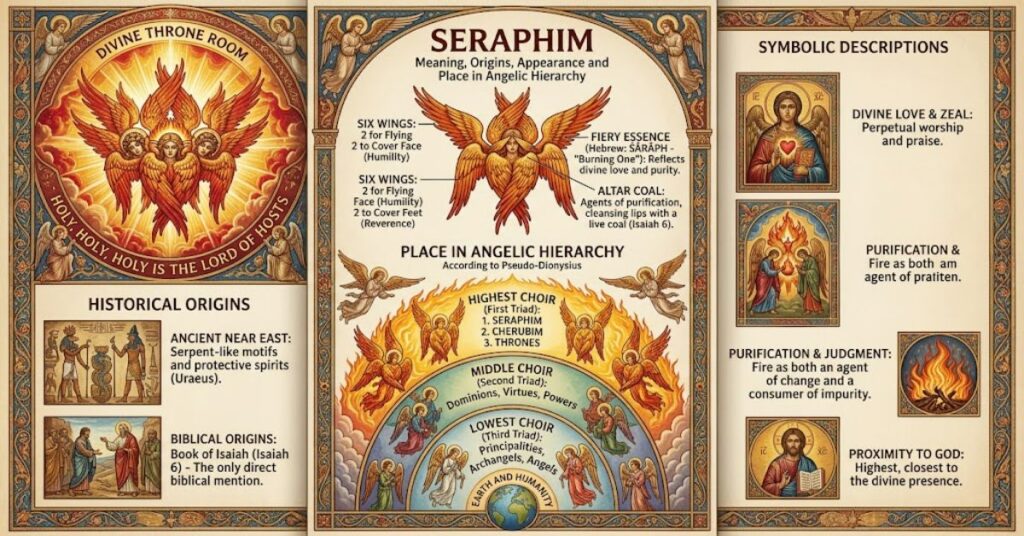
Seraphim are celestial beings associated with the presence and glory of God, particularly in the prophetic vision recorded in Isaiah 6. They are described as having six wings and standing around God’s throne, continually declaring His holiness. One of them also carries a burning coal from the altar and touches Isaiah’s lips, symbolically preparing the prophet for his calling.
The word is commonly connected with the Hebrew saraph, often understood in relation to burning or fire. That association helps explain why later religious traditions connected these beings with spiritual intensity, purification and divine love.
The biblical description, however, is relatively limited. Isaiah provides the clearest canonical account, and it does not offer the detailed physical portrait often seen in modern paintings, films or popular illustrations. Later Jewish and Christian writings expanded the concept, while Christian theologians developed a structured hierarchy in which seraphim became the highest of nine angelic orders.
That distinction is important. The seraphim of Isaiah should not simply be treated as identical to every later idea about angels. Their biblical role, symbolism and later theological interpretation developed across different periods.
What Are Seraphim?
In the traditional Christian understanding, seraphim are among the highest heavenly beings. The supplied Matrics360 brief describes them as occupying the highest rank in traditional Christian angelology and a high tier in Jewish angelic hierarchies.
The strongest biblical reference is Isaiah 6. Isaiah describes a vision in which seraphim stand above the divine throne. Each possesses six wings. Two cover the face, two cover the feet and two are used for flying. Their repeated declaration of God’s holiness becomes one of the defining features associated with them.
| Feature | Description |
| Primary biblical source | Isaiah 6 |
| Number of wings | Six |
| Main setting | Before the divine throne |
| Vocal role | Proclaiming God’s holiness |
| Purification role | One seraph carries a live coal to Isaiah |
| Traditional Christian rank | Highest of the nine angelic orders |
Why Do Seraphim Have Six Wings?
The six wings are not simply decorative imagery. Isaiah assigns different functions to them.
Two wings cover the seraph’s face, two cover the feet and two enable flight. The arrangement communicates reverence and readiness. The beings are close to the divine presence, yet their posture reflects humility before it.
The wings therefore carry symbolic meaning as well as visual significance. They distinguish the seraphim from ordinary human figures and emphasise their supernatural status.
Popular artwork sometimes portrays seraphim as attractive human-like angels with large white wings. That image is largely shaped by later artistic traditions. The biblical text itself gives a much narrower description and does not provide the detailed appearance frequently assumed today.
The Meaning of the Name
The meaning of seraphim is debated.
One common interpretation connects the Hebrew term with a verb meaning “to burn” or “consume with fire”. This interpretation fits the Isaiah narrative because one of the beings uses a burning coal from the altar during the purification of Isaiah.
Another scholarly line connects the term with “fiery” or flying serpent imagery found elsewhere in the Hebrew Bible. The Jewish Encyclopedia records this interpretive debate and notes that the exact original conception of the beings remains difficult to establish from Isaiah alone.
This uncertainty is useful rather than problematic. It shows why the history of angelology cannot be reduced to a single definition. Different religious communities and historical periods have interpreted the same terminology in different ways.
Seraphim in Jewish Tradition
The biblical account belongs to Jewish scripture, and later Jewish literature also discusses seraphim.
The Jewish Encyclopedia notes that seraphim appear in the Book of Enoch alongside cherubim and other heavenly beings. It also describes an important distinction between seraphim and the ordinary category of angels understood primarily as messengers.
This is an important point because modern popular culture often uses “angel” as a general label for every heavenly creature. Historical Jewish angelology is more varied. Different beings can have different identities, functions and relationships to the divine realm.
The descriptions also changed over time. Later traditions increasingly imagined these beings in forms that combined human and animal characteristics, showing how religious imagery developed beyond the limited description in Isaiah.
Seraphim and the Christian Angelic Hierarchy
The familiar Christian hierarchy of nine angelic orders is associated particularly with Pseudo-Dionysius and later theologians. In this structure, the first hierarchy contains seraphim, cherubim and thrones. The second contains dominations, virtues and powers, while the third contains principalities, archangels and angels.
| Order | Traditional placement |
| Seraphim | First hierarchy, highest order |
| Cherubim | First hierarchy |
| Thrones | First hierarchy |
| Dominations | Second hierarchy |
| Virtues | Second hierarchy |
| Powers | Second hierarchy |
| Principalities | Third hierarchy |
| Archangels | Third hierarchy |
| Angels | Third hierarchy |
Thomas Aquinas later discussed this hierarchy in the Summa Theologiae, explaining the traditional placement of seraphim as the first order. He associated their name with exceptional spiritual ardour and described them as being especially oriented towards God.
This hierarchy should be understood as theological development rather than a complete ranking explicitly laid out in one biblical passage. The system became influential in Christian thought through late antique and medieval theology.
Seraphim vs Cherubim
Seraphim and cherubim are often confused, but they are distinct categories in the biblical tradition.
Isaiah associates seraphim with the divine throne and the proclamation of holiness. Cherubim appear prominently in Ezekiel, where they are described in a much more complex vision involving multiple faces, wings and other features.
Later Christian theology placed both groups in the highest celestial hierarchy.
The distinction matters because modern imagery frequently combines characteristics from several different biblical creatures. The result can create an image of “angels” that does not closely correspond to any single scriptural description.
The Purification of Isaiah
One of the most significant moments involving seraphim occurs when Isaiah becomes aware of his own unworthiness after seeing the divine vision.
A seraph takes a live coal from the altar and touches Isaiah’s lips. The action represents purification before the prophet receives his commission.
This scene gives the seraphim a role beyond worship. They are associated with holiness, purification and preparation for sacred service.
That combination helps explain why later Christian writers connected the beings with spiritual fire. The fire is not merely destructive; it becomes a symbol of purification and intense devotion.
What Seraphim Represent
Across later interpretations, several themes repeatedly appear:
- Holiness: Their central proclamation focuses on God’s holiness.
- Reverence: Their covered faces and feet convey humility.
- Purification: The burning coal represents cleansing.
- Divine proximity: They are positioned immediately around the throne in Isaiah’s vision.
- Spiritual intensity: Later theologians connected their fiery name with exceptional love and devotion.
These meanings should not be treated as interchangeable with the original biblical text. Some belong specifically to later theological interpretation.
The Future of Seraphim Studies in 2027
By 2027, interest in angelology is likely to remain closely connected with digital religion, historical research and popular culture. Online communities increasingly combine biblical scholarship, religious interpretation, art history and mythology when discussing supernatural beings.
The main challenge is separating historical evidence from modern invention. Digital platforms make it easy for an illustration, fictional description or later tradition to be presented as though it came directly from scripture.
Future discussions will therefore benefit from clearer source separation: biblical descriptions should be distinguished from later Jewish literature, Christian theology, medieval art and modern entertainment.
For seraphim in particular, this approach matters because the surviving biblical description is relatively short, while later interpretations are extensive.
Key Insights
- Seraphim are best known from Isaiah 6 rather than from a broad collection of biblical passages.
- Their six wings have specific functions in the prophetic vision.
- The meaning of their name remains subject to scholarly interpretation.
- Jewish and Christian traditions developed different understandings of their identity and role.
- The nine-order hierarchy became prominent through later Christian theology.
- Modern images often combine characteristics belonging to different heavenly beings.
- The purification of Isaiah gives the seraphim a symbolic role beyond worship.
Conclusion
Seraphim occupy a distinctive place in the history of Jewish and Christian religious thought. Their strongest biblical appearance is the vision of Isaiah, where six-winged beings stand near the divine throne, proclaim holiness and participate in the prophet’s purification.
Later traditions expanded this limited biblical portrait. Jewish writings placed seraphim among other heavenly creatures, while Christian theologians eventually positioned them at the top of a nine-order celestial hierarchy. Pseudo-Dionysius and Thomas Aquinas were particularly influential in shaping that later framework.
Understanding the difference between scripture and later interpretation makes the subject more interesting, not less. It explains why seraphim can simultaneously represent fiery spiritual devotion, heavenly worship, purification and divine proximity while remaining difficult to define through a single description.
FAQ
What are seraphim?
Seraphim are heavenly beings described most clearly in Isaiah 6. They stand near God’s throne, possess six wings and proclaim God’s holiness.
How many wings do seraphim have?
The seraphim in Isaiah’s vision have six wings. Two cover the face, two cover the feet and two are used for flying.
Are seraphim angels?
The answer depends on the tradition. Later Christian theology places seraphim within the celestial hierarchy of heavenly beings, while some Jewish sources distinguish them from angels understood specifically as divine messengers.
What do seraphim symbolise?
They are commonly associated with holiness, reverence, purification, divine proximity and intense spiritual devotion.
Are seraphim higher than cherubim?
In the traditional Christian nine-order hierarchy, seraphim rank above cherubim. Both belong to the highest of the three celestial hierarchies.
Where are seraphim mentioned in the Bible?
Their clearest and most direct biblical description appears in Isaiah 6. The passage describes their six wings, worship and role in Isaiah’s purification.
Methodology
This article uses the keyword definition and editorial framing supplied in the Matrics360 production brief. Historical and theological claims were checked against established reference material from the Jewish Encyclopedia and Catholic Encyclopedia, together with Thomas Aquinas’s Summa Theologiae. The article distinguishes biblical descriptions from later theological interpretations because the nine-order hierarchy developed as a theological system rather than appearing as a complete hierarchy in a single biblical text.
No firsthand testing, interviews or personal observations were conducted, so none have been presented as original experience. The main limitation is that the biblical description of seraphim is brief, leaving substantial room for later interpretation.
Visual Strategy
- Isaiah’s Temple Vision: A cinematic ancient temple interior with a prophet standing before a radiant throne, six-winged seraphim surrounding the scene, dramatic warm light and an editorial focus on biblical symbolism rather than fantasy imagery.
- The Six-Winged Seraph: A historically informed artistic reconstruction showing a six-winged heavenly being in an ancient Near Eastern setting, subdued gold and stone textures, directional light and emphasis on the unusual biblical description.
- Celestial Hierarchy: An editorial-style vertical composition showing the traditional nine orders of Christian angelology as a structured symbolic hierarchy, dark atmospheric background, controlled illumination and emphasis on the distinction between seraphim, cherubim and lower orders.
Suggested image alt text: Six-winged seraphim in a biblical heavenly vision
References
Hirsch, E. G., & Benzinger, I. (n.d.). Seraphim. Jewish Encyclopedia.
New Advent. (n.d.). Seraphim. Catholic Encyclopedia.
New Advent. (n.d.). Angels. Catholic Encyclopedia.
New Advent. (n.d.). Dionysius the Pseudo-Areopagite. Catholic Encyclopedia.
Aquinas, T. (n.d.). Summa Theologiae: The angelic degrees of hierarchies and orders. New Advent.