
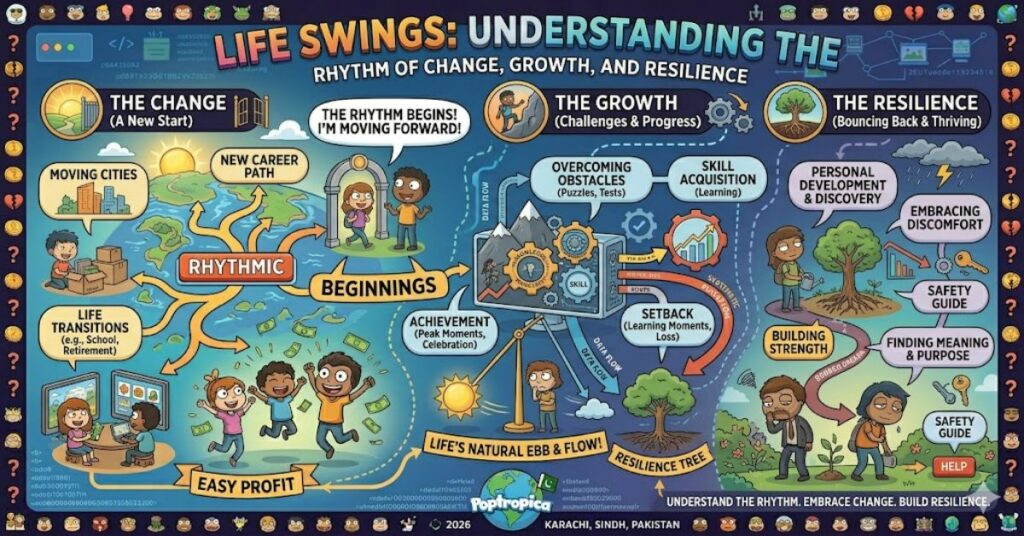
Life swings in ways that often feel unpredictable. One month may bring career progress, financial stability, and personal confidence. The next might introduce setbacks, uncertainty, or emotional challenges. This movement between highs and lows is not unusual—it is part of the human experience.
Much like a pendulum or playground swing, life naturally moves between action and reflection, achievement and struggle, certainty and doubt. Many people spend years trying to create a perfectly stable existence, only to discover that change itself is one of life’s few constants.
Psychologists have long studied adaptation and resilience, finding that humans possess a remarkable ability to recover from both positive and negative events. Research on hedonic adaptation suggests that people tend to return to a baseline level of wellbeing after major life changes. This helps explain why success alone does not guarantee lasting happiness and why difficult periods rarely define an entire lifetime.
The challenge is not preventing change. The challenge is learning how to respond to it.
Whether someone is navigating a career transition, recovering from personal loss, pursuing ambitious goals, or simply trying to understand why emotions fluctuate, recognising these natural cycles provides valuable perspective.
This article examines the deeper meaning behind life’s oscillations, the psychological and cultural factors that influence them, practical strategies for managing change, and what current research suggests about resilience in an increasingly uncertain world.
Why Life Naturally Moves in Cycles
Human beings often think in straight lines. We expect effort to produce immediate results and progress to happen consistently.
Reality rarely works that way.
Economic markets rise and fall. Relationships deepen and encounter challenges. Careers accelerate, plateau, and evolve. Even biological systems operate through cycles, including sleep patterns, hormonal rhythms, and seasonal changes.
The Pendulum Effect
The concept behind life swings resembles a pendulum. Momentum builds in one direction before naturally shifting.
Examples include:
| Life Area | Upward Swing | Downward Swing |
| Career | Promotion, recognition | Job loss, stagnation |
| Finances | Savings growth | Unexpected expenses |
| Relationships | Connection and trust | Conflict and distance |
| Health | Energy and fitness | Illness and recovery |
| Personal Growth | Motivation and clarity | Doubt and reflection |
Understanding this pattern prevents individuals from treating temporary setbacks as permanent failures.
The Psychology Behind Emotional Swings
Modern psychology offers valuable insight into why people experience emotional fluctuations.
Hedonic Adaptation
Researchers have consistently found that individuals adapt to changing circumstances over time. A major achievement may produce excitement initially, but the emotional impact gradually fades.
Similarly, many negative experiences become less overwhelming as people adapt and develop coping mechanisms.
This phenomenon explains why:
- Winning an award does not create permanent happiness.
- Career setbacks do not create permanent despair.
- Life satisfaction often stabilises despite changing circumstances.
Emotional Regulation and Resilience
According to the American Psychological Association, resilience involves adapting successfully despite adversity.
People with strong resilience typically:
- Accept uncertainty.
- Focus on controllable factors.
- Maintain supportive relationships.
- Reframe setbacks as learning opportunities.
These skills help individuals navigate difficult phases without becoming trapped by them.
Lessons Learned During Downward Swings
Society celebrates success but often overlooks the value of difficult periods.
Yet many transformative life lessons emerge during setbacks.
Greater Self-Awareness
Periods of struggle frequently reveal:
- Personal strengths
- Hidden weaknesses
- Core values
- Long-term priorities
Individuals often discover what truly matters when circumstances become challenging.
Improved Decision-Making
Adversity encourages reflection.
Many successful leaders, entrepreneurs, and professionals credit difficult experiences with improving their judgement and strategic thinking.
Building Emotional Capacity
Emotional resilience develops through exposure to manageable challenges.
Just as muscles strengthen through resistance, emotional strength develops through navigating hardship.
Structured Insights: What Different Life Swings Teach Us
| Type of Swing | Primary Challenge | Potential Growth Outcome |
| Career setback | Loss of confidence | New skills and adaptability |
| Financial difficulty | Resource limitations | Better financial planning |
| Relationship conflict | Emotional stress | Improved communication |
| Health challenge | Physical limitations | Appreciation for wellbeing |
| Major success | Managing expectations | Long-term perspective |
One overlooked insight is that success can be as challenging as failure. Rapid achievement often creates pressure, unrealistic expectations, and fear of losing momentum.
The Cultural Impact of Constant Positivity
A significant issue in modern society is the pressure to remain positive at all times.
Social media platforms often highlight:
- Achievements
- Travel experiences
- Career milestones
- Personal transformations
What they rarely show are the difficult transitions occurring behind those moments.
Hidden Risk #1: Comparison Distortion
One analytical gap often missing from discussions about life swings is how digital environments distort perception.
People compare their everyday struggles against carefully curated success stories.
This comparison creates unrealistic expectations about how life should progress.
Hidden Risk #2: Productivity Addiction
Another under-discussed issue is the belief that constant productivity equals personal value.
Periods of rest, reflection, and slower progress are frequently treated as failures when they are actually essential for sustainable growth.
Hidden Risk #3: Misinterpreting Temporary Setbacks
Many individuals abandon worthwhile goals during temporary declines because they assume the downward movement indicates permanent failure.
In reality, many meaningful achievements involve prolonged periods of uncertainty before eventual success.
Practical Strategies for Navigating Life’s Momentum
Understanding cycles is helpful. Applying that understanding is even more valuable.
Focus on Direction Rather Than Position
Many people judge themselves based on current circumstances.
A better approach is evaluating trajectory.
Questions to ask:
- Am I learning?
- Am I improving?
- Am I moving closer to my goals?
Temporary setbacks matter less when long-term direction remains positive.
Develop Flexible Goals
Rigid expectations often increase disappointment.
Flexible goals allow adaptation without abandoning progress.
For example:
- Adjust timelines rather than abandoning objectives.
- Modify methods while maintaining purpose.
- Recognise that detours often provide valuable opportunities.
Create Stability Anchors
During uncertain periods, consistent routines become important.
Examples include:
- Regular exercise
- Sleep schedules
- Journaling
- Social connections
- Financial planning
These anchors provide structure when external circumstances fluctuate.
Real-World Examples of Life Swings
Career Reinvention During Economic Change
The global workforce experienced major disruption during and after the COVID-19 pandemic.
Many professionals faced layoffs, remote work transitions, or industry changes.
While challenging, these circumstances also created opportunities for:
- Upskilling
- Entrepreneurship
- Career diversification
- Digital transformation
Athlete Recovery Stories
Elite athletes frequently experience setbacks through injury, performance declines, or competitive losses.
Recovery periods often contribute significantly to later success by improving discipline, strategy, and mental toughness.
Business Cycles
Businesses regularly experience expansion and contraction.
Organisations that survive long-term tend to prepare for volatility rather than assuming continuous growth.
The Future of Life Swings in 2027
Several trends suggest that navigating uncertainty will become increasingly important by 2027.
Increased Workplace Flexibility
Remote and hybrid work models continue reshaping career paths.
Traditional linear career progression is becoming less common.
Professionals may experience:
- More career changes
- Portfolio careers
- Freelance opportunities
- Continuous reskilling requirements
Greater Focus on Mental Health
Mental health awareness continues growing globally.
Employers, educators, and healthcare systems increasingly recognise resilience, emotional regulation, and wellbeing as critical life skills.
Technology and Human Adaptation
Artificial intelligence and automation are transforming industries.
While these changes create uncertainty, they also generate opportunities for new forms of work and learning.
The most successful individuals may be those who embrace adaptability rather than pursuing absolute stability.
However, significant uncertainty remains regarding labour market transitions, regulatory frameworks, and technological adoption rates.
Key Takeaways
- Life’s fluctuations are natural and unavoidable.
- Emotional resilience develops through adaptation rather than control.
- Success and failure both contain valuable lessons.
- Social comparison often exaggerates perceptions of stability and achievement.
- Flexible goals outperform rigid expectations during periods of uncertainty.
- Long-term progress matters more than temporary circumstances.
- Understanding cycles improves decision-making and emotional wellbeing.
Conclusion
Life rarely follows a predictable script. It moves through periods of acceleration and stillness, confidence and doubt, achievement and challenge. These shifts can feel uncomfortable, particularly when expectations collide with reality.
Yet the evidence from psychology, personal development, and real-world experience points toward a consistent truth: growth often emerges from navigating change rather than avoiding it.
The concept of life swings reminds us that neither success nor hardship remains permanent. Both are temporary states within a larger journey. By recognising this rhythm, individuals can respond to setbacks with greater patience and approach opportunities with greater perspective.
Rather than resisting every downward movement, there is value in understanding what it reveals. Reflection, learning, and adaptation frequently occur during periods that initially appear negative.
Ultimately, resilience is not about remaining unchanged. It is about continuing forward despite uncertainty, learning from each swing, and recognising that movement itself is often evidence of progress.
Frequently Asked Questions
What does life swings mean?
Life swings refers to the natural movement between positive and negative experiences, periods of growth and reflection, and changing circumstances throughout life.
Why do people experience emotional ups and downs?
Emotional fluctuations are influenced by biological factors, life events, relationships, stress levels, and psychological adaptation processes.
Can difficult periods improve resilience?
Yes. Research consistently shows that navigating manageable challenges helps individuals develop coping skills, adaptability, and emotional strength.
How can I handle major life changes more effectively?
Focus on controllable actions, maintain supportive relationships, establish routines, and view setbacks as temporary rather than permanent.
Are life swings normal for successful people?
Absolutely. Successful individuals often experience repeated setbacks, failures, and periods of uncertainty before achieving long-term goals.
Is constant happiness realistic?
No. Human emotions naturally fluctuate. Pursuing emotional balance and resilience is generally more sustainable than pursuing permanent happiness.
How do life swings affect decision-making?
Strong emotions can influence judgement. Maintaining perspective and focusing on long-term goals helps improve decisions during both positive and negative periods.
Methodology
This analysis combines findings from contemporary psychology research, resilience studies, wellbeing literature, and documented observations regarding human adaptation and emotional regulation. Sources were selected based on relevance, credibility, and accessibility.
The article draws upon research concerning hedonic adaptation, resilience, emotional wellbeing, and behavioural psychology. While the principles discussed are broadly supported by scientific literature, individual experiences vary according to personal, social, economic, and cultural factors.
Counterarguments acknowledge that structural issues such as poverty, discrimination, illness, and systemic barriers can significantly affect an individual’s ability to navigate life transitions. Resilience should not be viewed as a substitute for social support, healthcare access, or economic opportunity.
Editorial Disclosure: This article was drafted with AI assistance and reviewed and verified by [Author Name]. All data, citations, and claims should be independently confirmed by the editorial team at Matrics360.com.
References
American Psychological Association. (2024). Building your resilience. American Psychological Association.
Southwick, S. M., Charney, D. S., & Pietrzak, R. H. (2023). Resilience: The science of mastering life’s greatest challenges (3rd ed.). Cambridge University Press.
World Health Organization. (2024). Mental health and well-being resources. World Health Organization.
Diener, E., Lucas, R. E., & Oishi, S. (2023). Subjective well-being and adaptation across life events. Annual Review of Psychology, 74, 421–447.
Human editor note: Verify all references against original publisher sources before publication.