
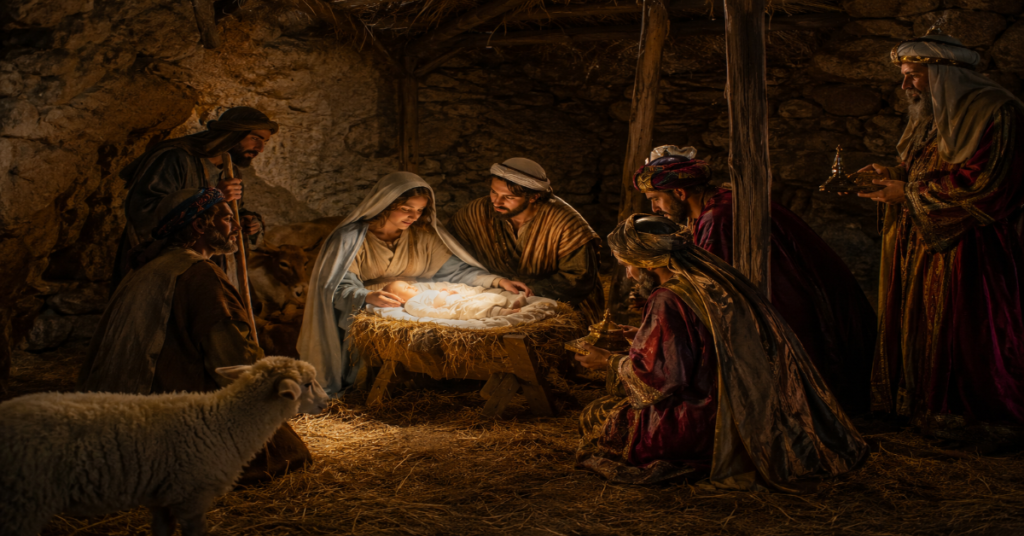
Nativität means Nativity in German and refers most commonly to the birth of Jesus Christ. In Christian belief, this event marks the Incarnation, the moment when God became human in the person of Jesus. The term comes from Latin nativitas, meaning birth, origin or being born. In English, “Nativity” is used both for the biblical event and for artistic or devotional scenes showing Mary, Joseph, the infant Jesus, shepherds, Magi and animals.
The search intent behind this word is usually simple at first: readers want to know what it means. But the term opens into a much wider subject. It belongs to language history, biblical interpretation, Christian theology, liturgical practice, European art and modern Christmas culture.
The Nativity narrative is drawn mainly from Matthew and Luke, the two canonical Gospels that include accounts of Jesus’ birth. Matthew emphasizes Joseph, the Magi, Herod and the flight to Egypt. Luke emphasizes Mary, the census, the manger, shepherds and angelic proclamation. Britannica notes that Christmas centers on the birth of Jesus as recorded in these two Gospels.
This article explains what the term means, where it comes from, why the event matters in Christian thought and how it became one of the most enduring religious and cultural images in world history.
What Nativität Means
Nativität is a German noun related to the idea of birth, especially the birth of Christ. Its closest English equivalent is “Nativity.” The word’s deeper root is Latin nativitas, which means birth. Etymonline traces “nativity” through Old French and Late Latin, connecting it to “birth,” “origin” and the Christian feast celebrating Christ’s birth.
In ordinary religious usage, the term usually has three meanings:
| Meaning | Explanation | Common Context |
| Birth of Jesus | The biblical event at the center of Christmas | Theology, sermons, scripture |
| Nativity scene | Visual depiction of Jesus’ birth | Churches, homes, public displays |
| Christmas feast | Liturgical celebration of Christ’s birth | Worship, calendars, tradition |
The word is not just a synonym for “Christmas.” Christmas is the feast or holiday. Nativity is the event being celebrated. That distinction matters because the event belongs to Christian doctrine while the holiday has also developed broad cultural, commercial and seasonal expressions.
Biblical Foundations of the Nativity
The New Testament does not provide one single continuous birth story. Instead, the Nativity is built from Matthew and Luke.
Matthew includes Joseph’s dream, the Magi, Herod’s threat, the massacre of the innocents and the flight into Egypt. Luke includes the annunciation to Mary, the census, the manger, shepherds in the fields and the angelic announcement. The two accounts share central elements, including Mary, Joseph, Bethlehem and the divine origin of Jesus’ birth, but they differ in narrative structure and emphasis.
| Gospel | Main Emphasis | Distinctive Elements |
| Matthew | Royal identity, prophecy and danger | Magi, Herod, star, Egypt |
| Luke | Humility, joy and universal salvation | Manger, shepherds, angels, census |
| Shared tradition | Jesus is born in Bethlehem | Mary, Joseph, divine conception |
This is one reason scholars treat the Nativity as both theological narrative and historical tradition. The accounts are not written like modern biography. They are shaped to communicate meaning: Jesus as Messiah, Savior, Son of David and Son of God.
Theological Meaning of the Nativity
The theological center of the Nativity is the Incarnation. In Christian doctrine, Jesus is not merely a prophet born into history. He is the Word made flesh. The Catechism of the Catholic Church explains the Incarnation through the creed: “for us men and for our salvation” the Son came down from heaven and became man.
That idea gives the birth story its weight. A child in a manger becomes a sign of divine humility. The setting is not imperial power but poverty, vulnerability and hiddenness.
Three theological themes dominate:
| Theme | Meaning | Why It Matters |
| Incarnation | God becomes human | Connects divine salvation with human life |
| Humility | Christ is born in lowly conditions | Reverses expectations of power |
| Fulfillment | The birth is linked to promise and prophecy | Places Jesus inside salvation history |
Nativität therefore functions as more than a seasonal word. It names a doctrine of divine nearness. The point is not simply that Jesus was born, but that his birth reveals how Christianity understands God’s relationship to humanity.
Historical Context and Date Questions
The exact historical date of Jesus’ birth is not known. Britannica states that December 25 became widely accepted as the date of Christmas, but several explanations exist for why that date became attached to the celebration. One view connects it to Christian reasoning around March 25 as the date of creation or conception. Another links it to Roman winter festivals and the symbolism of light.
Vatican City’s 2025 Christmas note also states that Jesus’ birth cannot be dated precisely by year or day, while explaining that the feast was honored in both Eastern and Western Christian communities by the early fourth century.
This creates a useful distinction:
| Question | Best Answer |
| Was Jesus’ birth important to early Christianity? | Yes, especially as Christological doctrine developed |
| Is December 25 historically certain? | No |
| Is December 25 liturgically important? | Yes |
| Is the Nativity only a Western tradition? | No, though dates and customs vary |
The uncertainty around the exact date does not weaken the theological role of the event. It shows how Christian memory, liturgy and cultural practice developed around a sacred narrative rather than a confirmed calendar record.
Nativität in Art, Music and Visual Culture
Few biblical themes have shaped art as strongly as the Nativity. Britannica describes the Nativity as one of the oldest and most popular Christian art subjects, with complex iconography that changed across centuries.
Early Christian depictions often emphasized Christ’s divine status. Medieval and Renaissance works increasingly emphasized tenderness, motherhood, poverty and adoration. The manger, animals, shepherds and Magi became visual tools for explaining theology to audiences that were often not literate.
The Metropolitan Museum of Art’s collection includes multiple Nativity works across media, including panel painting, stained glass and devotional imagery. One example, a Flemish stained-glass Nativity dated around 1525 to 1530, shows how the scene moved beyond manuscript and altar painting into architectural worship spaces.
This visual tradition matters because it made the Nativity portable. It could appear in churches, homes, town squares and later printed cards. The image became a public theology of birth, humility and hope.
Cultural Impact of the Nativity
The Nativity shaped more than church doctrine. It influenced public calendars, seasonal rituals, music, theater, charity and family customs.
Christmas pageants, carols, manger scenes and midnight services all depend on Nativity imagery. Vatican News notes that Christmas is the only liturgical celebration with four Masses: Vigil, Night, Dawn and Day. That structure shows how the event is unfolded slowly through worship.
In modern culture, the Nativity often sits beside nonreligious Christmas symbols such as trees, lights, markets and gift-giving. That creates both reach and tension. The story remains religious at its core, but its imagery has entered secular public space.
A relevant Matrics360 cultural comparison is the site’s article on the Google Dreidel feature, which examines how digital platforms represent religious and seasonal traditions through interactive design. That piece is useful context because it shows how sacred or cultural symbols can shift when they enter mainstream technology and entertainment environments.
Risks, Misreadings and Trade-Offs
Nativität is sometimes misunderstood in three ways.
First, readers may reduce it to decoration. A Nativity scene can become a seasonal object without theological depth. That risks flattening the story into atmosphere.
Second, readers may confuse Christmas customs with the biblical narrative. Trees, Santa imagery and modern gift culture are not the same as the Nativity. They may coexist, but they come from different historical layers.
Third, public use of Nativity imagery can create legal or interreligious sensitivity in plural societies. In civic spaces, the question is not only what the scene means to Christians, but how public institutions represent religion fairly.
The central trade-off is visibility versus simplification. The Nativity remains powerful because it is visually memorable. But the more widely it circulates, the easier it becomes to detach the image from its doctrinal roots.
Original Insights for Readers
| Insight | Why It Matters |
| The term works on three levels at once | It is linguistic, theological and cultural, not just a translation problem |
| Matthew and Luke create different narrative lenses | The Nativity is not one flat story, but a layered tradition |
| Visual art changed the public meaning of the event | Images made theology accessible outside formal teaching |
| Modern Christmas can preserve and dilute the Nativity | Cultural reach can expand awareness while weakening doctrinal precision |
| Date uncertainty does not erase liturgical meaning | Religious calendars often organize memory, not only historical proof |
The Future of Nativität in 2027
By 2027, the future of Nativität will likely be shaped by three pressures: religious literacy, digital culture and public pluralism.
Religious literacy is declining in many Western societies, which means more readers may encounter the word as a cultural or linguistic curiosity before understanding its theological meaning. Pew Research has reported concern in the United States that religious aspects of Christmas are declining in public life, although many Christians still affirm major elements of the biblical Christmas story.
Digital culture will also reshape Nativity representation. AI-generated images, virtual church services and interactive holiday experiences will make the scene more accessible, but they may also produce historically inaccurate or theologically confused depictions.
Public pluralism will continue to influence where and how Nativity scenes appear. Churches and private homes will remain stable settings. Public institutions may treat the imagery more carefully, especially in legally sensitive environments.
The most durable future for the term will depend on explanation. When the word is taught with its language history, scripture base and cultural impact, it remains meaningful. When it is used only as decoration, it becomes fragile.
Takeaways
- Nativität is best understood as the German term connected to the Christian Nativity.
- Its Latin root, nativitas, gives the word its basic meaning of birth.
- The biblical foundation comes mainly from Matthew and Luke.
- Theologically, the Nativity centers on Incarnation, humility and salvation.
- Historically, December 25 is liturgically important but not a confirmed birth date.
- Art and music carried the Nativity into public imagination for centuries.
- Modern culture keeps the image visible, but often separates it from doctrine.
Conclusion
Nativität is a compact word with a wide historical and spiritual field behind it. At the simplest level, it means Nativity: the birth of Jesus Christ. At a deeper level, it points to the Christian belief that God entered human history in humility, vulnerability and promise.
Its meaning cannot be separated from scripture, especially Matthew and Luke. It also cannot be separated from the centuries of art, music, worship and custom that turned the birth of Christ into one of the most recognizable scenes in the world.
The word matters because it preserves a link between language and belief. It reminds readers that Christmas is not only a holiday season, but a religious memory rooted in birth, incarnation and hope. Whether encountered in German, English, church liturgy or visual art, the Nativity remains one of Christianity’s most enduring ways of speaking about divine presence in human life.
FAQ
What does Nativität mean?
Nativität means Nativity in German. It usually refers to the birth of Jesus Christ, especially in Christian theology, worship, art and Christmas tradition.
Is Nativität the same as Christmas?
Not exactly. Nativität refers to the birth of Jesus. Christmas is the feast or holiday that celebrates that birth.
Where does the word Nativity come from?
Nativity comes from Latin nativitas, meaning birth or origin. The term later became associated especially with the birth of Christ.
Which Bible books describe the Nativity?
The Nativity is described mainly in the Gospels of Matthew and Luke. Each Gospel includes different details and theological emphasis.
Why is the Nativity important in Christianity?
It is important because it expresses the doctrine of the Incarnation, the belief that God became human in Jesus Christ for the salvation of humanity.
Was Jesus born on December 25?
The exact date of Jesus’ birth is not historically certain. December 25 became the accepted liturgical date for Christmas in much of Christianity.
Why are Nativity scenes so common?
Nativity scenes make the birth story visible. They help communicate themes of humility, worship, family, divine love and salvation through a simple visual arrangement.
Methodology
This article was drafted from the supplied Matrics360 production brief and structured around the required keyword, category, metadata, FAQ, visual strategy, future section and trust standards.
The research used reference sources on etymology, Christian doctrine, Christmas history, biblical framing, liturgical tradition and art history. Priority was given to established sources such as Britannica, the Vatican, Etymonline, the Metropolitan Museum of Art and Pew Research Center.
References
Britannica. (2026). Christmas: Origin, definition, traditions, history and date. Encyclopaedia Britannica.
Britannica. (n.d.). Nativity, Christianity. Encyclopaedia Britannica.
Britannica. (n.d.). Nativity, Christian art. Encyclopaedia Britannica.
Etymonline. (n.d.). Nativity: Etymology, origin and meaning. Online Etymology Dictionary.
Metropolitan Museum of Art. (n.d.). The Nativity, one of a set of 12 scenes from The Life of Christ. The Met Collection.
Pew Research Center. (2017). Americans say religious aspects of Christmas are declining in public life. Pew Research Center.
Vatican. (n.d.). Catechism of the Catholic Church: He was conceived by the power of the Holy Spirit and born of the Virgin Mary. Vatican.va.
Vatican News. (n.d.). Solemnity of the Nativity of Our Lord or Christmas. Vatican News.