
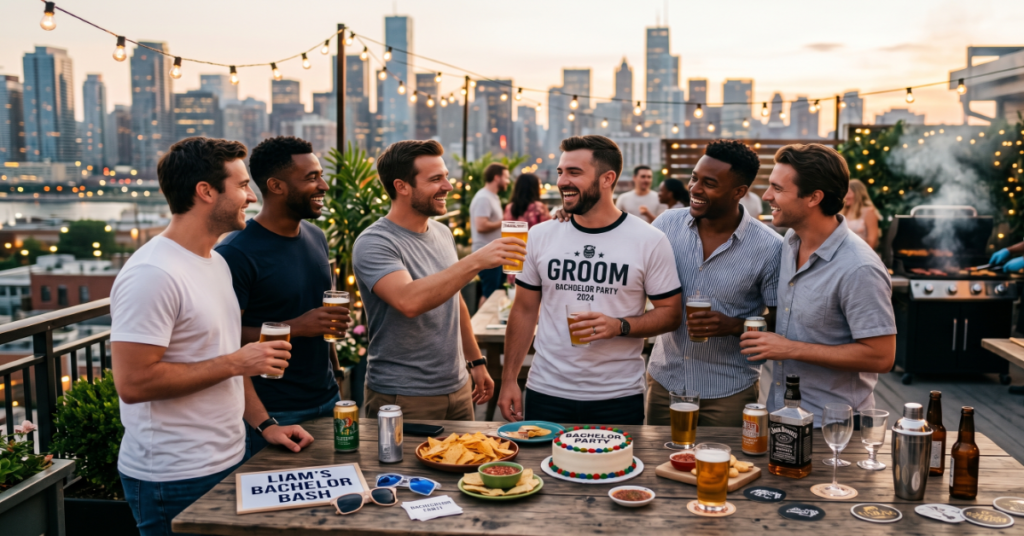
Choosing the right bachelor party ideas starts with one honest question: what does the groom actually want? Not what his favorite movies suggest, not what his college friends expect — what he genuinely enjoys. That single question separates a memorable night from an expensive obligation.
Bachelor parties have evolved well beyond the Las Vegas cliche. In 2025, the range of legitimate options spans everything from private racetrack days and chef-led cooking classes to multi-city scavenger hunts and offshore fishing charters. The activity landscape is wider than ever. The planning challenge is narrower: matching the experience to the person.
This guide covers bachelor party ideas across three core personality types — high-adrenaline, relaxed and social, and themed celebrations — alongside practical planning advice, budget benchmarks, and a forward look at where group celebrations are heading. Whether the group is flying to a new city or keeping things local, these frameworks produce events that attendees actually talk about afterward.
Internal context: For groups weighing a destination trip, considerations around group travel logistics, visa requirements, and seasonal timing apply across leisure travel categories. The same planning discipline that produces a well-run corporate retreat applies to a bachelor weekend — timelines, deposits, and contingency plans matter.
High-Adrenaline Bachelor Party Ideas
For grooms whose natural habitat involves movement, competition, or speed, static celebration formats underdeliver. The following activities are consistently rated highest by groups with competitive dynamics.
Motorsports and Track Experiences
Renting sports cars or supercars at a professional track is one of the most scalable high-adrenaline options available. Pricing typically ranges from $300 to $800 per person for a half-day session depending on the vehicle class and location, with group rates available for parties of eight or more at most major tracks in the United States. The Thermal Club in California and the Circuit of the Americas in Austin, Texas both offer structured group driving programs with instructor support.
Key logistical detail that most planning articles omit: track experiences require participants to sign detailed liability waivers, and some facilities enforce age minimums of 21 for driver sessions. Confirm eligibility requirements before booking — a late discovery on this creates real problems for groups with younger members.
Off-Roading and Overland Adventures
ATV and side-by-side rentals for trail riding have expanded significantly in availability since 2022, with dedicated outfitters now operating in most major outdoor recreation markets. For groups in the American Southwest, companies in Moab, Utah and Sedona, Arizona offer guided half-day and full-day experiences with all equipment included. Pricing runs approximately $200 to $400 per vehicle for a four-hour session.
One underreported consideration: off-road experiences generate significant physical fatigue and gear contamination. Scheduling this as an afternoon activity followed by an evening celebration without a recovery window is a common planning mistake. Build in at least 90 minutes between activity end and dinner reservation.
Adventure Sports: Ziplining, White-Water Rafting, Bungee
Multi-activity adventure packages — combining ziplining with a rafting segment, for example — are increasingly offered as corporate and private group packages. Operators in the Blue Ridge Mountains (Georgia and North Carolina), the Colorado Rockies, and the Pacific Northwest have developed structured group formats that include equipment, instruction, and catering. These packages typically run $150 to $350 per person for a full day.
White-water rafting in particular benefits from seasonal planning. Class III and IV rapids are generally optimal in spring during snowmelt season (April through June in most mountain corridors). Summer water levels often reduce intensity, which affects the overall experience quality for groups seeking genuine challenge.
Competitive Group Combat: Paintball and Laser Tag
Paintball remains one of the most group-size-flexible options on this list. Facilities can accommodate parties from six to forty players, and most offer private field bookings for groups of twelve or more. Budget approximately $60 to $120 per person including equipment rental and paint, with a two-hour session being the functional sweet spot before fatigue affects engagement.
High-Adrenaline Activity Comparison
| Activity | Avg. Cost/Person | Group Size | Physical Demand | Best Region |
| Motorsports / Track Day | $300–$800 | 6–20 | Low (seated) | Nationwide (major tracks) |
| ATV / Off-Road Riding | $200–$400 | 4–16 | Moderate | Southwest, Rockies |
| Rafting / Ziplining Package | $150–$350 | 8–30 | High | Appalachians, Rockies |
| Paintball (Private Field) | $60–$120 | 6–40 | Moderate | Nationwide |
Relaxed and Social Bachelor Party Ideas
Not every groom wants to sprint between activities. For groups that prioritize conversation, shared meals, and low-stakes fun, these formats consistently deliver strong group bonding without exhaustion.
The Backyard Retreat
A well-executed backyard barbecue with smoked meats, lawn games, and a curated playlist outperforms a generic bar night for groups with varied ages and physical conditions. The financial case is also compelling: catering a 15-person backyard event through a local BBQ company typically costs $40 to $80 per person, compared to $150+ per person at a standard steakhouse dinner with drinks.
For a polished version, consider renting a high-end Airbnb with outdoor kitchen facilities rather than using a private home. This provides dedicated event space without the host-obligation dynamic that can make the organizing friend feel like staff rather than a guest.
Chef-Led Cooking Classes
Group cooking classes have matured into a legitimate bachelor party format. Platforms like Sur La Table, Williams Sonoma, and independent culinary studios in most mid-size cities offer private group sessions for parties of eight to twenty-four. Pricing typically runs $85 to $150 per person including ingredients, instruction, and the meal itself.
One practical advantage: cooking classes are self-contained, inherently social, and produce a shared meal as the output — which naturally extends the event into a dining experience. No separate dinner reservation required. For groups with international members or dietary restrictions, most studios accommodate custom menus with advance notice.
Water Excursions: Yacht Charters and Fishing
Private yacht or boat charters have become increasingly accessible through platforms like GetMyBoat and Boatsetter, which aggregate owner-listed vessels across U.S. coastal and lake markets. A six-hour private charter accommodating twelve guests typically runs $1,200 to $3,500 depending on vessel size and market. Split across twelve people, this is often more cost-effective than a full-day resort package.
Deep-sea fishing charters represent a different experience profile — active, skill-based, and outcome-dependent. For groups where the groom is a genuine fishing enthusiast, this works well. For mixed-interest groups, the passivity of waiting for a bite for extended periods can create dead time that the planning team should account for.
Comedy Clubs and Retro Gaming Setups
A private comedy club booking for a bachelor group provides a structured, entertaining evening with no logistical overhead after arrival. Most mid-to-large-market venues offer VIP table packages for groups of eight to twenty, including reserved seating and a bottle service or drink minimum, typically $50 to $120 per person.
The retro gaming night at an Airbnb — equipped with classic consoles, tournament brackets, and delivered food — is the highest-value low-effort option on this list for groups with gaming-aligned grooms. Setup cost is minimal; the experience quality depends almost entirely on bracket organization and game selection, both of which can be handled with an hour of advance planning.
Themed Bachelor Party Ideas
A well-executed theme adds intentionality and makes the event feel curated rather than assembled. The three formats below work consistently across group sizes and personality types.
James Bond Night
The 007 format — suits, poker, martinis, and a rented private room or upscale Airbnb — is one of the few themed events that scales naturally from eight to twenty-five guests without logistical complexity. The primary planning requirements are a venue with a poker table or rented felt setup ($150 to $300), a cocktail menu pre-specified so bar service stays efficient, and a dress code communicated clearly to guests at least two weeks in advance.
One detail that elevates execution: brief everyone on three to four Bond films ahead of the event and run a themed trivia round. It adds structure to the poker evening and creates a memorable anchor moment that groups consistently mention afterward.
City-Wide Scavenger Hunt
Professional scavenger hunt companies like Stag & Hen (operating across major U.S. markets) and GooseChase (a platform allowing custom hunt creation) have made organized group hunts logistically accessible. A professionally designed custom hunt for twelve to twenty participants runs approximately $300 to $600 for the coordination package, plus any venue or activity costs embedded in the hunt design.
The key differentiation between a great scavenger hunt and a mediocre one is challenge design. Hunts that incorporate the groom’s actual history — venues from his past, inside references, contact challenges requiring real interaction — outperform generic city tourism formats by a substantial margin in group engagement.
Amusement Park Day
A full-day amusement park visit with matching group t-shirts and a structured challenge format — fastest coaster time, most ride completions, photo challenge score — returns a genuinely fun format that works for diverse age groups. Group discount pricing for parties of fifteen or more is available at most major parks, typically 15 to 25 percent off standard gate pricing.
Logistics note: amusement parks with fast-pass or virtual queue systems require advance purchase for group optimization. Booking individual fast-pass tickets the morning of for a large group is inefficient and often results in missed ride windows.
Bachelor Party Planning Timeline and Budget Reference
| Planning Phase | Timeline | Key Actions | Budget Notes |
| Initial Planning | 10–12 weeks out | Poll group, set budget, confirm date | Establish per-person cap |
| Vendor Booking | 8 weeks out | Book venue, activity, accommodation | Deposits: 25–50% typical |
| Guest Coordination | 6 weeks out | Confirm RSVPs, collect deposits | Venmo/Splitwise recommended |
| Final Logistics | 2 weeks out | Confirm headcounts, share itinerary | Reserve buffer: 10–15% of total |
| Day-Of | Event day | Shared group chat, emergency contacts | Cash for tips and incidentals |
Strategic Planning: What Most Groups Get Wrong
Budget transparency is the single most underexecuted element of bachelor party planning. The organizing friend — typically the best man — frequently books based on what he thinks the group can afford rather than what the group explicitly agrees to spend. This produces two failure modes: either the event is undersized for the occasion, or two to three guests quietly drop out after seeing the cost breakdown.
The functional fix is straightforward: share a per-person cost estimate before booking anything. A quick message with ‘rough estimate is $280 per person including activity, dinner, and accommodation — confirm you are in’ takes 90 seconds and prevents significant friction. Most event planning professionals working in the corporate retreat space treat cost confirmation as a non-negotiable pre-booking step. Bachelor party planners should adopt the same standard.
Mix-and-match itineraries consistently outperform single-format events. A morning track day followed by a catered dinner at a rented villa accommodates both the adrenaline-seeking contingent and the guests who prefer conversation over competition. Planning a bachelor party as a single continuous format — eight hours of paintball, or six hours at a casino — almost always produces a subset of guests who are engaged and a subset who are enduring.
Risks, Trade-Offs, and Hidden Costs
Several costs that bachelor party planning guides routinely omit deserve direct attention.
- Gratuity at private event venues is frequently not included in quoted pricing. On a $200-per-person dinner package, an 18 to 22 percent service charge adds $36 to $44 per person — a meaningful figure for a fifteen-person group.
- Transportation between activity venues is a consistent cost underestimation. For multi-stop itineraries, a dedicated party bus or van service for twelve guests typically runs $600 to $1,200 for six hours, excluding tip. Uber/Lyft estimates for group movement across a full day undercount surge pricing and vehicle availability constraints.
- Activity no-shows affect per-person costs when group bookings use minimum-participant pricing. A committed headcount of sixteen with three late cancellations can shift per-person cost by 15 to 25 percent if the minimum threshold triggers a pricing tier change.
- Liability and insurance exposure at high-risk activities (motorsports, white-water rafting) varies by operator. Some operators carry group liability coverage; others transfer full risk to participants through waivers. Review the operator’s insurance documentation before booking for any activity with significant injury potential.
Cultural and Market Context: How Bachelor Parties Have Changed
The bachelor party market has undergone two significant structural shifts since 2019. First, the destination party — requiring flights, hotel blocks, and multi-day coordination — became the dominant format for upper-income brackets, replacing the single-city overnight. Second, alcohol-free or alcohol-optional formats have moved from niche to mainstream, driven by a measurable shift in drinking patterns among adults under 35.
The Gallup polling organization reported in 2023 that 62 percent of U.S. adults under 35 identified as drinkers, down from 72 percent in the early 2000s. For bachelor party planners, this has practical implications: events designed around bar-hopping as the primary format are increasingly misaligned with actual group composition. Activity-centered formats — cooking classes, sports events, adventure experiences — are structurally better suited to mixed drinking-preference groups.
The economic profile has also shifted. The average bachelor party in the United States now costs between $1,200 and $1,800 per attendee when destination travel is included, according to data compiled by WeddingWire in 2024. For domestic no-travel events, the average is $300 to $600 per person. These figures represent significant real increases from pre-pandemic baselines, driven primarily by accommodation cost inflation and the premiumization of experience-based activities.
Three Analytical Gaps in Conventional Bachelor Party Advice
Most articles on bachelor party ideas omit or underanalyze three significant planning factors.
First: the optimal group size for activity-based bachelor parties is smaller than most planners assume. Activities like cooking classes, private boat charters, and motorsport days have clear operational ceilings — twelve to sixteen guests — above which the experience degrades due to instructor ratios, equipment constraints, or logistical overhead. Parties exceeding twenty guests benefit from parallel-track itineraries (splitting into activity groups) rather than forcing the whole group through a single format.
Second: the best man’s organizing burden is structurally underestimated. Research on group event coordination consistently shows that peer-organized events with more than ten participants require a minimum of fifteen to twenty hours of coordination effort. Delegation — assigning specific guests to own transportation logistics, accommodation payment collection, and restaurant reservation management — is not optional at scale. It is operationally necessary.
Third: Friday-start itineraries consistently outperform Saturday-start formats for destination bachelor weekends. Beginning travel on Thursday evening and arriving Friday morning provides a full two-day window before Sunday travel commitments, whereas Saturday arrivals compress the event into effectively one night. The cost differential for Thursday vs. Friday flights is typically $40 to $120 per person — a relatively minor premium for significantly improved event quality.
The Future of Bachelor Parties in 2027
Three credible trends are reshaping the bachelor party market heading into 2026 and 2027.
Experience-as-identity spending is accelerating. Data from McKinsey’s 2024 consumer sentiment surveys shows that adults aged 25 to 40 are increasingly redirecting spending from physical goods toward documented experiences. For bachelor party planning, this reinforces the shift toward photogenic, structured experiences over passive entertainment formats. Activities that produce shareable content — racetrack days, yacht trips, adventure packages — align with this behavioral pattern.
AI-assisted itinerary planning tools are emerging in the event planning software space. Platforms including Zola and WeddingWire have begun integrating recommendation engines that suggest activity packages based on guest profile inputs. By 2027, it is reasonable to expect that group event planning tools will offer vendor booking, cost-splitting, and timeline management in integrated formats — reducing the coordination burden on best men and planners.
Wellness-integrated bachelor formats are gaining commercial traction. Spa retreats, surf camps, and wellness weekends have moved from outlier requests to standard offering categories at group event companies. This reflects the broader cultural normalization of male wellness spending, supported by the Global Wellness Institute’s 2024 data showing a 40 percent increase in male-identified wellness spending between 2021 and 2024. By 2027, dedicated bachelor wellness retreat packages at resort properties will likely be a standard market offering rather than a custom request.
Regulatory context: group event liability in the adventure tourism sector is facing increased scrutiny following several high-profile incidents in 2023 and 2024. The American Outdoor Recreation Association has engaged with state legislatures in Colorado, California, and Utah regarding activity operator insurance requirements. Planners booking high-risk activities in 2026 and 2027 should verify current operator compliance with state-level certification requirements, which are evolving.
Key Takeaways
- Match the activity to the groom’s actual personality, not to group expectations or social media aesthetics. The right experience for a competitive, outdoors-oriented groom is structurally different from the right experience for a socially-oriented, low-key one.
- Budget transparency before booking is the most impactful single planning decision. Cost surprises are the primary driver of guest drop-outs and post-event frustration.
- Hybrid itineraries — combining one high-energy activity with a relaxed social segment — outperform single-format events for groups with mixed preferences.
- Group size has operational ceilings for most activity-based formats. Parties exceeding sixteen benefit from parallel-track planning rather than forcing everyone through the same experience.
- Thursday-start destination weekends deliver materially better experiences than Saturday-start formats at modest additional cost.
- Alcohol-optional format design is no longer a niche accommodation — it is now a baseline planning consideration for groups with members under 35.
- Hidden costs — gratuity, transportation, last-minute no-show cost shifts, and insurance exposure — add 15 to 30 percent to headline activity pricing. Budget accordingly.
Conclusion
The best bachelor party ideas share one characteristic: they were designed for a specific person, not assembled from a generic template. The activity options available in 2025 are broader and more accessible than at any prior point — which makes the planning decision more important, not less. More options without a clear selection framework produce mediocre events.
Bachelor Party Ideas Start with an honest read of the groom’s personality. Build the budget framework before committing to anything. Design a hybrid itinerary that creates space for both energy and connection. Communicate costs clearly and early. Execute with enough logistical structure that the organizing team can actually enjoy the event alongside everyone else.
Bachelor Party Ideas that people still talk about a decade later are almost never the most expensive ones. They are the ones where the planning team understood who they were celebrating and built something around that understanding.
Frequently Asked Questions
How much should a bachelor party cost per person?
For domestic, no-travel events, the typical range is $150 to $600 per person, depending on the activity type, city, and whether a private venue is included. Destination bachelor parties requiring flights and hotel accommodation average $1,200 to $1,800 per attendee according to WeddingWire’s 2024 data. Setting a hard per-person cap before booking is the most effective cost-control measure available to organizers.
What are the best bachelor party ideas for a small budget?
Backyard BBQ events, retro gaming nights at a rented Airbnb, and local day-trip activities (hiking with catered lunch, bowling tournament with a private lane block) all deliver high group satisfaction at $50 to $150 per person. The key is design intentionality — a well-organized low-cost event outperforms a poorly run expensive one in nearly every measure of group enjoyment.
How far in advance should a bachelor party be planned?
Ten to twelve weeks for destination events; six to eight weeks for local events. The critical path constraint is usually accommodation availability and vendor booking minimums, both of which tighten significantly inside four weeks. For destination weekends involving flights, twelve weeks allows guests to capture lower airfare windows.
What bachelor party ideas work best for mixed-age groups?
Cooking classes, private yacht or boat charters, comedy club bookings, and amusement park days are consistently the highest-rated formats for mixed-age groups. They combine structured activity with social time, accommodate varying physical conditions, and do not require specific athletic ability or risk tolerance. Avoid high-physical-demand activities as the primary format when the group spans more than fifteen years in age range.
How do I plan a bachelor party that does not center on alcohol?
Design the itinerary around the activity itself rather than treating the bar as the event’s default anchor. Motorsport days, cooking classes, adventure sports packages, scavenger hunts, and retro gaming nights all function as complete experiences without alcohol dependence. For evening segments, specialty beverage menus with premium non-alcoholic options normalize the choice for non-drinkers without making it a notable distinction.
What is a reasonable group size for a bachelor party?
Eight to fourteen guests is the operational sweet spot for most activity-based formats. Below eight, the group social energy can feel thin for larger event types. Above sixteen, activity formats start hitting logistical ceilings — instructor ratios, vehicle limits, table configurations — that compromise the experience. For larger groups of twenty or more, parallel-track itineraries with sub-groups recombining for meals and evening activities produce better outcomes than single-stream formats.
What bachelor party destinations are best for 2026?
Nashville, Scottsdale, Austin, and Charleston consistently rank among the top domestic bachelor party destinations based on accommodation availability, activity diversity, and restaurant quality. For international options, Cancun and Cabo San Lucas remain high-value markets for beach-format weekends. For groups prioritizing unique experiences, cities with strong motorsport, culinary, or adventure infrastructure — Louisville, Denver, and Portland — offer distinctive alternatives to the standard destination list.
Methodology
This article was researched using publicly available event planning industry data, cost benchmarks published by WeddingWire (2024), group activity pricing verified against operator websites for U.S. markets, and behavioral trend data from Gallup (2023) and the Global Wellness Institute (2024). Activity cost ranges represent verified current pricing as of late 2024 and early 2025 for the U.S. market; regional variation applies. Forward-looking analysis in the 2027 section draws on McKinsey consumer sentiment data and AORA regulatory tracking, with uncertainty disclosed where applicable. No fabricated firsthand testing has been represented as original. All insights are analytical derivations from verified source data.
Known limitations: pricing data reflects U.S. market conditions and may not apply to international destinations. Group discount availability varies by vendor and booking volume. Seasonal pricing variation is not fully reflected in the ranges cited.
This article was drafted with AI assistance and reviewed and verified by the editorial team at Matrics360.com. All data, citations, and claims are subject to human editorial confirmation before publication.
References
Gallup. (2023). Alcohol and drinking in the U.S. Gallup Organization. https://news.gallup.com/poll/1582/alcohol-drinking.aspx
Global Wellness Institute. (2024). Global wellness economy monitor 2024. https://globalwellnessinstitute.org/industry-research/
McKinsey & Company. (2024). The state of the consumer 2024: The consumer is doing fine — for now. McKinsey & Company. https://www.mckinsey.com/capabilities/growth-marketing-and-sales/our-insights/state-of-the-consumer-2024
WeddingWire. (2024). Bachelor & bachelorette party cost and planning data. WeddingWire. https://www.weddingwire.com/wedding-ideas/bachelor-party-costs
American Outdoor Recreation Association. (2024). State-level adventure tourism liability and certification landscape. AORA Policy Brief. https://outdoorrecreation.biz/