
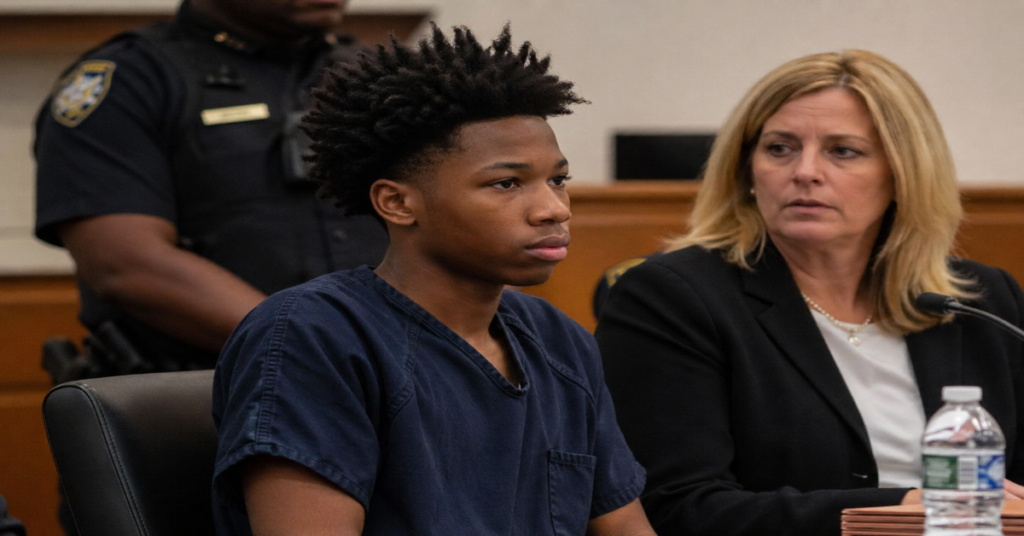
The Karmelo Anthony case has become one of the most closely watched juvenile murder prosecutions in Texas in recent memory. On April 2, 2025, Anthony — then 17 years old — allegedly stabbed 17-year-old Austin Metcalf in the chest during a confrontation at Kuykendall Stadium in Frisco, where both teenagers were attending a high school track meet. Metcalf was pronounced dead at the scene. Anthony was detained the same day.
What followed was a legal process that moved rapidly for a juvenile case: a first-degree murder charge, a grand jury indictment in June 2025, and a trial date set for June 1, 2026. The case is being prosecuted in adult court under Texas concurrent jurisdiction rules, meaning a judge — not a juvenile panel — determined that the gravity of the alleged offense warranted adult prosecution.
At the center of the case are two competing narratives. Prosecutors argue that Anthony made a deliberate, lethal choice at a public event. The defense counters that Anthony acted in self-defense after being physically touched by Metcalf, claiming he warned Metcalf before producing a knife. The jury trial expected in June 2026 will have to weigh those accounts against physical evidence, eyewitness testimony, and Texas self-defense statutes. This article examines the verified facts of the case, the legal framework governing it, the disputed evidence, and what the outcome could mean for how Texas handles juvenile defendants charged with violent crimes.
Case Timeline: From the Stabbing to the Courtroom
Understanding the sequence of verified events is essential before analyzing the legal arguments. The following table consolidates what public records, court filings, and credible reporting have confirmed.
| Date | Event | Significance |
| April 2, 2025 | Karmelo Anthony (17) stabs Austin Metcalf at Kuykendall Stadium during a Frisco ISD track meet | Metcalf pronounced dead at the scene; Anthony detained same day |
| April 3–5, 2025 | Anthony charged with first-degree murder; bail set at $1 million | Prosecution as adult initiated under Texas concurrent jurisdiction |
| April 2025 | Bail reduced to $250,000 with house arrest, ankle monitor, and travel restrictions | Signals Anthony is not considered a flight risk by court |
| June 2025 | Collin County grand jury returns indictment on first-degree murder | Formal charging process complete; case moves toward trial |
| June 1, 2026 | Trial scheduled to begin in 296th District Court, Collin County | Jury will decide murder or self-defense; verdict could shape Texas juvenile law |
The speed of the grand jury indictment — within roughly two months of the incident — is notable. In Texas, grand juries can move quickly when evidence is strong and charges are pre-filed. The Collin County District Attorney’s office did not announce delays, suggesting the evidentiary package presented to the grand jury was considered sufficient to support the charge without extended investigation.
Texas Law: How a 17-Year-Old Faces Adult First-Degree Murder Charges
Concurrent Jurisdiction and the Transfer Decision
Texas operates a concurrent jurisdiction model for juveniles aged 14 and older who are charged with specific violent offenses, including murder. Under Chapter 54 of the Texas Family Code, a juvenile court may retain jurisdiction or transfer the case to adult criminal district court. In cases involving first-degree felonies, the statute creates a rebuttable presumption in favor of adult certification if the child was 15 or older at the time of the offense.
Anthony was 17 when the incident occurred. His case was handled as a direct adult prosecution rather than requiring a full transfer hearing, because the concurrent jurisdiction rules for 17-year-olds in Texas treat them differently from younger adolescents. Under Texas law, a 17-year-old charged with a first-degree felony can be prosecuted as an adult without the same procedural transfer requirements that apply to 14- or 15-year-olds.
First-Degree Murder Under Texas Penal Code
Texas Penal Code Section 19.02 defines murder as intentionally or knowingly causing the death of an individual, or intending to cause serious bodily injury and committing an act clearly dangerous to human life. A conviction for first-degree murder in Texas carries a sentence of 5 to 99 years or life in prison, plus a potential fine of up to $10,000.
The prosecution’s theory — that Anthony intentionally stabbed Metcalf in the chest — falls squarely within the intentional killing definition. There is no lesser charge of manslaughter apparent in publicly available filings, which suggests the prosecution is not offering Anthony a path to a reduced conviction through a lesser-included offense at this stage.
Self-Defense Under Texas Penal Code Section 9.31
Texas law provides a robust self-defense framework. Under Section 9.31 of the Texas Penal Code, a person is justified in using force against another when they reasonably believe the force is immediately necessary to protect against the other person’s use or attempted use of unlawful force. The use of deadly force is justified under Section 9.32 when the actor reasonably believes it is immediately necessary to protect against another’s use or attempted use of deadly force.
The critical legal question is whether Anthony had a reasonable belief that Metcalf’s actions — particularly the reported physical contact — created an imminent threat of deadly force. Texas does not impose a duty to retreat in most circumstances, which strengthens self-defense arguments in public spaces. However, the use of a knife in response to what may have been a non-lethal touch will be the central factual battleground.
Prosecution vs. Defense: The Disputed Facts
Both sides have offered markedly different accounts of the moments leading to Metcalf’s death. The following table presents the key factual disputes the jury will be asked to resolve.
| Factor | Prosecution Position | Defense Position |
| Initiator of physical contact | Anthony escalated after a verbal dispute | Metcalf touched Anthony first, triggering the confrontation |
| Knife use | Drawing a knife was disproportionate to any perceived threat | Anthony warned Metcalf before producing the knife |
| Location context | Public track meet — retreat was possible | Anthony had limited space and no clear exit |
| Witness testimony | Multiple bystanders saw Anthony produce knife unprovoked | Some accounts support that Metcalf advanced on Anthony |
| Prior relationship | No known prior conflict — incident was impulsive | Strangers; no evidence of premeditation |
| Legal standard | First-degree murder: intentional killing | Self-defense: reasonable belief of imminent bodily harm |
The probable cause affidavit released after Anthony’s arrest describes him warning Metcalf verbally before producing the knife when Metcalf made physical contact. If accurate, this sequence does not automatically establish self-defense — the law requires that the responsive force be proportionate to the perceived threat. A single touch, without more, is unlikely to establish a reasonable belief that deadly force was immediately necessary. Defense attorneys will need to show the jury that Anthony perceived an escalating, imminent threat that a reasonable person would also have found life-threatening.
Eyewitness testimony is likely to be the most contested element. Track meets are public events with large crowds, meaning there are potentially dozens of bystanders who observed some portion of the incident. How those accounts are selected, presented, and weighed by the jury will significantly shape the verdict.
Background on Karmelo Anthony and Austin Metcalf
Limited verified background information has been made public about either teenager. Anthony was a high school student in the Frisco ISD area at the time of the incident. His family retained legal representation and issued public statements asserting his innocence. No prior criminal record has been publicly reported.
Austin Metcalf was also 17 at the time of his death and was participating in the track meet as a student athlete. His family has been publicly supportive of the prosecution. Local reports described Metcalf as an active member of his school’s athletic community.
The absence of any prior documented conflict between the two teenagers has been cited by defense attorneys as evidence against premeditation. The prosecution’s framing of the incident as an impulsive but intentional act does not require premeditation under Texas first-degree murder law, which does not distinguish between planned and spontaneous intentional killings.
Evidence Supporting the Self-Defense Claim — and Its Limits
Anthony’s legal team has identified several elements they believe support a self-defense finding. First, the verbal warning Anthony allegedly issued before drawing the knife may indicate awareness of the gravity of producing a weapon, and a deliberate attempt to de-escalate before acting. Second, if witness accounts confirm that Metcalf made physical contact with Anthony first, that contact could establish the initial unlawful force element required under Section 9.31.
Third, Anthony’s family has noted that he was a minor at the scene of a conflict that he did not initiate. While his age is legally less determinative in adult court, the defense may argue that a 17-year-old’s threat perception and fear response should be contextualized within developmental psychology frameworks, which courts have increasingly recognized in post-Miller v. Alabama (2012) jurisprudence.
However, self-defense claims face a significant proportionality problem. Texas courts have consistently held that the defender’s use of force must be proportionate to the threat perceived. A punch, a shove, or even a grab — none of which automatically constitute deadly force — is unlikely to legally justify a fatal knife wound to the chest. Unless the defense can present evidence that Metcalf was significantly larger, made explicit verbal threats of deadly force, or displayed a weapon of his own, the proportionality argument will be difficult to sustain.
Bail, House Arrest, and Pre-Trial Conditions
Anthony’s initial bail of $1 million was reduced to $250,000 with conditions that include house arrest, an ankle monitor, and restrictions on leaving his residence. This arrangement reflects a judicial assessment that Anthony is not a flight risk and does not pose an immediate danger to the community — factors courts weigh under Article 17 of the Texas Code of Criminal Procedure when setting or modifying bail.
The public response to the bail reduction was notable. Some observers characterized it as lenient given the severity of the charge; others pointed out that bail is constitutionally designed to ensure appearance at trial, not to serve as pre-conviction punishment. The conditions attached to the reduced bail — particularly the ankle monitor — represent standard pre-trial supervision tools used in serious felony cases across Texas.
Strategic and Practical Implications for the June 2026 Trial
The trial in the 296th District Court will be a jury trial, meaning 12 Collin County residents will determine the outcome. Collin County is a suburban, generally conservative jurisdiction — a demographic profile that historically correlates with skepticism toward self-defense claims involving weapons when the defendant initiated proximity to the victim. The defense will need to work carefully to establish that Metcalf’s physical contact — however minor it may appear from the outside — was experienced by Anthony as an immediate threat.
Expert witnesses are likely to play a significant role. The defense may call a forensic psychologist to speak to adolescent threat perception. The prosecution may call a medical examiner to describe the precise nature of the stab wound and what it reveals about intent and force. A wound to the chest — a vital area — may be argued by prosecutors to indicate aimed, intentional striking rather than a reactive, defensive motion.
A key risk for the defense is over-reliance on the verbal warning narrative. Telling someone you will use a knife and then using it may not help a self-defense claim — it could instead be read by the jury as evidence of premeditation. Defense counsel will need to frame the warning as an attempt to avoid the confrontation, not a preamble to it.
For the prosecution, the challenge is establishing intent beyond a reasonable doubt. There are no reports of a prior relationship between Anthony and Metcalf, no pre-existing motive, and no evidence the two had interacted before the track meet. A jury must be convinced that within the span of a brief argument over a tent at a public event, Anthony formed the intent to kill. That narrative, while legally sound under Texas law, requires the jury to accept a very rapid escalation from zero to lethal force.
Public Reaction, Media Coverage, and Cultural Dimensions
The Karmelo Anthony case attracted significant national media attention in the weeks following the stabbing. Coverage spanned local Texas outlets, national legal commentary platforms, and social media, where debate over the self-defense claim became politically charged. Some commentators framed the case in terms of broader conversations about youth violence; others focused specifically on the legal mechanics of the self-defense claim.
The case also prompted commentary on how Black teenagers are prosecuted in adult court relative to their white peers. Research by The Sentencing Project and the Annie E. Casey Foundation has documented persistent racial disparities in juvenile-to-adult transfer decisions across the United States. Anthony’s case has become a reference point in that debate, though it is important to note that the legal basis for adult prosecution in his case is the age-based concurrent jurisdiction rule, not a discretionary transfer decision.
Crowdfunding efforts were reportedly launched by supporters of both families following the incident — a reflection of how high-profile cases increasingly mobilize public support structures outside the courtroom. The Anthony family’s public statements have maintained a consistent self-defense framing, which is legally strategic: maintaining that narrative in public reinforces the credibility of the claim before a jury pool is even selected.
The Future of Juvenile Murder Prosecutions in Texas in 2027
The outcome of the Karmelo Anthony case will land at a moment when Texas — and the broader United States — is actively reconsidering how the juvenile justice system handles teenagers charged with violent crimes.
At the federal level, the Supreme Court’s 2012 ruling in Miller v. Alabama prohibited mandatory life without parole for juveniles, and subsequent decisions have gradually expanded protections for young defendants in adult court. Texas has implemented these rulings, but has not gone further to restrict adult prosecution of 17-year-olds in first-degree felony cases.
In the Texas Legislature, there have been recurring proposals to raise the age of juvenile jurisdiction to 18 in all criminal cases. As of mid-2025, no such legislation had passed. However, the visibility of cases like Anthony’s — in which a teenager with no prior record faces 5-to-life for an incident that lasted seconds — may accelerate legislative conversation in the 2027 session.
The self-defense dimension of the case is also consequential for future prosecutions. If Anthony is acquitted on self-defense grounds, it would strengthen precedent for the proposition that Texas self-defense law applies robustly to public confrontations between minors, even when a knife is involved. If convicted, prosecutors will have established that verbal warnings before deploying a weapon do not constitute a mitigating factor sufficient to negate intent.
Texas courts are unlikely to see a dramatic shift in the treatment of juvenile murder cases before 2027 absent legislative action. What may change is the quality of expert testimony on adolescent brain development — a field that has advanced significantly since Miller v. Alabama — and the degree to which defense attorneys leverage neuroscience to contextualize the split-second decisions of teenage defendants.
Takeaways
- Anthony’s prosecution as an adult is legally sound under Texas concurrent jurisdiction rules for 17-year-olds charged with first-degree felonies — the decision did not require the same transfer hearing process applicable to younger juveniles.
- The self-defense claim is not implausible, but faces a serious proportionality problem: Texas law requires that the force used be proportionate to the threat perceived, and a fatal knife wound in response to a touch is a difficult legal argument.
- Eyewitness testimony from the crowded track meet will be determinative — the number, credibility, and consistency of those accounts will likely decide the verdict more than physical evidence alone.
- The bail reduction to $250,000 with conditions reflects standard Texas pre-trial practice for serious felonies and does not indicate prosecutorial weakness or judicial leniency regarding the underlying charge.
- Anthony’s age — and the growing body of legal precedent on adolescent brain development — may be more relevant in sentencing than in the guilt/innocence determination, given that the trial is in adult court.
- The case has become a reference point in broader debates about racial disparities in juvenile transfer decisions and the adequacy of self-defense law in public-space confrontations — debates that are likely to continue regardless of the verdict.
Conclusion
The Karmelo Anthony case is not a simple story. It involves two teenagers, a dispute that lasted minutes, and a legal system that will now take at least two years to work through the consequences. The facts as publicly known support a legitimate prosecution: a person is dead, Anthony was present, and a knife was used. The facts also support a genuine legal defense: the confrontation may have escalated in ways that Anthony reasonably perceived as threatening.
What the case ultimately turns on is credibility — of witnesses, of Karmelo Anthony Case account, and of the legal principle that self-defense requires proportionate, not just reactive, force. A Collin County jury in June 2026 will hear all of it and render a verdict. That verdict will matter not just for Anthony and the Metcalf family, but for how Texas and other states continue to calibrate the boundary between holding young people accountable and recognizing that adolescents operate under legal, developmental, and situational constraints that adult defendants often do not.
Whatever the outcome, the Karmelo Anthony case will be cited in Texas courtrooms and legislative chambers for years to come.
Frequently Asked Questions
What is Karmelo Anthony charged with, and what sentence could he face?
Karmelo Anthony Case has been indicted on first-degree murder under the Texas Penal Code following the death of Austin Metcalf on April 2, 2025. A conviction carries a prison sentence of 5 to 99 years or life, plus a fine of up to $10,000. The prosecution is not publicly pursuing a lesser charge.
Why is Anthony being tried as an adult if he was 17 at the time?
Texas law allows — and in some cases presumes — adult prosecution for 17-year-olds charged with first-degree felonies. Under the state’s concurrent jurisdiction rules, Anthony’s case was handled in adult criminal district court without requiring the standard juvenile transfer hearing applicable to younger defendants.
What evidence supports Anthony’s self-defense claim?
The probable cause affidavit indicates Anthony verbally warned Metcalf before drawing the knife, and that Metcalf made physical contact with Anthony before the stabbing. Karmelo Anthony Case Defense attorneys argue this sequence establishes initial unlawful force by Metcalf. However, proportionality — whether a knife was a justified response to that contact — remains the central legal Karmelo Anthony Case dispute.
What happens if Anthony is acquitted on self-defense grounds?
An acquittal would mean Anthony faces no criminal penalty for Metcalf’s death. It would also establish persuasive precedent in Texas courts for self-defense claims in public confrontations involving minors. The Metcalf family would have no further recourse in criminal court, though civil litigation is theoretically possible.
When is the Karmelo Anthony trial scheduled to begin?
The trial is scheduled to begin on June 1, 2026, in Collin County’s 296th District Court. Trial dates in serious felony cases can be continued, but as of publicly available information, no postponement has been reported.
What are Texas concurrent jurisdiction laws for juveniles charged with murder?
Under Chapter 54 of the Texas Family Code and related provisions of the Texas Penal Code, prosecutors can pursue adult charges against juveniles aged 14 and older for first-degree felonies, including murder. For 17-year-olds, the path to adult prosecution is more direct than for younger teens, requiring less judicial intervention to initiate adult criminal proceedings.
Has the Karmelo Anthony case affected how Texas handles juvenile murder cases?
The case has renewed public discussion about juvenile-to-adult transfer rules and racial disparities in prosecution decisions. As of mid-2025, no legislative changes had been enacted, but the case is expected to remain a reference point in Texas criminal justice policy debates, particularly if the trial produces a high-profile verdict in either direction.
Methodology
This article was researched using publicly available court documents, including the probable cause affidavit related to Anthony’s arrest, official statements from the Collin County District Attorney’s office, and credible news reporting from established Texas and national outlets covering the case through mid-2025. Legal framework analysis draws on the Texas Penal Code (Sections 9.31, 9.32, and 19.02), the Texas Family Code (Chapter 54), and publicly available case summaries from Texas appellate courts.
Information on racial disparities in juvenile transfer decisions was sourced from published research by The Sentencing Project and the Annie E. Casey Foundation. Constitutional precedent references (Miller v. Alabama, 2012) are drawn from the published Supreme Court opinion.
Known limitations: Eyewitness accounts have not been fully disclosed in publicly available filings. The defense’s complete evidentiary strategy is not yet public. Forward-looking analysis in the 2027 section is grounded in verifiable legislative and judicial trends but reflects uncertainty inherent in any prediction about trial outcomes or legislative action.
Counterargument: It is possible that evidence not yet made public significantly strengthens one side’s position. This article does not presuppose guilt or innocence; it analyzes the publicly known legal and factual record as of the date of publication.
References
Texas Penal Code § 19.02 – Murder. (2023). Texas Legislature Online. https://statutes.capitol.texas.gov/Docs/PE/htm/PE.19.htm
Texas Penal Code § 9.31 – Self-Defense; § 9.32 – Deadly Force in Defense of Person. (2023). Texas Legislature Online. https://statutes.capitol.texas.gov/Docs/PE/htm/PE.9.htm
Texas Family Code § 54.02 – Waiver of Jurisdiction and Discretionary Transfer to Criminal Court. (2023). Texas Legislature Online. https://statutes.capitol.texas.gov/Docs/FA/htm/FA.54.htm
Miller v. Alabama, 567 U.S. 460 (2012). Supreme Court of the United States. https://www.supremecourt.gov/opinions/11pdf/10-9646.pdf
The Sentencing Project. (2023). Racial disparities in youth incarceration persist. https://www.sentencingproject.org/fact-sheet/racial-disparities-in-youth-incarceration-persist/
Annie E. Casey Foundation. (2024). Youth incarceration in the United States. https://www.aecf.org/resources/youth-incarceration-in-the-united-states
Collin County District Attorney’s Office. (2025). Public statements regarding the Anthony indictment [Press releases]. https://www.collincountytx.gov/district_attorney